Showing posts with label W.T. Grant. Show all posts

Wednesday, November 29, 2017

Southgate Mall: Elizabeth City, NC

A few years ago, I had a chance to tour for the first time one of the oldest malls in North Carolina, a simple dumbbell shaped mall that has now reached its end.  Plans to demolish the mall this year have already been announced and the JCPenney store has already been demolished, so I advanced this post to showcase this mall in its antique glory before it is lost to the dustbin of history.  As the last and only enclosed mall found in Northeastern North Carolina, it should have been so much more, but weak economic factors in the region made it unable to expand or survive.  As the location of one of the first ever modern Belk prototype stores, it deserves a mention despite being rather unimpressive by modern mall standards.


Constructed from 1967-1969, Southgate Mall opened with four anchors: Belk Tyler, Grant's, Winn-Dixie and People's Drugs.  It is unclear who originally built the mall, but it was owned throughout much of the 1970's and 1980's by Federal Realty.  Its design was essentially a small town mall combining typical strip mall tenants with a regional department store in an enclosed mall.  Its design features an front and rear entrance corridor, main corridor and spacious center court with high ceilings and high windows functioning as skylights: a design very common in malls constructed in the 1965-1973 period.  Next to the mall on the west side, a Gateway Cinema was opened in 1973 and right behind it to the right a Mammoth Mart discount chain.  This anchor lineup obviously could not last considering that Winn-Dixie has been gone from North Carolina for 12 years and none of the other stores still exist.  Grant's was obviously the first to go, closing their store at the mall in 1976.  Regional discount chain Roses arrived to quickly fill the void left by Grant's.  It was odd that Kmart did not actually take over that store, but Kmart itself would not appear in Elizabeth City until 1982!


Entering center court with view of the back entrance wing and center court skylights.


A view from the Belk wing to center court complete with the jewelry kiosk in the center


A couple more views of center court and the now-removed fountain.  I can only imagine that a far more substantial fountain was in center court prior to the 1990's.  From the flooring patterns in the photo, it appears that the fountains and planters stretched the entire length of the center court and likely included a sunken area.


Christmas display from January 1, 2014.  You got the feeling even then that the mall was not long for this world despite the festive feature.


A view to center court from the healthier Belk wing.  Photo from January 1, 2014.


A view to center court from the JCPenney wing.  Photo from Jaunary 1, 2014.

1982 saw the next anchor shift as Winn-Dixie left the mall to join that same Kmart at the then-new Holly Square shopping center.  This left a void in the mall at a time when, unlike today, department stores were actually expanding and looking for new malls to anchor.  Thus, around 1985 JCPenney relocated from their downtown store to take over the former Winn-Dixie space.  It was a compact apparel-only store for JCPenney, and it ultimately would prove too small for them.  The opportunity opened up when in 1993, Roses closed their store and left town.  At the time, Roses was still an actual discount chain and was feeling the sting from Wal-Mart's expansion.  JCPenney seized on the opportunity and relocated their store into the outer 2/3 of the former Rose's in 1996.  This project was coupled with a small expansion of the mall into part of the old Grant's space.


Belk's mall entrance is obviously one of the most uneventful they did in the 60's, but it is also one of the very oldest mall-based Belk stores, so it still was bound to look a lot better with "Belk Tyler" sprawled across the front.  Throughout the 1970's and 1980's, Belk built some of the classiest mall entrances in the industry.


A look at the front entrance corridor in both directions.  Plenty of unused space in this hallway suggesting they just covered up the empty stores.


Back entrance to the mall connecting to center court

It appears that the mall's last renovation coincided with JCPenney relocating their store into the old Grant's/Rose's meaning it also occurred in 1996.  Since the mall space was expanded into part of the former store to reach the new JCPenney, this makes sense.  That renovation appears to have also taken out what appears to have been a far more spectacular center court replacing what was likely a larger fountain and planters with a smaller, more subdued fountain and more floor space.  Hibbetts Sports took over part of the old Grants space next to JCPenney as part of this expansion.  The changes were not dramatic enough to completely rob the mall of its vintage appearance, however, and much of the mall still maintains much of that early 1970's look and feel: a situation that has not been beneficial in more recent years.  After JCPenney moved, Goody's would come into replace the former Winn-Dixie/JCPenney space in 1998, but they would only stay a few years.  The 90's closed out with Belk Tyler converting to just Belk and People's Drugs becoming Revco in 1993, then CVS in 1998.  While turnover was high, the mall was small enough to sustain this, thus it was pretty much running steady through all of this.


Original 1969 Belk including a rare design pre-dating the standard 1970's brick arches.  Belk is still committed to the mall and its redevelopment.


Belk Tyler included a garden center, a very rare concept that was only on a few Belk stores.  The former garden center is unused, but is not in disrepair.

Overall, the coming and goings in the junior anchors at Southgate Mall were like musical chairs.  The original Winn-Dixie space housed five tenants.  The former People's Drug housed two other drug store chains before becoming at least three other restaurants, the most current being Dragon Buffet.  The Grant's changed two more times, and the mall was expanded into part of it.  Roses, which departed the mall in 1993, came back with their "Roses Express" format taking over the former Winn-Dixie/JCPenney space.   Roses then quickly outgrew this space and relocated into the former Mammoth Mart that had just been vacated by a replacement store for the Holly Square Winn-Dixie.  The Mammoth Mart building had many uses itself operating as King's Department Store from 1980-1983 and Farm Fresh from 1983-1997 before becoming Winn-Dixie Marketplace and later Roses.  Yes indeed, the current Roses that is just west of the mall located in what had been a 1990's replacement store for the Winn-Dixie that replaced the original mall Winn-Dixie!  To make things more confusing, former anchors moved around the city fairly close to the mall.  Both Winn-Dixie and Kmart relocated from Holly Square by that time with Kmart the first to relocate in 1993 and Winn-Dixie in 1997.  Holly Square sat mostly vacant for a time before finally being demolished in 2004 for Lowes after its last tenant Big Lots relocated from the older dead Kmart to part of the newer dead Kmart!  CVS also left the mall around 2003, relocating to a free-standing location one mile to the east.


A look down the JCPenney wing in 2016.  Burkes Outlet (formerly Winn-Dixie, JCPenney, and Roses Express) is on the right.  The 1996 addition into what was Grant's/Rose's is visible just beyond the entrance hallway on the left.


A look back to January 2014 when JCPenney was still open.  You can clearly see here how the hallway was extended for the store.


JCPenney left their sign up after the store closed, but it has since been demolished (as of November 2017)

After 2010, the mall's struggles ramped up with the retail industry.  Despite a steady growth rate in the region due to the proximity to tourism in the Outer Banks, the antiquated mall coupled with industry changes and high poverty rates in the region led to vacancies becoming more difficult to fill.  This escalated when JCPenney finally gave up on the mall.  JCPenney closed their store at the mall in 2016 ending a 30 year run at the mall in two separate locations.  However, Belk proved to be far more established at the mall and renovated their store within the same year.  This ultimately meant that Southgate Mall was a dying mall anchoring a successful Belk and Burkes Outlet.  It was becoming painfully obvious that the location of the mall was not the problem, it was the mall itself.

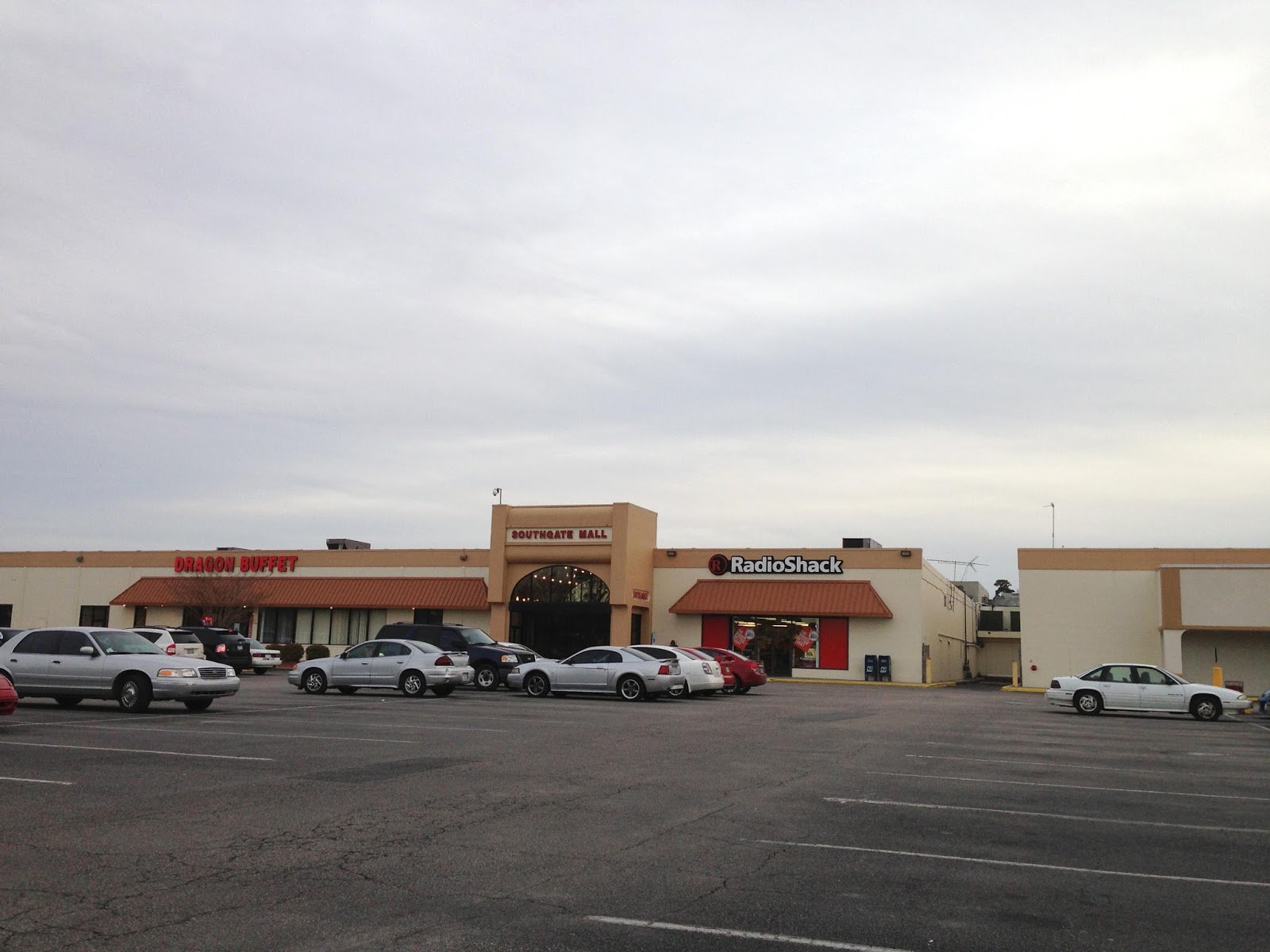


Main mall entrance to Southgate Mall.  Close-up shot from July 1, 2016 and setback shot from January 1, 2014.


Detail of inside of interest with the brass panels.  It's a fascinating touch.


JCPenney front entrance with obvious details left over from Grant's.


When JCPenney took over the old Grant's/Rose's, they had to cut a new entrance into the back.  Otherwise, it looks like a typical unremarkable 1970's discount store from the rear.


Grant's Auto Center was obviously sold off long before JCPenney took over the store, but they were probably forced out for the store's demolition.

According to Dailyadvance.com, it was announced in February 2017 that the mall was sold in an auction for $2.3 million.  It had been sold the previous July for $8 million, and prior to that it was owned by ABC Properties of New York City since 2005 until they defaulted on the mortgage.  The new owners were not coy about their plans for the mall.  By July, it was announced that the interior mall of Southgate Mall would be closed and torn down after nearly 50 years of business.  This announcement came as somewhat of a surprise considering that the mall still has active tenants inside, Belk is committed to the mall, and Burkes Outlet is still operating in the former Winn-Dixie space.  In other words, the new owners simply do not think they can rework the interior mall in any way to make it successful again, thus the center will be transformed into a traditional strip shopping center with Belk as an anchor tenant.


A couple front view of the mall with the top photo looking from JCPenney to Belk and the bottom photo looking at Burkes Outlet (former Winn-Dixie, original JCPenney), and later JCPenney in what was Grant's/Rose's.  Rose's is now located in what was the third Winn-Dixie just west of the mall.


Southgate Mall sign from W Ehringhaus St (U.S. 17 Business)


The mall theaters to the right of the mall.  They did not open at the mall and were instead added in 1973.


Historical map of the mall showing anchor history of the mall and its outlots 1969-present.  The 2018 date refers to the pending demolition of the remaining interior mall.

Too many things in the past 15 years have begun to work against the mall.  The primary issues were newer competition, an antiquated mall design, and traffic pattern changes.  First, the construction of The Shoppes at Tanglewood (a strip adjacent to a Wal-Mart Supercenter) helped pull traffic, inline tenants and customers away from the mall.  Second, as a mall much closer to downtown, the mall also suffered from a change in traffic patterns as US 17 was relocated to a new by-pass west of the city. While not particularly unique for its time, Southgate Mall is one of the very last representations of early enclosed malls, and its demolition will be another stinging loss as it joins many other malls across the country closing for good.  At least these photos will help us to remember this quaint little mall.

OTHER RESOURCES:

Mallmanac: Southgate Mall (Another post with information about the mall)
Ajsanjua's Flickr Page (A wealth of information and photos about both the mall and Elizabeth City retail.  Information from these galleries was used to write a proper history for this mall with permission.)

Tuesday, June 23, 2015

Quenby Mall: Albemarle, NC

It can reasonably be said that prior to the 1970's malls were still in their experimental phases.  Up until then, most malls were still locally built and came in all shapes and sizes both enclosed and open-air.  They were tested in all types of markets with all types of formats and layouts often with everything from cutting edge designs to buildings with all the ambiance of a middle school.  Some were smaller than a modern Wal-Mart, but few exceeded 500,000 square feet.  The smallest ones from that era rarely are still standing today: most demolished or converted to other uses as they became outmoded within 15 years of their original construction.  Usually located in smaller towns that were too small to support anything larger, and heavily driven by a local developer bent on creating a new spin on one of the typical strip malls of the era, these malls were just that: a typical 1960's strip mall of the era turned inward.  Nevertheless, these early malls packed quite a few stores into a small space even if selections were limited.  Quenby Mall in Albemarle, NC was one of those.

In this small North Carolina city far enough away from major cities, Albemarle is strange in that it once had two operational malls.  While no enclosed mall operates today as a retail center within the entire county, Quenby Mall still lives on repurposed as government offices.  Quenby Mall was the first of those two malls opening in 1966.  While not functional as a shopping mall in over 20 years, the mall today still remains largely unmodified from the day it first opened preserving many of its authentic 1960's elements due to the lack of funding or interest in removing those features from the former mall.  In all, it serves as a hidden time capsule likely saved from demolition due to its size being small enough to be a perfect fit for the needs of county government.


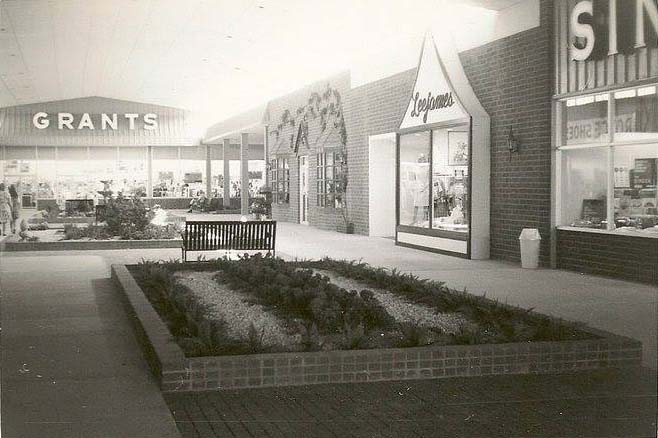
These historical photos of Quenby Mall above were provided to me by the Stanly County Museum.  The first, originally photographed by Rodney Mauldin, shows the interior as it looked in May 1967.  The second photo shows the exterior with the sign, number of stores inside the mall and Belk's prior to the conversion to the big "B" Belk that was used from 1967-2010.


A directory of "Stanly County Commons" showing the many services that operate out of this former mall.  The right side of the mall according to that image has had its hallways reconfigured.  Photo by Mike Kalasnik.

When Quenby Mall opened, it featured a total of four anchor stores: two mainline and two junior anchors.  The largest of those anchors was Grant's, which forms the north endcap of the mall and occupied as much as 1/3 of the mall's total square footage.  Second to this was Belk, which was one of the very few Belk stores anchoring a mall signed originally as "Belk's" before the "Big B" era.  Belk formed a large chunk of the mall's inline space on the southwest west side.  In fact, Quenby Mall is possibly the oldest enclosed mall in North Carolina to have operated a Belk predating stores at Southgate Mall in Elizabeth City and Pennrose Mall in Reidsville.  The third anchor was a Harris Teeter supermarket, which was built on the southeast corner and likely lacked mall access.  The last of those was an Eckerd Drugs, which was behind the mall shops on the east side of the mall between the former Harris Teeter and hallway next to Grant's accessible next to the adjacent mall entrance.  Aside from those four anchors, the mall space itself had a whopping 10 inline tenants.  Indeed, it was by no means a large mall.


Northwest entrance wing next to the former Grant's/JCPenney.  The former anchor's mall entrance was to the center of the hallway on the left.  Photo by Mike Kalasnik.


Northeast entrance wing just beyond the Grant's/JCPenney mall entrance.  Doors and walls have clearly been reconfigured on the left.  Near the end of the hallway on the right was where Eckerd Drugs connected to the mall.  Photo by Mike Kalasnik.


A couple views opposite Grant's/JCPenney looking toward the now removed south entrance wing.  Belk was previously on the right at the end of the hall past the drywall.  A hallway to the left where the drywall is now used to take shoppers to the southeast entrance and Harris Teeter, which likely did not have direct mall access.  Photos by Mike Kalasnik.


Drywall today covers the south entrance wing, which is now divided up into offices.  Belk used to be further down on the right.  Photo by Mike Kalasnik.

Quenby Mall was joined by several other malls in the region of similar design that were very small with few inline spaces all located in towns too small to support a larger venue.  The malls most similar to Quenby Mall included the two long-demolished malls in Salisbury: Rowan Mall and Towne Mall.  In South Carolina, also-demolished Gaffney Mall and Chester Mall were likewise extremely similar in design suggesting that at least four of the five malls were built by the same developer.  De-malled Henderson Mall north of Raleigh was another possible build by the same developers.  All were simple malls that met an early fate and all had a similar layout of one prominent discount store, one department store (usually Belk), one drug store and one grocery store and only a handful of inline stores.  The size of all of the anchor stores was suitable for the 1960's, but they would have all required significant expansion in the 1970's to remain on-site.  Most likely the land around the malls was not adequate to support the massive expansions required, so the anchor stores all eventually left for other nearby locations.


Here is looking back to Grant's with the former Belk on the left.  The white overhang jutting into the mall on the right was where the Singer store was originally.  The wall of the former Belk extends to the overhang in the background.  Photo by Mike Kalasnik.


Three shops were located on the left with the hallway ending in front of the old Grant's/JCPenney.  Entrance wings extend to the left and right in front of it.  Photo by Mike Kalasnik.


In these images, the JCPenney labelscar is still barely visible.  Clearly JCPenney made significant modifications to the former Grant's including the brick wall added on the right and removal of the metal awning seen in the 1967 photo.  Also note the dropped ceiling and off-center text for "JCPenney".  This shows that the ceiling had not been dropped prior to conversion to Stanly County Commons.  Photos by Mike Kalasnik.


Nothing resembling an old school mall directory here.  Maybe they could direct you to its replacement mall, but it's dead, too.  Photo by Mike Kalasnik.

Quenby Mall began to die quite early due to the fact it was very small, built too close to downtown and was on the wrong side of town when development began to spring up on the NC 24 by-pass.  However, it did enjoy 15 years of dominance in the market.  During those 15 years, Grant's was replaced with JCPenney thus the mall gained a certain level of legitimacy as a regional mall.  However, Belk, JCPenney and Harris Teeter soon realized that they were outgrowing their stores within the mall.  Needing more space, both Belk and JCPenney bolted for slightly larger and much better located Albemarle Mall in 1981.  Albemarle Mall itself was a very tiny mall, but it provided more space for both stores with greater visibility and was attached to a larger strip center.  When both stores departed Quenby Mall, no anchors came into fill the void.  Harris Teeter remained in the mall a few years longer, however, replacing their store with their current store less than a mile away in 1989.  Eckerd looks to have joined Harris Teeter in that move later moving again across the street from Harris Teeter only to be re-branded Rite Aid in 2007.


Former Belk exterior entrance.  The entire southwest corner of the mall was taken up by Belk.  Photo by Mike Kalasnik.


In the 1960's, Belk added auto centers to their malls.  This one was located on an outlot on the northwest corner of the mall.  It was likely closed the same time that Belk relocated to its present location at the now demalled Albemarle Mall in 1981.  Photos by Mike Kalasnik.


Exterior shots of the front of the former Grant's/JCPenney.  Unfortunately the mansard awning was removed after the mall became Stanly County Commons.  A window sits in the place of the former exterior entrance.  In the first photo, the mall entrance sits to the right of the former Grant's.  Photos by Mike Kalasnik.

By 1989 Quenby Mall had been left effectively vacant except for a couple small shops inside.  Most likely the mall would have been abandoned and eventually torn down, but ultimately the relatively unremarkable structure was saved.  Soon after the mall closed, the county purchased the mall converting much of the space into various county services including board of education, social services department and health department.  While the county left much of the mall intact, quite a bit was changed.  Corridors were relocated, awnings removed, anchor entrances were bricked up and the ceiling inside the main mall corridor was dropped.  While the main corridor is intact as well as the entrance corridor on the Grant's side, the original hallways in front of what was Harris Teeter and extending to the back of the mall between Harris Teeter and Belk was removed and rerouted through the center of what had been the store sealing off the original exterior entrance on that side.  A drive-thru window exists today on what was clearly a bricked up entrance.  Otherwise, the mall remains unchanged.


Here is the northeast (back) entrance of the mall.  The county board of education on the right was previously Eckerd Drugs.  Grant's/JCPenney was on the left.  Photo by Mike Kalasnik.


This simple sign replaced the 60's faux-Colonial Quenby Mall sign sometime in the 1990's.  Photo by Mike Kalasnik.


This building on the outlot was either a walk-up ATM or Fotomat.  Photo by Mike Kalasnik.


Since the mall had 14 stores, it is not clear where every store was in the inline shops based on available information.  However, anchor information is all confirmed and accurate with exception to the exact dates that JCPenney was in the mall.

No longer functioning for retail uses, what is today "Stanly County Commons" is only open during business hours throughout the week.  Obviously shopping is not going on here, but if you work for Stanly County there is a good chance you work in this building.  Once the principal shopping destination for Albemarle, today there is no reason to go there unless you are a resident of the county in need of county services.  At least in its repurposed form, however, a relic of the early mall era managed to survive.