
The span of time has changed many stores, and it was interesting to note how many original stores were highlighted in the newspaper that day. There were so many storefronts photographed that I only picked a select few, though I tried to capture every department store image the best I could. Bon Appetit, a crepe restaurant obviously similar to Magic Pan, has since closed and Ruby Tuesday is today Applebee's. All of the trendy clothing stores of the time both regional and national such as Foxmoor and Chess King have been replaced with the standard American Eagle (in the old Bon Appetit) and Gap today. Parisian has since been downscaled as part of a dual Belk, Pizitz is long gone and Morrison's is now Piccadilly. Harco Drugs, located next to JCPenney, is today Rite-Aid and no longer in the mall. McCrory's disappeared with all the other five and dime stores.

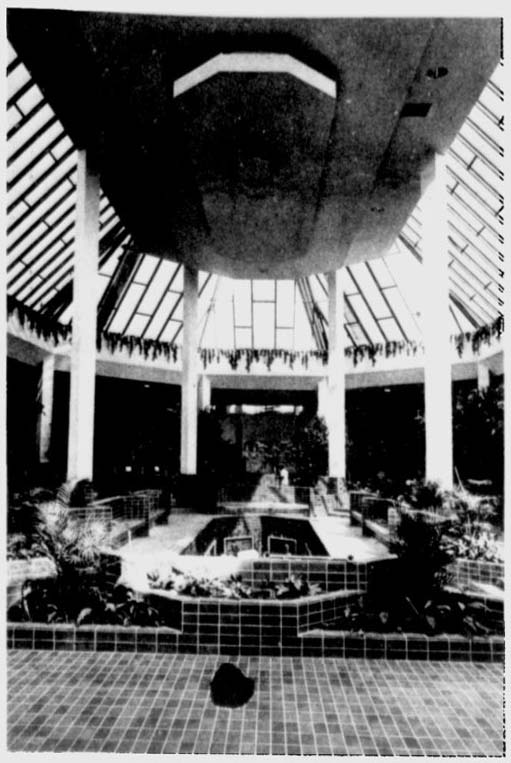
A view into the mall from one of the courts in front of the anchors. The brick cased planters have since been replaced with more classic fountains and potted planters. The first photo is of center court showing the most complete view.

A view of the Sears court. It looks like it was originally a sunken area. I am trying to figure out what exactly the sputnik-shaped thing is in the front. Is it situated in a fountain?

Lush landscaping...still in the mall to a lesser degree, but lost from most malls today.

Another view along the mall corridor.

Darker part of the mall with a Lerner store on the left. I remember an older, classier logo, but this must have been standard for 1980. Lerner Shops disappeared completely by the 1990's.

JCPenney court. Harco Drugs was to the right, but today is a clothing shop. JCPenney still has the diagonal wood look on the entrance, though it has been painted white. This was typical treatment in the early 80's, apparently.
What did not change in the mall was surprisingly much. Lorch's Diamond Center, a North Alabama chain, continues to operate at the mall. Taco Casa, a popular local chain, continues to do business in the exact spot it opened in. Other national chains that opened in the mall such as Spencer's Gifts are still there. In a time when so much old is lost to both progress and decline, it is comforting to see that some things do not change as much. While those fortunes could always change, the fact is that the mall is representative of the city, which is showing quiet resiliency. Its combination of education and manufacturing are beginning to establish it as a respectable city in its own right, though it lacks the name recognition of Alabama's largest and more colorful cities.

This was pieced together to give a complete map and list of the layout and original tenants at the mall. Note the original mall logo.

Aaron Aronov, whose company still operates the mall today, is pictured on the right. Note one entrance with this style had not changed in my newer photos.

A not-so-clear picture of the original Pizitz store, which later became McRae's and today Belk Men's.

Pizitz of Birmingham...which it was only known as such in Tuscaloosa...created a short-lived, but confusing mess of two completely different stores both named Pizitz. The Pizitz Tuscaloosa chain faded away by the following year, so the "of Birmimgham" would soon be dropped.

The only thing different on Sears today is the logo. The store still looks just like this otherwise.

Parisian did not have their store complete for awhile after the mall opened, so they created an inline boutique known as "Parisian Preview" offering a more limited selection while they waited for the store to be completed. The store, when completed, operated as Parisian until 2007 when it became Belk Women's.

The 70's and early 80's were the beginning of boring and subdued logos. The bright, often tacky and glitzy signs so common up to then were replaced with these super boring signs almost always printed in Helvetica or similar. Note they also featured some artwork created out of the initials as well. The modern logo is such a vast improvement over this!
Realizing what a surprisingly notable history that Tuscaloosa has had retailwise, I regret that I did not cover even more than I did. Taco Casa definitely deserved its own page, and one of the few remaining Bruno's was operating right next to University Mall. This post also marks the end of the Tuscaloosa series, but this also marks the first time this region has received any spotlight in retail history. What brought me to Tuscaloosa, though, was the realization that one of Alabama's oldest malls would soon fade into history. However, I was surprised to find that the mall that took the helm was interesting enough itself.

"A grand new place to dine". Uh huh. They moved twice in less than five years, but this would be their last since Morrison's was bought out in 1995. Morrison's actually featured a country-styled pointy serifed logo on their stores, so the logo they are using there is quite unfamiliar. It's amazing how cafeterias fell so hard out of favor, but that is a whole other discussion.

This place LOOKS fun. As a kid, I would have been instantly drawn to a place that looked like this!

What is Jeans West?

Adrian's looked to be a regional chain like oft-covered Budd's in these posts. Budd's did open at the mall, but did not provide an image like this quintessential 70's storefront drawing.

Harco's logo was nothing short of cute...honestly. They were apparently absorbed into Rite-Aid in the 1990's, and Rite-Aid has long since left this mall.
