Showing posts with label Pennsylvania. Show all posts

Thursday, January 18, 2018

Town & Country Discount Store

Something that has been very curious to me is the discovery of a defunct discount chain that apparently everyone forgot about: Town & Country.  In 1961, they were purchased by Lane Bryant, which quickly expanded the chain.  Prior to the purchase they were a Harrisburg-based operation with six small discount stores and a catalog service.  As they grew, they were mostly located in Pennsylvania, but they expanded to three locations were in Virginia, two in Maryland, and one in West Virginia.  Quite a few of the former locations still exist today, most repurposed in some form or another since they were generally smaller stores of around 30,000 square feet that were relatively easy to redevelop.  In all, it looks like the chain had at least 21 locations at its peak, and it catered to small and medium sized markets.


1969 photo of the Town & Country store located in Winchester, VA (Photo by Tim Legg)

It is not entirely clear how Town & Country was marketed, but judging by the ads they were a store that focused a bit more on hard lines than soft lines (although its parent company was a clothing store), and it sold a little of everything sort of like Kmart did at the time.  Its catchphrase was that it offered a "Golden Guarantee".  While the stores carried a wide variety of merchandise, they did not appear to offer any services such as a pharmacy, auto center, garden center, restaurant, optical, etc.  This explains how they could offer a wide variety of merchandise in only a 30,000 square feet store.  Perhaps this lack of services was a factor that led to their demise since it was not an all-in-one shopping experience.  It made it difficult to make them stand out against competitors like Woolworth/Woolco, Murphy's Mart, and Newberry's.  It seemed that Kmart's expansion into its territory was what led to its seemingly planned demise.  No mention was ever made that the store chain was actually unprofitable as a reason for its closure.  Most likely it was a corporate decision to focus on their core business: Lane Bryant.


Town & Country grand opening flyer at North Hanover Plaza in Hanover, PA in 1965.  It was the 12th in the chain.  Image from "The Evening Sun" from September 15, 1965.


Clearly the logo didn't match the exterior in the first iteration of the store.  It would be replaced with an awesome looking logo by the 1970's.  Image from The Evening Sun from September 15, 1965.


October 12, 1966 ad from The Evening Sun.


1970 saw the enclosure of North Hanover Plaza into North Hanover Mall.  The portion with Town & Country was fronted by an enclosed strip that ended at the former store.  Kmart looks to have greatly expanded the store in later years.  Image from April 1, 1970.


The 1971 reopening introduced us to that AMAZING "turbo" logo that was in use in the first part of the decade.  Note the update to the entrance to accommodate the enclosure of the strip in front of the store.  Image from The Evening Sun from June 29, 1971.


The interior of the updated Town & Country at North Hanover Mall.  It looks small and cluttered by today's standards, but this was apparently spacious for the time.  Image from The Evening Sun from June 29, 1971.

The store chain used three different logos, and the second generation logo was memorable...a mid-century turbo-style font.  Many of their stores featured a distinctive "hooded" canopy feature over the front entrance with sloping sides and a glass front that was quite similar to classic Mobil stations built during the same period.  Not much else is known about them except that they went out of business in 1977, and Kmart took over many locations as an attempt to expand into the Mid-Atlantic region.  Kmart locations that opened in these stores operated into the 1990's.  That means that most likely Kmart was willing to finish the leases on these stores considering that they likely operated on a 30 year lease with most locations open only around 10-15 years as Town & Country.


One more flyer from the grand reopening.  Image from The Evening Sun from June 29, 1971.


Constant logo changes could not have helped the bottom line of Town & Country.  This is the third and final version as shown in this ad from The Evening Standard from June 29, 1974.


Norman Rockwell dads are waiting to be showered with gifts on Fathers Day.  They also want you to make sure you shop the specials at Town & Country!  Image from The Evening Standard from June 29, 1974.


Maybe the Blues Brothers should have crashed into Town & Country instead of Dixie Square Mall, because "This place has everything!".  Image from The Evening Standard from June 29, 1974.


The New York influence comes out in this ad.  It was pretty clear that "Every day's a sale day at May's" was playing through their head when they came up with that slogan.  It's also a bit ironic to see bone thin cartoon women with no butts in a clothing ad from a store whose parent company is Lane Bryant.  Image from The Evening Standard from June 29, 1974.

Kmart has since closed or replaced every store that originally opened as Town & Country, all much smaller than the typical Kmart.  Along with J.M. Fields and others, it was one of the early casualties of the highly competitive discount store market that today is down to primarily just Wal-Mart and Target with no regional discount stores left in the Mid-Atlantic states.  Stores like Ames, Hill's, Murphy's, Jamesway, Clover, and others were all later casualties, but they lasted much longer than Town & Country and had a more significant footprint.


Part of why I wrote a post on this store is that I kept bumping into these stores.  When I saw this former store in Harrisonburg, VA, I was DYING to know what store it used to be.  Needless to say, finding out it was an obscure discount chain nobody had ever heard of was pretty exciting.  Look closely and you can see the angled canopy, which has been largely covered up on the front with this detestable stucco update.


The unceremonious end of Town & Country usually ended up like this one: a single store subdivided into two or more stores.  Of course, this Big Lots has obviously been here awhile as it still sports the older logo.


Interior detail, including angled canopy, at the Big Lots (former Town & Country/Kmart) in Winchester, VA.

A complete list of former Town & Country locations (as of 1974) is below along with the present tenant (if the building still exists).  The known locations to have existed include the following:
  1. Altoona, PA (3100 Pleasant Valley Blvd.)
    • Now a Nissan dealership (Courtesy Motor Sales)
  2. Beckley Plaza Mall: Beckley, WV
    • Was later Kmart, currently Schewel's
    • Kmart relocated in a new store to left of existing shopping center in the 1990's
  3. Carlisle Plaza Mall: Carlisle, PA
    • Opened 1964, closed 1977
    • Was a mall anchor on the east end of the mall
    • Was replaced by Kmart, which itself closed in 1995 and relocated
    • Former location was demolished for Lowe's along with a portion of the mall
  4. Chambersburg, PA (1363 Lincoln Way East)
    • Subdivided between Napa Auto Parts & Essis & Sons Carpet One Floor & Home
  5. White Oaks Shopping Center: Cumberland, MD
    • Subdivided between Big Lots & Aaron Furniture Rental
    • Aaron's was formerly Rite-Aid
    • Larger Town & Country location
  6. Hagerstown, MD (562 Northern Ave)
    • Currently Gold's Gym
  7. North Hanover Mall: Hanover, PA
  8. Harrisburg, PA (100 E. Park Shopping Center/4200 Derry St)
    • Building gutted with only the roof and walls intact (unrecognizable) and in that state at least a decade
    • Was the site of a spectacular fire in the 1970's that destroyed the original building
  9. Cloverleaf Shopping Center: Harrisonburg, VA (131 S. Carlton St)
    • Subdivided into three tenants, including Big Lots and a Chinese restaurant
  10. Hazleton, PA (702 W. Broad Street)
    • Free-standing store
    • Was probably a Kmart location before Kmart opened in a former Ames at Laurel Mall in 1994
    • Was Ollie's Bargain Outlet, now vacant
  11. Latrobe Shopping Center (Latrobe 30 Plaza): Latrobe, PA
    • Subdivided between Dunham Sports & Planet Fitness
  12. Lemoyne, PA (1023 State Road)
    • Road name appars to have been changed to Gettysburg Road
    • Location unclear, but appears to be close to Capital City Mall
    • Most likely where Big Lots and Aldi have subdivided a store next to AMC Camp Hill 12
    • First location to close, closing in 1976
  13. Greater Lewistown Plaza: Lewistown, PA
    • Located either where Weis is currently or where Ollie's is currently (across the street from each other)
    • Weis may have been in current Ollie's and relocated into the former Town & Country
  14. Pottsville, PA (North Claude A. Lord Blvd/Rt. 61)
    • Appears to be where Giant is currently located
  15. Westerly Parkway Plaza: State College, PA (424 Westerly Pkwy)
    • Unclear of where it was located in the shopping center
    • May have been demolished
    • Weis may also be present location
  16. Staunton, VA (1106 Greenville Avenue)
    • Current location of Goodwill & Super Shoes
    • Appears to have been subdivided
  17. Sunbury, PA (Shamokin Dam)
    • Appears to be Orchard Hills Shopping Center
    • Currently Tractor Supply
  18. Uniontown Shopping Center: Uniontown, PA
    • Currently Tractor Supply Company
  19. West Chester, PA (1115 West Chester Pike)
    • Appears to be current location of Shop-Rite
  20. Williamsport, PA (3500 W. 4th St)
    • No longer retail
    • Now home to 3D Creative Services, a metal working shop
  21. Winchester, VA (1090 Millwood Pike)
    • Was previously as Kmart, currently Big Lots
    • Kmart appears to have relocated in 1994
    • Kmart's later location closed in 2014 and is today subdivided between Dick's Sporting Goods and The Fresh Market

Wednesday, December 6, 2017

Plymouth Meeting Mall: Plymouth Meeting, PA

One of the earliest and most overlooked enclosed malls in the Philadelphia market is Plymouth Meeting Mall, a spacious two-level mall opened by the Rouse Company in 1966 that, like many other malls in the region, is overshadowed by the mighty King of Prussia.  Originally anchored by Strawbridge & Clothier and Lit Brothers, the mall was designed by famed mall architect Victor Gruen, and it is shown in a circulated postcard with its signature fountain in front of Strawbridge's that remains to this day.  It was also once a dominant player in the market before multiple expansions of King of Prussia Mall began hurting business.  Because of that, this classy mall has unfortunately been affected by the highly competitive and overbuilt retail environment across the Keystone state that has taken no prisoners.


Plymouth Meeting Mall was one of several Rouse-built malls in the Philadelphia market including Exton Square Mall located 23 miles to the west, The Gallery at Market East in Center City and three malls on the New Jersey side.  Rouse, formerly headquartered in Columbia, MD, was very active in the Mid-Atlantic region and was famous for building some of the largest and first enclosed malls.  The mall has been a laboratory for innovation for a traditional enclosed mall, but today its biggest challenge will be reinventing itself since the market dealt it a crushing blow with the loss of its oldest and most prominent anchor tenant.  Despite being a two level mall that has lasted over 50 years, it was never a true regional mall.  It never had anchors like Sears or JCPenney and it never expanded beyond two anchors.  In most other cities, this mall would have failed by the 1990's due to these factors alone.


Plymouth Meeting Mall's signature fountain dates to the opening of the mall and appears to have been installed by Strawbridge's.  Strawbridge's tended to finance grand fountains as a means of showcasing their stores. Views are from the bottom and top floors with Strawbridge's behind me on the photo.


Plymouth Meeting Mall's signature fountain in the early days of the mall.  Postcard from "Malls of America".  Much has changed, but amazingly the fountain survived!


Another view of the fountain and mall.


View of fountain facing Strawbridge's.  If you look carefully you can see the labelscar.


The "STR" of Strawbridge & Clothier is quite visible in this image from the second level mall entrance.


As a dumbell-shaped mall, the design of the mall is pretty consistent throughout with a few minor discrepancies and alternating skylight styles.  However, with such a wide court and abundant natural light, the mall feels quite spaceous.  The carousel was most likely added in a 1990's renovation.  Carousels were a short-lived fad in malls that were likely put there to fill the void left behind by fountains.  Nowadays, even the carousels are being removed from most malls that had them.

In many ways, the early mall embraced elements of utopianism embraced by both its developer James Rouse and Victor Gruen.  A few years after this mall was constructed, Rouse would construct an entire city in Maryland with an enclosed mall as its downtown.  In some ways, this mall attempted to include some elements of Victor Gruen's original vision of having malls as the center of fully functioning urban villages.  Plymouth Meeting itself was developed as a rough example of the optimistic and often-cited "live, work, play" type of environment with not just a mall, but also an office tower (Pearson Professional Center), medical center, and even a church among its tenants!  Obviously the "live" part did not evolve, but at the time it was built single family houses were far more affordable, and malls as primarily retail centers represented by nearby suburban development at the time.  This vision continued for years after as the mall was innovative in cutting edge retail trends.  Perhaps the "live" part may soon be on the table as the "play" part seems to be winding down.


A side corridor leading to an outside entrance.  Domed skylights were popular in the 60's and 70's, and Rouse Malls tended to have them along entrance wings.


This directory shows that what appears to be a straightforward mall has a catch: a whole office wing featuring a tower and even a church!


One of the mall entrances between the office building and Boscov's


Detail of an entrance atrium from the inside next to the "Church in the Mall"


A look inside the lobby of the office building, which holds on to many more Rouse elements than the mall itself.


This has to be the only case in the entire U.S. where a church was actually built into a mall from the beginning.  Many churches meet in malls, but not as a planned part of the infrastructure.

Despite only having two department store anchors, the mall has no original anchors today.  Lit Brothers went under in 1976 to be replaced by Hess's in 1979.  The Hess's location was apparently the largest branch store in the chain, but it was also the only location in the Philadelphia market.  Hess's was doing marginally throughout the 1980's, suffering from extreme over expansion due to owners Crown American bringing it into many unfamiliar markets.  After many years of decline and selling off chunks in numerous markets, the chain's problems caught up to it and the location was closed in 1993.  After three more years of vacancy, Boscov's arrived and filled the void, and it still operates there to this day.  Strawbridge's, however, operated continuously at the mall until 2006 when it was converted to Macy's.  After poor sales likely due to its proximity to the nearby more popular King of Prussia store, Macy's closed at the mall in 2017 leaving the mall with a major vacancy that will be difficult to fill.


The variety of mall entrances in the mall is intriguing.  Here, the church is on the left and the 9 story office building is on the right.


Detail of the office building.  Plans show that this mid-century facade will be removed and replaced with an updated faced featuring way more glass.


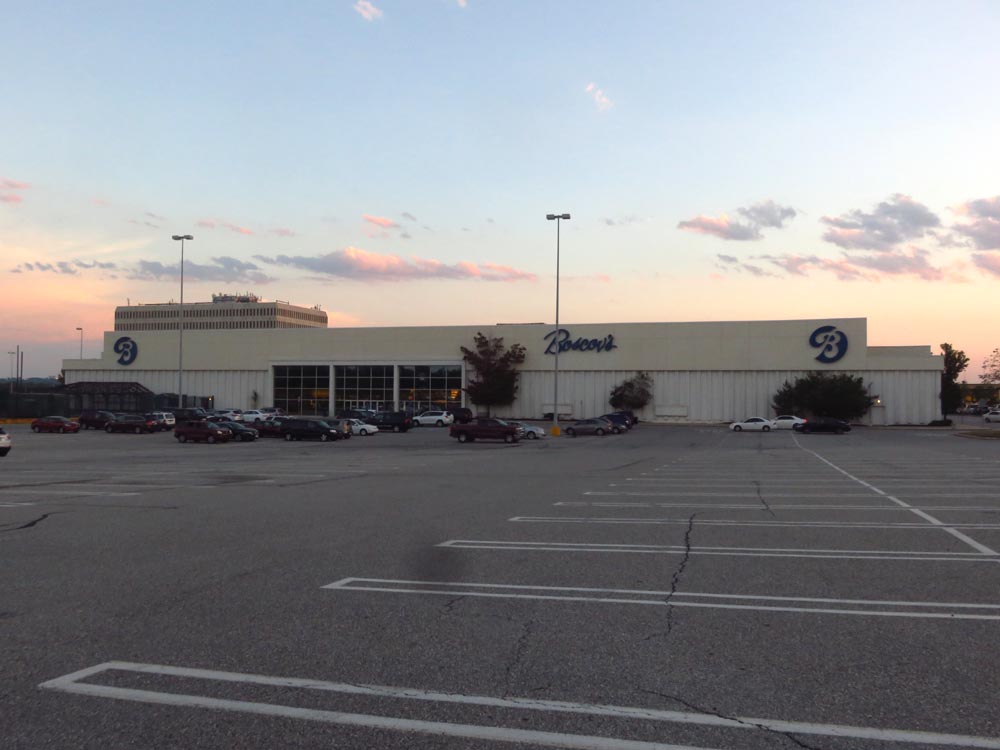
Boscov's mall entrance.  Boscov's opened as Lit Brothers and was later Hess's before becoming Boscov's.


The Boscov's juniors to the left of the entrance would suggest that this used to be a Bamberger's, but that was never the case.  However, Hess's was also aggressive at expanding store space.


A couple shots of the Boscov's on the outside.  The store is original to Lit Brother's except for the white paint and restructuring of the main entrance.


One interesting footnote in the mall's history is that Swedish Furniture chain IKEA opened their first U.S. store on an outlot of the mall.  The chain is ubiquitous as a destination for its cheap furnishings, but it has very few locations across the U.S. making it a destination store.  Ultimately, IKEA would relocate one exit down I-476 with the former tenant demolished and replaced with the present lifestyle center portion.  This new retail center brought in many typical tenants of lifestyle centers (Chico's, etc.) with its centerpiece a Whole Foods Market.  Legoland Discovery Center, another non-traditional tenant, also began construction in 2016 and should be opening this year.


This post would not be complete without interior photos of the old Strawbridge's/Macy's.  It appears the last interior model was done around 1979-1980, and it shows.  However, the design is so warm and inviting compared to the typical sterile look seen in most modern Macy's.  Unfortunately, this lack of updating was for a reason.  The store closed in 2017.


Parquet flooring...a design feature popular in the 70's


Funky goodness here with the wood and floor patterns.


Seeing an actual contrast between the merchandise and the store makes you want to actually buy something here, doesn't it?  Unfortunately, customers chose King of Prussia instead.


Impressive court with fancy skylights, chandeliers, and a mix of stairs and escalators...very similar to their Neshaminy store, but still just as awesome.  RIP, great old store.

So here we have another mall at a crossroads.  As was said on an earlier post, malls in Philadelphia are extremely overbuilt.  Due to the aggressive growth of Strawbridge's and Wanamaker's in the 70's and 80's, Macy's ended up inheriting a ton of locations in the market: many that are no more than 10-15 miles apart.  The process of right-sizing this resulted in Macy's being closed at the mall.  Furthermore, Plymouth Meeting is in an unfortunate position of living in the shadow of the largest mall in the USA.  King of Prussia Mall is not your average competitor.  A mall with under a million square feet and one operational department store is not going to be able to effectively compete with one of over 3 million square feet!  Not only that, but Macy's clearly had no interest in its store at Plymouth Meeting Mall.  It appears the last time any renovations were done was in the late 70's or early 80's.  So what does the mall do now?


Strawbridge's personified the mid-century look on their suburban stores.  A mix of brutalism and "confidence" embodied by a very prosperous time.  In the first pic, you see the mall's office tower on the right.


Macy's takeover of Strawbridge's did not strip the store of all its elements.  The Strawbridge's "Seal of Confidence" (appropriate for a mid-century store) can still be found on nearly all of their former store locations.  If this isn't Philly-pride, I don't know what is.


The sun sets on this former Strawbridge's both literally and figuratively.  Unlike when this mall was built, people are not feeling as much confidence.

In all honesty, Plymouth Meeting Mall has unfortunately become redundant.  Even before Macy's closed, the mall saw a drop in sales per square feet and an uptick in vacancies.  These have undoubtedly accelerated with Macy's closure.  With no options for replacement stores, there is little the mall can do to stop this.  Furthermore, Boscov's may be looking at relocating themselves from their current store although it is unclear if they would just close or where they might move.  Thus, its future as a traditional enclosed retail mall is unlikely.  Pretty much what you can expect for the future of Plymouth Meeting is mixed use.  It is a beautiful, spacious and inviting mall that would be perfect for a college campus, medical center, corporate headquarters, entertainment complex, housing (condos/apartments) or some other non-retail use where lots of space is needed.  It is also in a very upscale part of the Philadelphia metro area meaning that it is in-demand real estate.  This means some sort of redevelopment is likely.  At the very least, substantial renovations for reuse are likely on the now-closed Macy's.  Parts of the mall may be demolished, parts of the mall may be carved up for offices and parts of it used for entertainment.  Offices may be less likely, however, since an office tower already flanks the mall and is definitely there to stay.  However it is carved up, there is still "confidence" that this mall will continue to evolve: hopefully into something that both Victor Gruen and James Rouse originally intended.