Showing posts with label Boscov's. Show all posts

Wednesday, December 20, 2017

Town Mall/Cranberry Mall: Westminster, MD

Town Mall of Westminster is a cozy mall nestled on a hillside on the north side of the the city of Westminster.  Situated at the southeast corner of the intersection of Routes 27 & 97, the mall sits in the transition zone between the outlying Baltimore suburbs and rural farmland.  Opening on March 4, 1987, the 430,000 square ft. mall came along during a time with a ton of transition in the retail industry, and it indeed opened up with a very unusual roster of anchors.  Today the mall remains marginally successful helped along by its unconventional anchor mix.  Its trade area serves Westminster along with several other towns and communities in the area in both Maryland and Pennsylvania.


Cranberry Mall as it was originally known was a mall that was delayed for many years.  Complications involving zoning, roadways, land use, and the original owner being unable to finance construction of the first mall.  This delayed the construction of the mall for over 15 years.  In fact, had everything fallen into place, this mall would have been built in 1972 instead of 1987.  Some of the original tenants that had considered opening at the mall included G.C. Murphy and Giant Food.  Perhaps the delay led to a mall that ended up being slightly higher end than the original mall would have been.  This is considering that a mall with the kinds of anchors originally proposed resembles several dead malls found across the Baltimore region that consisted primarily of low-end tenants such as North Mall, Chatham Mall, and Timonium Mall.  Each and every time that everything seemed to come together to build the mall, it was delayed yet again.  It wasn't until the land was sold to the Shopco group in 1985 did plans finally materialize for a mall.


The first view is the center court fountain with Sears in the background.  Sears was built for the defunct Baltimore-based Hutzler's.  The second two photos show the same fountain in respect to center court.  It's a cool fountain, but it looks a little lonely with no plants around it.  These days, you just have to be happy that at least the mall still has a fountain.  Mall fountains are a major reason I got into this hobby, so I'm very unhappy to see them go.


A couple views of the court outside of Belk.  The moody 70's-style skylights are one surprising feature to find in a mall built in 1987.  The whole mall looks like it was designed in the early 80's with few modifications when it opened.


One of two ramped sections in the otherwise one-level mall give the mall personality.  It is very appropriate considering that Carroll County is quite mountainous.


Boscov's has certainly been a positive for this mall given that it might have not survived had they not come in.  It was previously a Montgomery Ward.


Toy department inside Boscov's.

The unusual anchor mix was something original to the mall.  Built by the Shopco Advisory Group, the originally planned anchors were Virginia-based Leggett, Baltimore-based Hutzler's, and New York-based Caldor.  Caldor was expanded during that time as part of a legacy of Baltimore-based Stewart's (both were owned by the same company).  Hutzler's, however, was going under during the mall's construction meaning that the store was built but never opened.  After three lawsuits against the failing chain for non-payment of construction and non-completion of the store, the Hutzler's space was taken instead by Sears.  Montgomery Ward later joined the mall in 1990, resulting in one of a few malls around the country with both Sears and Wards as anchors.  In all, it looked like a situation that would end badly, but the mall is still hanging on 30 years later.


Leaving Boscov's with the mall directory on the right.


Town Mall (Cranberry Mall) directory.  Sears was built for Hutzler's (opened as Sears), Belk was Leggett, Boscov's was Montgomery Ward and the cluster of Dick's Sporting Goods, Paradise of Fun, and Gold's Gym was previously discount chain Caldor.  Caldor opened original to the mall, but most Baltimore-area locations were formerly Stewart's Department Store.


The second fun little ramped section includes a very cool greenhouse dome in one of the stores.  They were very popular in the late 1980's, but it is unclear what that originally was.  Chick-Fil-A still going strong is a good sign.  They are the chicken in the coalmine.  When they go, so does the mall.


Approaching Dick's Sporting Goods.  It is hard to tell how this looked as Caldor since it has been so heavily modified unless the entrance on the right in black is original.  In any scenario that the mall gets redeveloped, Dick's will definitely be one who stays.

Although Leggett was mostly found in Virginia, the logic of Leggett opening in the mall was not as strange as it seemed.  Leggett was previously located in Westminster Shopping Center and had opened there in 1963 before moving to the mall.  Today, Belk occupies the former Leggett space.  The older shopping center is situated less than a mile from the current mall and is currently doing well, although it is no longer a true regional shopping center.


A look at the two entrance wings next to Dick's Sporting Goods.  I'm not sure which one is which, but I'm pretty sure the second one is the northwest entrance wing since it appears the mall's theaters are on the left in the background.  The other is the northeast entrance meaning shoppers have to enter the mall to go to Dick's.  It's a bit ironic that the mall's Chick-Fil-A is not in this food court.


Sears is sporting the dual entrances on the east wing off of center court suggesting this was a Hutzler's idea.  


Somehow I knew that Toys 'R' Us Express stores in malls were going to be a novelty.  .  Now that the company has announced at least 100 stores closing, we likely will not be seeing these ever again.  This is sad in a sense considering that this same chain likely killed a real toy store chain such as Circus World or Kay Bee Toys within the same mall in the past decade or so.  Photo from May 4, 2013.

Since the 1980's, a number of anchor changes have taken place.  In fact, the mall does not have a single original anchor.  The first to change was Leggett, which was sold to Belk in 1996.  Belk largely passed on most of the former Leggett stores in Maryland leaving this as one of only two Belk stores in the state although a store is proposed to open soon at Valley Mall in Hagerstown.  It is also the second most northern Belk store in the entire chain (the northernmost store is in Morgantown, WV).   While Leggett was affiliated with Belk as part of the Belk family of stores, it was a separate chain operating in Virginia, West Virginia, Maryland and Delaware.  Following the change from Leggett to Belk, the next anchor to change was when discount chain Caldor folded in 1999.  From 2003-2009, Steve & Barry's University Sportswear used part of the former Caldor space.  Today that store is divided between Dick's Sporting Goods, Gold's Gym and Paradise of Fun.  Dick's also has a mall entrance.


Climbing back up the second of two ramps with Belk emerging on the horizon.


Belk mall entrance from the south court.  What wonderous water feature was covered up by this garish maroon carpet?  This carpet at least needs a dripping snow cone justification.

Shortly after Caldor faded into history, Montgomery Ward shut down for good in 2001.  However, it did not remain vacant long as Reading, PA-based Boscov's stepped in to fill the void shortly after.  At the time, there was real concern the mall would not survive, so Boscov's was seen as a godsend.  The resulting anchor changes meant that this is the only mall where Boscov's and Belk share a store.  Piedmont Mall (now Danville Mall) in Virginia also once shared a Belk and Boscov's, but the Boscov's in that mall was short lived.  The result of this anchor shuffle fortunately did not lead to a dead mall.  However, the unconventional anchor lineup has not resulted in a healthy mall.  The mall today has many vacancies, and it is questionable how much longer Belk will continue to operate this store so far from their base with the nearest Belk store over 80 miles of that location.  Unless Belk expands in the region, this store will remain a very isolated outpost.  It is a worry that Belk will close this store when they open in Hagerstown despite them being in entirely different markets.


Belk, formerly Leggett, sporting an exterior that looks more like 1982 than 1987.  It is still quite attractive in a 1980's brutalist sort of way.


When it was Leggett.  Images from The Baltimore Sun from February 21, 1987 and March 8, 1987.

Cranberry Mall became Town Mall in 2000 when the mall was sold to Strategic Resources.  In addition to the new name, the new owners commenced a renovation that was completed in 2002, thus the look was somewhat updated.  However, the updates to the malls were not extreme, thus the mall still looks somewhat vintage.  In addition, the design itself looks older than its age with design cues that look more early than late 1980's such as ramps, a center court fountain, and recessed skylights giving it a few distinctive vintage elements not present in most other malls of the region.


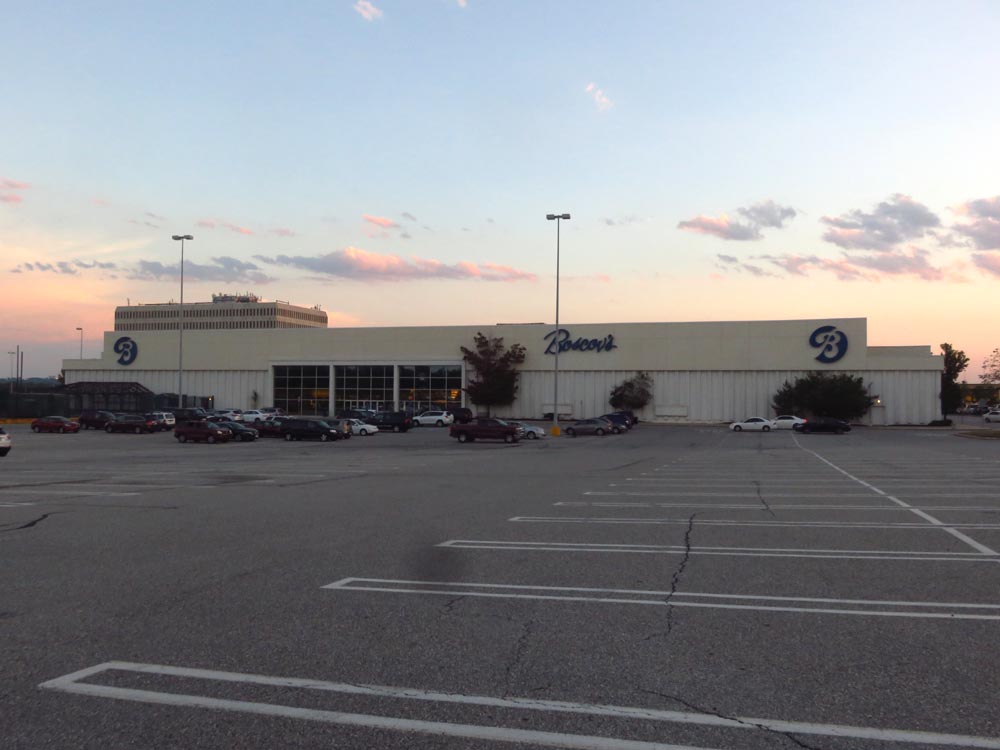
Sears and Boscov's.  Notice that the Sears looks nothing like a Sears, but the Boscov's looks everything like a 1990's Wards.  It is unclear if the Hutzler's sign ever even made it to the exterior of the Sears.


I'm sure this mall entrance update from 2000 took the greater part of 15 minutes to design.  Exactly why did the mall have to be renamed in the first place?  Also, it is actually TownMall, but I am not willing to refer to two words in a name like that.  If it was CranberryMall, it would be ludicrous.


Caldor grand opening flyer with a real treat...a list of all the locations open in the area in 1987.  So many are long gone and several anchored long-demolished community and regional malls across the region that were hammered by a combination of industry changes, anchor loss, and severe economic decline in the Baltimore region.  The Baltimore stores are probably the primary culprit for Caldor liquidating in 1999.  Image from The Baltimore Sun from March 1, 1987.


Not much out there shows the mall's original logo, but this ad certainly does.  It was definitely one of those very classy and attractive logos used in the late 1980's.  I still do not understand what was wrong with the name.  Image from The Baltimore Sun from March 1, 1987.

These days, Town Mall looks to be one that will likely be demalled within the next 5-10 years.  Both Sears and Belk are stores likely to exit the mall in the near future.  The mall also has a very awkward layout with poor access to the north end where Dick's and Boscov's are located.  The likely future of this mall will be that when Belk and Sears finally do depart that the interior mall is demolished, anchors relocated, a small outdoor lifestyle center portion is constructed and Wegman's brought in as a new anchor.  A mall with those three anchors would likely be far more popular than the current mall, and it would be more appropriate for a smaller city that likely lacks the demand for an enclosed mall.  For 30 years, however, this retail anomaly has held well enough on its own despite many bumps in the road proving that the long wait for it to be built might have been for the best.  It will be interesting to see what becomes of the place within the next few years and how well it survives.

Wednesday, December 6, 2017

Plymouth Meeting Mall: Plymouth Meeting, PA

One of the earliest and most overlooked enclosed malls in the Philadelphia market is Plymouth Meeting Mall, a spacious two-level mall opened by the Rouse Company in 1966 that, like many other malls in the region, is overshadowed by the mighty King of Prussia.  Originally anchored by Strawbridge & Clothier and Lit Brothers, the mall was designed by famed mall architect Victor Gruen, and it is shown in a circulated postcard with its signature fountain in front of Strawbridge's that remains to this day.  It was also once a dominant player in the market before multiple expansions of King of Prussia Mall began hurting business.  Because of that, this classy mall has unfortunately been affected by the highly competitive and overbuilt retail environment across the Keystone state that has taken no prisoners.


Plymouth Meeting Mall was one of several Rouse-built malls in the Philadelphia market including Exton Square Mall located 23 miles to the west, The Gallery at Market East in Center City and three malls on the New Jersey side.  Rouse, formerly headquartered in Columbia, MD, was very active in the Mid-Atlantic region and was famous for building some of the largest and first enclosed malls.  The mall has been a laboratory for innovation for a traditional enclosed mall, but today its biggest challenge will be reinventing itself since the market dealt it a crushing blow with the loss of its oldest and most prominent anchor tenant.  Despite being a two level mall that has lasted over 50 years, it was never a true regional mall.  It never had anchors like Sears or JCPenney and it never expanded beyond two anchors.  In most other cities, this mall would have failed by the 1990's due to these factors alone.


Plymouth Meeting Mall's signature fountain dates to the opening of the mall and appears to have been installed by Strawbridge's.  Strawbridge's tended to finance grand fountains as a means of showcasing their stores. Views are from the bottom and top floors with Strawbridge's behind me on the photo.


Plymouth Meeting Mall's signature fountain in the early days of the mall.  Postcard from "Malls of America".  Much has changed, but amazingly the fountain survived!


Another view of the fountain and mall.


View of fountain facing Strawbridge's.  If you look carefully you can see the labelscar.


The "STR" of Strawbridge & Clothier is quite visible in this image from the second level mall entrance.


As a dumbell-shaped mall, the design of the mall is pretty consistent throughout with a few minor discrepancies and alternating skylight styles.  However, with such a wide court and abundant natural light, the mall feels quite spaceous.  The carousel was most likely added in a 1990's renovation.  Carousels were a short-lived fad in malls that were likely put there to fill the void left behind by fountains.  Nowadays, even the carousels are being removed from most malls that had them.

In many ways, the early mall embraced elements of utopianism embraced by both its developer James Rouse and Victor Gruen.  A few years after this mall was constructed, Rouse would construct an entire city in Maryland with an enclosed mall as its downtown.  In some ways, this mall attempted to include some elements of Victor Gruen's original vision of having malls as the center of fully functioning urban villages.  Plymouth Meeting itself was developed as a rough example of the optimistic and often-cited "live, work, play" type of environment with not just a mall, but also an office tower (Pearson Professional Center), medical center, and even a church among its tenants!  Obviously the "live" part did not evolve, but at the time it was built single family houses were far more affordable, and malls as primarily retail centers represented by nearby suburban development at the time.  This vision continued for years after as the mall was innovative in cutting edge retail trends.  Perhaps the "live" part may soon be on the table as the "play" part seems to be winding down.


A side corridor leading to an outside entrance.  Domed skylights were popular in the 60's and 70's, and Rouse Malls tended to have them along entrance wings.


This directory shows that what appears to be a straightforward mall has a catch: a whole office wing featuring a tower and even a church!


One of the mall entrances between the office building and Boscov's


Detail of an entrance atrium from the inside next to the "Church in the Mall"


A look inside the lobby of the office building, which holds on to many more Rouse elements than the mall itself.


This has to be the only case in the entire U.S. where a church was actually built into a mall from the beginning.  Many churches meet in malls, but not as a planned part of the infrastructure.

Despite only having two department store anchors, the mall has no original anchors today.  Lit Brothers went under in 1976 to be replaced by Hess's in 1979.  The Hess's location was apparently the largest branch store in the chain, but it was also the only location in the Philadelphia market.  Hess's was doing marginally throughout the 1980's, suffering from extreme over expansion due to owners Crown American bringing it into many unfamiliar markets.  After many years of decline and selling off chunks in numerous markets, the chain's problems caught up to it and the location was closed in 1993.  After three more years of vacancy, Boscov's arrived and filled the void, and it still operates there to this day.  Strawbridge's, however, operated continuously at the mall until 2006 when it was converted to Macy's.  After poor sales likely due to its proximity to the nearby more popular King of Prussia store, Macy's closed at the mall in 2017 leaving the mall with a major vacancy that will be difficult to fill.


The variety of mall entrances in the mall is intriguing.  Here, the church is on the left and the 9 story office building is on the right.


Detail of the office building.  Plans show that this mid-century facade will be removed and replaced with an updated faced featuring way more glass.


Boscov's mall entrance.  Boscov's opened as Lit Brothers and was later Hess's before becoming Boscov's.


The Boscov's juniors to the left of the entrance would suggest that this used to be a Bamberger's, but that was never the case.  However, Hess's was also aggressive at expanding store space.


A couple shots of the Boscov's on the outside.  The store is original to Lit Brother's except for the white paint and restructuring of the main entrance.


One interesting footnote in the mall's history is that Swedish Furniture chain IKEA opened their first U.S. store on an outlot of the mall.  The chain is ubiquitous as a destination for its cheap furnishings, but it has very few locations across the U.S. making it a destination store.  Ultimately, IKEA would relocate one exit down I-476 with the former tenant demolished and replaced with the present lifestyle center portion.  This new retail center brought in many typical tenants of lifestyle centers (Chico's, etc.) with its centerpiece a Whole Foods Market.  Legoland Discovery Center, another non-traditional tenant, also began construction in 2016 and should be opening this year.


This post would not be complete without interior photos of the old Strawbridge's/Macy's.  It appears the last interior model was done around 1979-1980, and it shows.  However, the design is so warm and inviting compared to the typical sterile look seen in most modern Macy's.  Unfortunately, this lack of updating was for a reason.  The store closed in 2017.


Parquet flooring...a design feature popular in the 70's


Funky goodness here with the wood and floor patterns.


Seeing an actual contrast between the merchandise and the store makes you want to actually buy something here, doesn't it?  Unfortunately, customers chose King of Prussia instead.


Impressive court with fancy skylights, chandeliers, and a mix of stairs and escalators...very similar to their Neshaminy store, but still just as awesome.  RIP, great old store.

So here we have another mall at a crossroads.  As was said on an earlier post, malls in Philadelphia are extremely overbuilt.  Due to the aggressive growth of Strawbridge's and Wanamaker's in the 70's and 80's, Macy's ended up inheriting a ton of locations in the market: many that are no more than 10-15 miles apart.  The process of right-sizing this resulted in Macy's being closed at the mall.  Furthermore, Plymouth Meeting is in an unfortunate position of living in the shadow of the largest mall in the USA.  King of Prussia Mall is not your average competitor.  A mall with under a million square feet and one operational department store is not going to be able to effectively compete with one of over 3 million square feet!  Not only that, but Macy's clearly had no interest in its store at Plymouth Meeting Mall.  It appears the last time any renovations were done was in the late 70's or early 80's.  So what does the mall do now?


Strawbridge's personified the mid-century look on their suburban stores.  A mix of brutalism and "confidence" embodied by a very prosperous time.  In the first pic, you see the mall's office tower on the right.


Macy's takeover of Strawbridge's did not strip the store of all its elements.  The Strawbridge's "Seal of Confidence" (appropriate for a mid-century store) can still be found on nearly all of their former store locations.  If this isn't Philly-pride, I don't know what is.


The sun sets on this former Strawbridge's both literally and figuratively.  Unlike when this mall was built, people are not feeling as much confidence.

In all honesty, Plymouth Meeting Mall has unfortunately become redundant.  Even before Macy's closed, the mall saw a drop in sales per square feet and an uptick in vacancies.  These have undoubtedly accelerated with Macy's closure.  With no options for replacement stores, there is little the mall can do to stop this.  Furthermore, Boscov's may be looking at relocating themselves from their current store although it is unclear if they would just close or where they might move.  Thus, its future as a traditional enclosed retail mall is unlikely.  Pretty much what you can expect for the future of Plymouth Meeting is mixed use.  It is a beautiful, spacious and inviting mall that would be perfect for a college campus, medical center, corporate headquarters, entertainment complex, housing (condos/apartments) or some other non-retail use where lots of space is needed.  It is also in a very upscale part of the Philadelphia metro area meaning that it is in-demand real estate.  This means some sort of redevelopment is likely.  At the very least, substantial renovations for reuse are likely on the now-closed Macy's.  Parts of the mall may be demolished, parts of the mall may be carved up for offices and parts of it used for entertainment.  Offices may be less likely, however, since an office tower already flanks the mall and is definitely there to stay.  However it is carved up, there is still "confidence" that this mall will continue to evolve: hopefully into something that both Victor Gruen and James Rouse originally intended.