University Mall seems to be a popular name for a mall, and Tuscaloosa's mall of that name is indeed a popular mall. That was definitely the case with University Mall when it opened in 1980 much to the misfortune of McFarland Mall. What is amazing, though, is how long McFarland Mall held on with this mall only a couple miles up the street. University Mall had four department stores, McFarland had one. University Mall had more than twice the inline tenants as well, quickly relegating the older mall to a second tier status while putting a strain on the original second tier mall, Meadowbrook. Most of all, it had Birmingham stores that McFarland never had. It was a superregional mall in the truest sense despite all being on one level.

The main reason McFarland survived the opening of University Mall is that University Mall made one mistake, possibly deliberately, and that was not designing a mall that could adequately support a fifth anchor nor luring away McFarland Mall's major tenant, Gayfer's. That is how Gayfer's and later Dillard's ended up shoring up the city's oldest mall instead of joining the parade at the biggest mall in town. However, McFarland did lose Pizitz Tuscaloosa to the new mall as well as its status as the city's premier shopping destination.
Entering the Parisian (now Belk Women's) court from the store into the mall. I found the main entrance is not a good way to start mall photography unless there are no other options. The picture above is a view of the glorious center court.
Continuing from center court to the other Belk, which was McRae's for most of its existance.
Pizits/McRae's/Parisian/Belk court, which is identical to the JCPenney court in every way. A small wing is off to the left leading to an outside entrance.
Detail of the fountain in Pizitz/McRae's court. The mall has a total of five fountains, which is unheard of for a mall its size in 2010. I'm not complaining one bit.
A look down the entrance wing off of the Pizitz/McRae's court. In the JCPenney version, a Piccadilly would be near the entrance on the left.
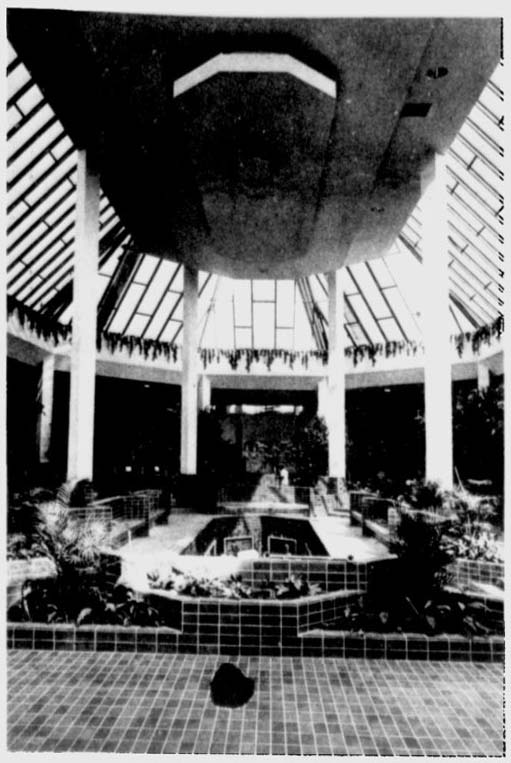
When the mall opened, it was an elegantly designed center with a huge center court atrium featuring a large fountain in the center of an expansive sunken garden. A huge vaulted skylight also brought substantial natural light to the lush center court as well to not only feed all the tropical plants but also to add to the ambience. Large planters and seating areas surrounded by brick holders also were situated in small courts in front of all the anchors in addition to modern art sculptures. Overall, the mall was a contrast of light and dark including bright skylights and dark faux brick linoleum tiles, which were popular in the era. Each anchor was situated at equidistant wings off of the center court, and all the smaller courts in front of each anchor shared almost exactly the same design, essentially making it a plus shaped mall. The only differences are a small entrance wing facing west that created a fifth leg on the mall, which is today the food court, and two small wings near JCPenney and Belk Men's (former Pizitz/McRae's) where the Morrison's Cafeteria (today Piccadilly Cafeteria) is located.

Looking back along the Pizitz/McRae's wing toward center court.
Now looking at JCPenney, which only differs from the Pizitz/Belk court by the fact that the JCPenney features the period diagonal wood paneling.
A look back along the JCPenney wing to center court. The lighting is far less in these corridors than in the courts, creating a huge contrast in the middle of the day.
Something about the mall's shape here makes me think of some villain on an old Atari game. Note the off-base food court wing on the upper left, which I guess is the head.
The outside of the mall today still carries much of the period design. This includes a deep red brick, which was also used on Century Plaza in Birmingham. The entrances had the brownish black tones, and one of those rear entrances still maintains the original look today. Morrison's Cafeteria also had outside windows forming a nook in the mall between the Parisian and JCPenney wings. In other mall food, the food court is very unusual. Instead of a big seating area with walk-up order areas facing the mall, the eateries are located in actual stores with sit-down areas inside. It was perhaps the only time I've ever seen a sit-down area in a Sbarro. In all, it was and still is high design in a quintessential second generation mall.
Looking back along the Parisian wing toward current Belk Women's. I will never understand why Belk let Parisian go, and you can bet the folks here in this town and Birmingham are having an even harder time with that decision.
This shot came outright professional looking! The mirrored sign backing definitely helped with that. I'm sure this looked awesome with the old Parisian logo. I have noticed the older clientele seems to linger closest to the Belk stores, and Belk is having a bit of trouble shaking that image as well.
Original anchors to the mall also established Tuscaloosa as an up and coming town in lieu of an average small city. Upscale Parisian and traditional Pizitz (of Birmingham) joined Sears and JCPenney. Since it is not obvious today, Parisian was the northwest anchor and Pizitz the southeast anchor. A mix of local, regional and national tenants joined the fray as well including previously mentioned Morrison's Cafeteria, which had moved twice since 1977. Morrison's had previously operated at Meadowbrook Mall and McFarland before that. In all, though, nobody was much worried about the health of the two older malls but they were very worried about the health of downtown. Downtown did indeed receive a crushing blow as Sears and JCPenney closed their downtown shops and the independent Pizitz Tuscaloosa chain closed soon after. With three malls in the city, there was not much of a need for downtown by that point. On the flip side, Tuscaloosa was well served with plentiful and quality retail options.


I would love to have gotten more detail of the pill-shaped fountain in the middle of the court, but a relatively high security presence made photography difficult here as it was. I seem to come to this mall prepared for a more difficult time getting pictures, but I got through it without the drama. Note the kiddie train surrounding the fountain in the second photo. This is one of the finest center courts ever, quite frankly.
Over time, the mall has indeed seen a few changes. Mostly, this had to do with the mid-market department store shuffle. First, Pizitz converted to McRae's in 1986 later to be renovated in 1998. Later, Morrison's Cafeteria converted to Piccadilly in 1995. This was followed by a multi-million renovation of the mall completed in 1999 that mostly replaced the dated floor tiles, upgraded the main entrance and replaced the blocky courts in front of the department stores with a more subdued style featuring potted planters and small, elegant fountains. The wild consolidation fever also did not leave the mall alone in 2005 as Parisian was doubled at the mall after McRae's was sold to Belk. Only a year later, Belk would buy out Parisian, ultimately ending up in the mall anyway. The popular mall would also be supplanted a short time later after a small lifestyle center opened directly across the street originally promised to lure Dillard's from McFarland.


A look at the front entrance wing doubling as the food court. Unlike most food courts, this is a very integrated one with restaurants built in like stores with sit-down areas inside in lieu of the hot dog stand-style eateries popular in most food courts today. I liked it.
An important thing to note about Tuscaloosa is how significant its major industry is: University of Alabama. Not only that, but in the past 15 years the city has grown a substantial industrial sector as well including a Mercedes plant that opened in the late 1990's. Considering this, University Mall's major success along with struggling McFarland Mall's survival is essentially a reflection of a very robust local economy that expanded beyond simply "college town" status. Tuscaloosa also is a central location for shoppers in Mississippi looking for Birmingham-quality retail options without actually having to drive all the way to Hoover.
Looking along the Sears wing from center court.
Sears mall entrance is custom here in lieu of the ugly tiled look on most malls. I like it much better.
I imagine the sign backing is the same as when the mall opened aside from a different style of logo. Once again...no complaints.
Despite this, the city is still in danger of being over-retailed as significant suburban growth coupled with new shopping center construction threatens to marginalize all of the older centers, including University Mall. The lifestyle center across the street, for instance, kept many upscale stores from opening in the mall instead while McFarland down the street is quickly emptying out. Perhaps it is time for University Mall to expand? I would suggest right away that Belk reconstructs the original Parisian as a two level store coupled with a mall expansion along the Belk/former McRae's wing to include a new Dillard's. Perhaps the expansion could also lure in Borders or Books-A-Million currently situated in the old Winn-Dixie at McFarland. Dillard's had planned to build in the lifestyle center across the street, but why not at University Mall?

University Mall shows a clash of two different styles here. The older 80's red brick and brutalism here is hard to hide behind the splashy 1998 entrance. The American Eagle with outside windows is one of the oddest things here, though. Applebee's is on the right, and likely has been here most of the mall's existance.
The back of the mall, however, shows the original design intent. This entrance is unchanged from when the mall opened over three decades ago, but is well hidden from busy Skyland Blvd (US 82). Piccadilly Cafeteria's mall entrance is just inside that door on the right, and Piccadilly makes up the entire corner to the right of the entrance.
This sign on Skyland Blvd is definitely not original, but is quite awesome compared to the minimalist original logo. In the background on the right is one of the last operating Bruno's locations.
All around, University Mall was one of the most attractive malls I have visited in the South, and I was actually pleasantly surprised as well. It was wonderful to see that the 1998 renovation did not strip away the original mall elements that made it enjoyable in the first place. It probably helps that the original mall developers, Aronov Realty, still own and manage the mall. Aronov is legendary in Alabama. His company built one of the very first malls in the country in Montgomery in 1954, and he was instrumental in bringing modern retailing to Yellowhammer State. If Simon had owned the mall, it would have been a guaranteed that the lush center court would have been replaced with a flat spot looking like the third world bazaar under a skylight.

Looking at this store, it is absolutely amazing to me that this was Parisian. For a store known for elegant, cutting edge design features, I'm sure this was such a store for its time. Today it looks so simple and 70's, but it is very eye catching. I'm sure people in Atlanta, Nashville and Columbia would have a hard time picturing a Parisian looking like this, however.
Sears was definitely going for a Space Mountain look on this one. I do not think I've ever seen another Sears with this design, so I'm guessing Sears did not design it themselves.
I'm not sure if it was Parisian, McRae's or Belk that did this entrance overhaul, but today there is no evidence whatsoever of what this store looked like when it opened as Pizitz.
JCPenney, unfortunately, spoils the party here in design. JCPenney was at its very worst form with this design in 1980 when quite a few of their stores opened. I also noted this look at Haywood Mall.
In all, it is rather interesting to note how many malls in Alabama remain under local management. Quintard Mall in Anniston is also locally operated, and it has thrived as well. In fact, University Mall today looks to only be attracting commerce as the new lifestyle center across the street appears to be fully complementing the thriving center. This means that today University of Alabama students shopping at a mall built before they were born still see the place as hip as the day it was built 31 years ago.
UPDATE 5/01/11: University Mall was close to the tornado that hit Tuscaloosa, but narrowly missed the mall. The mall is open for business. It is unknown how much, if any, damage occurred at the mall.