Showing posts with label Morrison's Cafeteria. Show all posts

Friday, July 15, 2016

Newmarket North Mall/Newmarket Fair Mall: Newport News, VA

A reality that is nothing new to the residents of Hampton Roads is that the area is overmalled.  Hampton Roads can be compared in many ways to Florida in how it is basically a huge sprawing suburban cluster of cities instead of a single city making up the area.  The result is that each city attempted to carve out its own suburban realm including their own malls to pad the city's tax base.  Mall developers, eager to oblige, built and built malls until malls both major and minor were all located within 5-10 miles of each other cannibalizing each other for stores, sales and shoppers.  This became evident quickly as the earlier malls died more quickly than most and the newer, larger malls found it difficult to survive.  This was certainly the case for Newmarket North Mall.


Newmarket North suffered for a number of reasons.  One was that it was developed using apparently outdated or at least not well researched data.  Constructed by the Hahn Company, the mall was not well positioned for the time it was built: a superregional mall opening in an area that was already becoming too blue collar to support it.  Newmarket North did not initially appear to be a rotten apple.  It had solid anchors, was in a seemingly prime retail strip and it was not redundant with other area malls.  That distinction did not last very long.


Obviously the most remarkable thing about Newmarket North Mall is that despite the mall itself being demalled for nearly 20 years, Sears still lingers on with the old 1975 logo still hanging on at the mall entrance!

When the mall opened on March 26, 1975, it was anchored by Sears, Leggett and Miller & Rhoads.  All of those were prominent anchors in Virginia at the time with Sears a guaranteed draw, Leggett a desirable anchor found throughout the state as a division of Belk and Miller & Rhoads a prominent upscale department store based in Richmond.  Its nearest competitor was Coliseum Mall, which complemented the mall with anchors that included Korvette's (later Wards), JCPenney and Rice's-Nachman's.  Colliseum Mall was better positioned along I-664, but it lacked the solid anchors that Newmarket North Mall had.  The result was an expansion in 1976 that added Thalhimer's and Smith & Welton to the mall.  This honeymoon lasted a little over a decade.  Another mall, Mercury Mall, was much closer but it was a very small early mall without any major anchors and was effectively killed off by Newmarket North by the mid-1980's.


This tent-like structure was obviously added in the 1989 update


Looking opposite Sears toward Miller & Rhoads.  At this point, only the layout gives away its origins as a mall.  All of the storefronts were removed in 1998 and replaced with these walls.  However, the ceiling, rails and flooring are original to the 1989 update other than the fact the once teal blue rails are now a drab gray.


Lower level view looking back to Sears and the Sears court

In 1987, competition arrived to both malls in the form of Patrick Henry Mall.  Like Coliseum, the new mall did not initially appear to be as credible of a threat as another Crown American mall anchored by Hess's, Bradlee's and another location of Leggett.  However, changes in the retail scene were underway that would deal a crushing blow on the still-new mall.  The first was when Miller & Rhoads parent company Allied Department Stores became a victim of the financial scandals that created major upheaval in the industry.  While many Allied stores were sold to competitors, primarily Hess's, Miller & Rhoads went under.  In 1990, the store closed for good with no other department store coming to take its place.  Hess's was the logical successor, but they were not about to duplicate stores with their Patrick Henry store.


The center court update with the grand looking staircases and domed skylight were part of the 1989 update.  However, much of the color was stripped out of this scene in subsequent updates.


Despite the pending closure of Miller & Rhoads, the mall was sold to Goodman Segar Hogan.  Its new owners were still ambitious about the mall's future and immediately set forward to commence a major renovation.  The mall was gutted and redone as a lighter, brighter mall and given a new name: Newmarket Fair Mall.  Nonetheless, new tiles, paint and skylights were not the cure to this mall's illness.  The fact was that the newer Patrick Henry Mall was visible along I-64 in a better neighborhood and Coliseum Mall also expanded heavily in an attempt to compete with Patrick Henry Mall.  Newmarket North received no such expansion, and it was a couple miles off the interstate in a declining neighborhood.


About the only evidence left of a former storefront is on the left side with Miller & Rhoads behind me.


The right side of the former Miller & Rhoads mall entrance is still visible while the left side is walled off.  It is today a Verizon call center.


Diagonal escalators in the Miller & Rhoads court give the mall a DeBartolo feel.  Only the down escalator was working so as to prevent shoppers/visitors (what shoppers?) from accessing the restricted parts of the second floor.


Once a fountain, now a tacky cluster of house plants where the water used to flow.

As the 80's were coming to a close, the stores were also beginning to close.  By the early 90's the mall had a high number of vacancies, and the blows kept coming.  After Miller & Rhoads closer, next to go was when Leggett, who also had a store at Patrick Henry, downgraded their store to an outlet in 1991.  In 1992, the bridge/tunnel on I-664 to the south was completed connecting Newport News to Norfolk taking traffic off of Mercury Blvd while drawing more traffic away from the mall and to better shopping options further south and east.  By that time a new look could not restore the luster.  By the middle of the decade, the mall was half-empty and Leggett pulled out around the same time.  When the dust settled all that was left were a few stores including a Morrison's Cafeteria and Sears.


Piccadilly Cafeteria, formerly Morrison's Cafeteria, continues to serve mall walkers (and maybe workers)


Entrance wing with Piccadilly on the right and the Sears court behind me

What is strange is that despite the death of the mall as a retail center, Sears never left.  When all three malls opened in Newport News, the others failed to attract a Sears nor provided room for them to relocate.  The mall itself was ultimately repurposed as a business center in 1998 meaning that a fully functioning Sears with two levels of merchandise and a Piccadilly Cafeteria, originally opening as Morrison's Cafeteria, are all the retail that remain.  What's even more interesting is that Sears never even updated its mall entrance still sporting its red Times New Roman logo on the mall entrance!


Sears, facing east.  The logo on the exterior was, unfortunately, updated.


Sears auto center also still going strong


Former Miller & Rhoads, facing south.  It was not a terribly inviting store.

Newmarket North Mall's revival as a business center was successful, but it also looks to be winding down.  The mall has in fact survived longer as a repurposed center than it did as an actual retail mall.  However, the reality of malls as a whole failing coupled with the glut of office space since the 2008 crash has made repurposing malls less attractive with once enthusiastic tenants vying for the shared, affordable office space leaving for nicer buildings.  In addition, the mall's sole surviving anchor is today a very troubled company likely to liquidate within the next 2-5 years meaning that the unyielding survivor is basically feasting on scraps to keep the lights on and doors open.  The rest of the mall closes at 5 PM on weekdays like any other office building.


The main part of the mall includes window cuts were a brutalist brick facade was once windowless.  This is the Miller & Rhoads court entrance.

In all honesty, there is not much left to see in the mall as most of its 1980's store fronts have all been stripped away for various office facades.  Nonetheless, the building itself actually outlasted its more successful primary competitor: Coliseum Mall.  The mall today is one of many joining the chapter of failed malls since the 40 year mall boom busted including many in the area.  Coliseum Mall, now an open-air center known as Peninsula Town Center, just lost its Macy's in the former Thalhimer's and Chesapeake Square to the south is emptying out.  Several other smaller malls in the region are also long gone including nearby Mercury Mall.  How much longer will Newmarket North continue to go south before it bottoms out?

BONUS: 1988 commercial for the mall showing it in its original 1975 look.


ALSO: Further reading with historical photos on Sick Malls.


Wednesday, January 19, 2011

West Town Mall: Knoxville, TN

Knoxville is not one of the most recognized areas retail-wise, and indeed I have heard comparatively little about it compared to other cities in the South.  It is also a fluky and difficult to understand market where stores that have come there tended to fail while stores that come out of there also do likewise.  It is still a modern, interesting city with TVA and University of Tennessee both major employers, but its hillbilly image proves a bit difficult to shake: at least to prospective retailers.  Nevertheless, the Knoxville area is among one of the most scenic locales, and its proximity to Great Smoky Mountains National Park has drawn significant vacation home growth as well as tourism.  The area infrastructure has also had to expand significantly to handle football crowds, tourists, traffic from the junction of two major interstates and, of course, organic growth in the area.


In all, the Knoxville area has had four major malls in recent years.  In addition to West Town Mall, these include East Town Mall (renamed Knoxville Center), Foothills Mall in Maryville and Oak Ridge Mall in Oak Ridge.  Oak Ridge Mall was a poorly conceived idea where a 1950's strip mall was converted to an enclosed mall, and it was never successful.  It was sealed off in 2008, though I took pictures in 2005 and covered it in depth.  Foothills Mall is marginally successful, but it is a weaker player in the market, and it lacks the offerings of Knoxville's two major malls.  West and East Town Malls, however, are a vastly different story with both carrying the torch in different times as the star of the city.  East Town held it in the 80's and early 90's and West Town, the first, still does today.


Here, I am first entering the mall from the Dillard's wing.  This is the oldest part of the mall.


Dillard's is located on the site of what was previously Hess's and originally Miller's of Tennessee.  The store, however, was gutted and rebuilt with two stories vs. the original anchor.


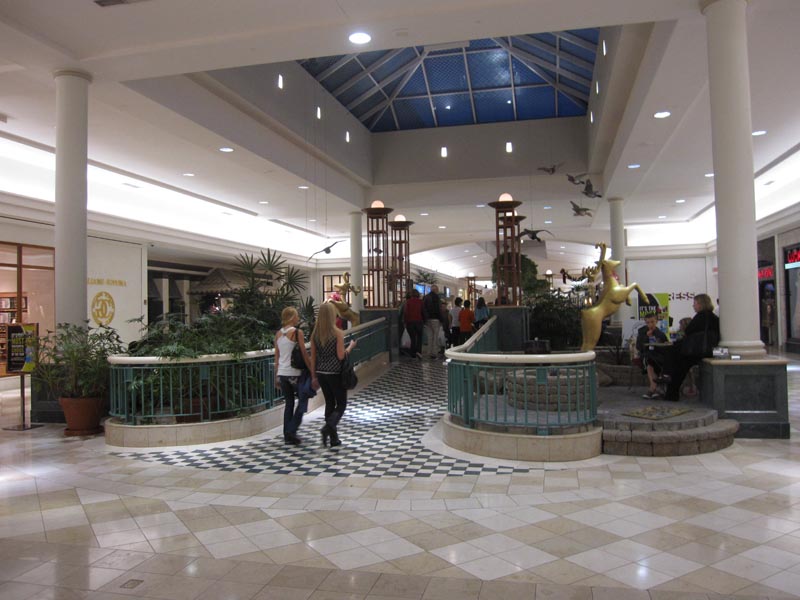
One of the things I find so special about this mall is that instead of making it all kiosk hell, they actually kept scultures and built-in planters all throughout the mall.  This one is on the same Dillard's wing.


Detail of the planter pictured above.

West Town Mall is not just one of the malls.  It is, in fact, the premier mall for all of East Tennessee.  This one story mall checks out at around 1.5 million square feet anchored by two Belk stores, Dillard's, Sears, JCPenney, junior anchor Forever 21 and a large movie theater.  While the anchors are mid-market, the mall offerings are somewhat more upscale featuring many of the trendy shops, including some of those typically found in lifestyle centers such as Pottery Barn and Williams-Sonoma.  While the mall is no Lenox, SouthPark or Green Hills, the mall definitely leans upscale with such stores as Brooks Brothers and Banana Republic.  The Belk also was set up as an A-class store offering merchandise closer to Nordstrom in lieu of the typical Belk offerings making it similar to its flagship stores at South Park in Charlotte and Phipps Plaza in Atlanta.  However, Belk is struggling to obtain brand loyalty after it purchased Proffitt's and Parisian, which were both extremely popular stores in the mall.  Dillard's, recognizing that the mall has no truly upscale anchors, features more exclusive offerings since Parisian became Belk.  Macy's is not in the Knoxville market at this point, and since the city has no luxury department stores so mall patrons are likely grateful that Dillard's has helped.


Here, I am entering the longest part of the mall with many more surprises and a lot of walking in store.  Belk Women's is behind me.


Here, I am entering a court area that includes an arbor, trees and skylights.  To the right is the food court, which originally was Frankenberger's.  The path to the left leads to an outside mall entrance and straight ahead continues to Sears, JCPenney and Belk Men's (formerly Parisian)

Here I am walking under the arbor in the same court.  Thank you, Simon.  This was special for a change.


Another view of the court pictured above coming from the food court


This is the path to the left of the arbor going to the northwest outside entrance.  It's a little bland, but the tree there definitely helps.


You do not have to be directionally challenged to get lost in this mall.  Where I am standing is in the wing dividing the blue part of the mall, and the court pictured above is where that wing junctions with the main part of the mall.


A view of the food court, which once was the inside of a department store.  Unfortunately, I know nothing about Frankenberger's.

West Town Mall was the city's very first mall, and according to Mall Hall of Fame, it was planned as early as 1965 but delays led to it not being completed until 1972 making it slow to gain a mall for a city its size.  In fact, Chattanooga, Cleveland and Kingsport all had malls open for business years before West Town Mall opened its doors.  When finished, the mall featured Proffitt's, Miller's and JCPenney as its major anchors and Frankenberger's as its junior anchor.  Sears would arrive soon after the mall opened giving a city that had never previously had a shopping mall of any kind a five anchor mall.  Five anchors for 1972 was astounding.  All original anchors in the mall except Frankenberger's were two-levels.  As for Proffitt's, this was their first mall-based location as well as the newly designated flagship for the Maryville-based chain.  Proffitt's was also only barely two levels with its home store on a small lower level.  Miller's was also entering the mall business for the first time, and it is not to be confused with Miller Bros. in Chattanooga, which did not consolidate into Miller's until 1973 and already had mall locations in Chattanooga and Cleveland. 


Here, I am walking along the Sears wing.  The second photo shows a ramped area with the wing extending to the food court visible on the right.  About the only surprises this mall does not have are a surprise second level in one of the wings of the mall.


Here, I am approaching Sears.  Despite being an original anchor to the mall, the store has been expanded and renovated to the point that it looks like most any other.  With the way Sears is going, this may one day be a Macy's, Nordstrom or even something like Von Maur.

Malls in this period tended to include several items guaranteed: a supermarket, a cafeteria-style restaurant and a movie theater.  While Morrison's Cafeteria filled the restaurant slot in the mall, both A&P and the movie theater were located on outparcels of the center.  With the mall doing very well, the mall existed free of competition until 1984 when East Town Mall attempted to steal some of its thunder.  Oddly, the mall did not react for quite awhile to the news, and the mall co-existed with its new crosstown competition unchanged for a long period of time.  Apparently the mall was not worried due to its nonchalant response to its new rival.  About the only change to occur at all in the first couple decades was the closure of Frankenberger's in the 70's, which brought a new food court in by the early 80's.  In the mean time, one of the mall's original anchors Miller's turned into Hess's in 1987 only to close in 1992.  Dillard's reopened in the space in 1993, gutting the store and adding on to the building according to their own needs while keeping some of the original Miller's exterior intact.  Dillard's then was new to the market, and they also opened a location in the former Hess's of rival East Town Mall.


This court is in the new section of the mall where the small JCPenney wing splits off from the longer Belk Men's (Parisian) wing.  This did not turn out the best since it was overloaded with Christmas decorations.


A look at the mall entrance to JCPenney v.2.0.  Opened in 1998, it replaced JCPenney v.1.0 the original 1972 store that is now part of the mall itself.  Insert tech geek joke here.


Belk Men, Home and Kids featuring swanky wood trim.  Inside, an A-class store awaits shoppers still pissed off that Parisian is not there anymore.

Dillard's arrival to West Town Mall spelled the beginning of major changes to the already unusually shaped mall.  By then, it was the smaller of the two rivals, and it joined many other malls in the 90's to do humongous expansions in order to remain competitive.  With the U-shaped mall already enough of a maze, the layout would become much more complex.  The reason for this is because the new wing would extend on the other side of the existing JCPenney to include a new JCPenney store and Parisian.  One might then ask what happened to the original JCPenney?  This is where it gets interesting.  The old JCPenney did not actually get a new anchor in its place.  Instead, they cut the portion where the mall corridor passes through down to one level.  The rest of the upper level was restructured into to a Regal Cinema on one side and family entertainment complex on the other side, the latter of which has since closed.  Along with that came a six story parking deck and two new wings forking off the other side of the de-anchored Penney's connecting to the relocated JCPenney and brand new Parisian, all completed in 1998.  By then, what was first and still a dominant mall suddenly became a force to reckon with.  This also made West Town Mall the largest in the entire state.


Now, for the most amazing feature of the mall is this pond and fountain with a bridge over it.  On the other side of this was the original JCPenney mall entrance prior to 1997-98.  You can still get to JCPenney that way, but you have to walk through what was the store to get there.


A view of the fountain from the bridge complete with more sculptures.  All malls should be required to have something like this. 


Walking across the bridge.  This whole feature should be in every advertising brochure of this mall.

Obviously, the mall has seen some anchor shifts over time.  Not only had the anchors expanded, but they were also moved around.  Proffitt's was expanded the most, expanding both into the mall (eliminating the front entrance wing) and into the parking lot.  Since 2005, the anchor shifts were all due to Belk moving in to completely dominate the market through the gradual buyout of the whole Saks, Inc. portfolio aside from Saks Fifth Avenue itself.  First, Belk purchased Proffitt's in 2005, converting the store by 2006 to the Belk banner.  Belk would then move in and grab Parisian later in 2006: a move which forced the chain to create an A-class store to appease the removal of an upscale department store anchor.  The dual Belk setup resulted in the old Proffitt's flagship becoming a women's store with the Parisian becoming a men's store.  Belk also was left with excessive space, so the lower level of the old Proffitt's was sealed off and what appeared to have been the Proffitt's Home Store was spun off to Forever 21.  As a result, Belk's arrival did lead to definite changes to the mall including the loss of the popular Proffitt's flagship store, which chain-wide apparently was not profitable enough for Saks, Inc.


Belk Women's here was Proffitt's flagship store up until 2006.  It is an unusual store with a basement level that is currently sealed off as well as parts of the store that are expanded into existing mall space.  The mall makes a 90 degree turn at the mall entrance.


The court in front of Belk Women's is the way they used to be: a lush jungle of vegetation and modern art.  Note the sculpture on the right.

My visit to West Town Mall presented me a mall that was more like one of the 70's than so many of the struggling malls of today.  The parking lot was nearly to capacity even with the parking decks.  Having never seen or paid any attention to the mall before, I was not prepared for how incredibly huge this mall was inside.  The mall also featured many distinctive court areas including a small pond with a bridge, ironworks, trellises and trees.  The detail reminded me a lot of Biltmore Square Mall but less elegant.  I also was surprised to find that such an extremely popular mall was only one story.  Did structural issues keep them from just making this a two-level mall to start with?


I personally detest night shots of mall anchors from the outside, but I was here at night and I did well to get all of these to turn out.  Photos are of Dillard's, on site of the former Hess's and Miller's, Sears, Belk Men's Home and Kids in the former Parisian, JCPenney and Belk Women's in the former Proffitt's flagship store.

The expansion of West Town Mall may have been a little too successful.  The reason for this is that the other three malls in the city took a big hit from that 1998 expansion.  East Town Mall (now Knoxville Center) is also owned by Simon, and it is struggling to stay alive especially after losing Dillard's in 2008.  Foothills Mall in Maryville has also lost ground to the behemoth, and Oak Ridge Mall faded into history 10 years from when the project was completed.  Perhaps West Town Mall is too much of a good thing when city residents have apparently lost interest in patronizing the other malls of the area.  Granted, I will say that Knoxville Center and Foothills Mall could be better, but what comes of these other malls is unknown.  Foothills Mall is in a lower growth area, which makes it difficult to evolve, but Knoxville Center has one advantage in that West Town Mall will have a difficult time expanding to accomodate any new anchors such as an entry of Macy's into the market.  This gives Knoxville Center a slim opportunity to recover despite the fact that retail has only gravitated west of the city, not east.


One of the outside mall entrances between Sears and Belk Mens, Kids and Home


I cannot complain about the mall sign posted along Kingston Pike.  This is pretty elegant!  I don't much like the name, though.  I would rather this have been called Kingston Square Mall (for Kingston Pike, where the mall is located), Kingston Ridge Mall, Knox Ridge Mall or something else more distinct.  At least they avoided the moronic elegant "e" on the end of town.


This was my best attempt at an early map of West Town Mall.  Imagery used was from 1993, so I am uncertain of the original size of Miller's or Sears.  Please feel free to make corrections.

West Town Mall is not going anywhere, however.  Few malls are this solid, but I do believe that the mall will have to make some changes in the future to its design: namely a major renovation to make the mall not so colorless and a reconfiguring of the former JCPenney location.  However, the unusual layout and special touches really make this mall.  The pond and fountain in the middle of the mall is the biggest treat with the bridge crossing the middle of it.  It is rare to find themed court areas in most malls these days, especially Simon malls.  Fortunately, it seems that Simon has shown more interest in keeping the mall distinct to protect its status as not just a mall, but a tourist destination for East Tennessee in the region's largest city.

ALSO: Check out the new Google Maps link to the mall.  This is a new feature I plan to add to more posts in the future.