Showing posts with label Belk Hudson. Show all posts

Wednesday, March 3, 2010

Gadsden Mall Opening Day - July 29, 1974: Gadsden, AL

My last post showed how Gadsden Mall looks today.  While still a lively mall, it was quite a different mall in 1974 than it is today.  It had different stores, different skylights and a different look though the structure is still the same aside from the front anchor.  Given the continued popularity of a mall that has otherwise expanded minimally, it is actually curious to me if the mall would still be successful maintaining its 1974 look.  Clipping ads, logos and somewhat crusty images out of the local paper, I have put together a post that looks backwards to the mall as it first looked.


What stands out the most with early Gadsden Mall is that it had a very distinct logo, fake stone planters and seating areas, tile floors in lieu of carpet and there was no department store in the front.  What also changed tenant-wise was pretty significant.  Original anchors to the mall on opening day included Pizitz, Belk Hudson, Sears, Morrison's Cafeteria, Elliott Drugs and Rifkin Theater.  Most of the inline tenants were also regional chains that had no locations outside of the state.  Compare today where American Eagle and Gap are must-haves for an A-list mall, which it has both.  Of those original major tenants I listed, only Sears and Belk are still there.  Curiously, the mall never had a five and dime store.


This was taken in the court area in front of Pizitz looking north toward Sears.  Hickory Farms was the other restaurant in the mall at the time besides Morrison's.  Chick-Fil-A did not come until later.


This photo speaks volumes of the early mall.  It looks like the mall was actually pretty bright and the ceiling treatment is considerably different (no exposed trusses).  Those fake stone seats look a bit uncomfortable as well.  This is in center court looking south toward Pizitz.  The store on the left is called John Simmons.

Today, a visitor to the mall brought here in a time machine would not recognize much.  The anchor changes were confusing and the turnover has been substantial.  Pizitz is now Belk, Belk Hudson is now a theater, JCPenney fronts the mall, the original theaters are gone, Morrison's Cafeteria is gone, Elliott Drugs was converted into a food court and the mall was fully renovated at least once.  In addition, the original mall was owned by Colonial Properties while today it is PREIT (Pennsylvania Real Estate Investment Trust).  While there are recognizable points, it was like all malls built in the second generation.  Like those built before 1985, they were forced to eventually evolve and change.  In that, it is obviously working as the mall is still packed all the time.  This means much of the original shoppers may have been there from the beginning, so they will also likewise enjoy this trip down memory lane.


Mall directory of the original mall including a list of stores.  Strangely, the area around Sears was the slowest to fill and still seems to have vacancy problems today.

With Gadsden Mall and future mall posts, it is nice that I can occassionally find pictures, ads and information that allow me to press rewind (sounds better than skip back) and show these places in their original form, which in many cases was also their prime.  I can tell from these pics there was a lot to like about the original mall even though it was no Atlanta or Birmingham mega mall.  Until I can find some decent photos, I have a pretty decent set of newspaper clips to give a visual of the early days of a mall that will soon be 36 years old.


Another view of the original mall and fountain in center court.


Apparently at Belk Hudson, Urban Cowboy was already in full swing in Summer 1974.


1974 cutting edge technology...it's all there at Pizitz!  While Pizitz was not known outside of Alabama, it was a big deal.  It was similar to Rich's of Atlanta and had 13 stores statewide before selling out to McRae's in 1986.  McRae's immediately took over that location after the sale.


Budd's...another long gone local Alabama chain.  They are photographed (abandoned) on my post about The Mall in Huntsville.  I believe they were the upscale men's store in the period even though the name makes you think of beer on the back of a pickup truck bass fishing on Lake Henry, which you could probably do right behind the mall!


Hagedorn's looked to be Gadsden-exclusive.  I wonder how long they lasted after the mall opened.


 Elliott's Drugs had both outside and interior entrances forming the original junior anchor of the mall.  Large chain drug stores were probably another reason for the demise of five and dimes, which Gadsden Mall never had.  The food court is now located where this was.


Belk Hudson's mall entrance looking pure 70's.  Today, a 16 screen cinema fills the void of the former Belk, but it functioned as a department store up until 2000 when JCPenney finally left downtown for the mall in 1994.


Coosa Federal Savings, named for the Coosa River...a prominent feature in the city.  I rarely ever see Savings & Loans places anymore, but there are plenty of loan sharks and title pawn places today sadly.


A visual of the "tuning fork" style mall sign posted on Rainbow Drive (US 411).  It is also barely visible in the arial photo.  The interior mall logo is actually very neat looking...kind of reminds me of Superman.


An overview of the mall with Sears in the foreground, Pizitz in the background, Belk Hudson on the far right and the faint view of the mall sign in the middle left.  Note that Belk Hudson is built up on the sides like it is two stories even though it is one level.  Why?


A full grand opening flyer, but the scan could not be done in the level of detail necessary to show it only like this.


An architectural drawing of Belk Hudson, which shared a look used on several Parks-Belk stores in east Tennessee.  I imagine this was probably removed when JCPenney arrived, and it is definitely not like this now.  Today, you can still make out the Belk Hudson labelscar, however.


If this was supposed to be a drawing of the new Pizitz store in the ad, it doesn't actually look like it at all.  What store is this anyway in the picture?

Sunday, February 28, 2010

Gadsden Mall: Gadsden, AL

Gadsden, AL is another one of several small to medium sized cities located along US 431 (historically known as the Florida Short Route) and I-59.  It is located about 50 miles northeast of Birmingham and the state's largest mall, Riverchase Galleria.  It is also one of the more scenic locales in the state due to its crown jewel, Noccalula Falls Park, a city park built around a small gorge and amphitheater-style waterfall that remains a popular regional tourist draw.  The waterfall exists at the southern end of Lookout Mountain, a long limestone plateau with numerous significant natural features that extends northeast through Georgia to end at Point Park in Chattanooga.  The city itself is situated mostly at the foot of it with the Coosa River, one of Alabama's major rivers, flowing through it on the other side.  It is also a town that has historically been an industrial town, and its Goodyear plant remains operational despite an industrial base that has eroded in a similar fashion to many Midwestern towns.  It is a uniquely Northern situation in the Deep South where not only is the struggling local economy dependent on this industrial giant, but also of course Gadsden Mall.

Gadsden Mall sits in a fairly interesting setting.  It sits near the end of I-759, a spur off of I-59 into the city, and the mall is backed by Neely Henry Lake where it starts backing up the Coosa River.  The mall itself opened in 1974, and is a basic one level center that is today anchored by Sears, Belk, JCPenney and a 16 screen stadium-seating theater located off of center court.  It also has a small food court and one junior anchor, Books-A-Million.  Books-A-Million has been a godsend to second tier malls and markets overlooked by Barnes & Noble and Borders, though in many cases the chains overlap.  Ruby Tuesday previously operated at the mall as well, closing in a recent downsizing of the chain.


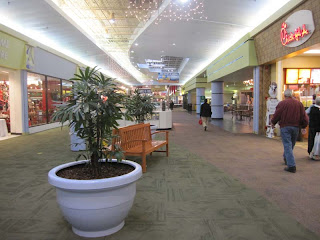
Here is a look at the north court.  Sears is to the left, the main mall is to the right and I am in the back right entrance corridor facing the front right entrance corridor.  Ruby Tuesday formerly operated in the background.  The first photo is a view along the main mall with Chick-Fil-A and the entrance to the built-in food court on the right just beyond it.  The direction of the photo is walking away from Belk to center court.


A look along the back right entrance corridor, which features a lot of wall with the sign of stores in the background.  The problem is that these aren't empty stores apparently.  It seems this was just a flaw in the design.


Facing the back right entrance.  I think that was the original movie theater on the left.

Gadsden Mall inside is a pretty basic design with a strange combination of some contemporary elements and some extremely vintage elements, but its interior design is far different from most malls these days.  In contrast with the drab white and tan scheme being applied to most malls, Gadsden Mall features a spacey violet blue and lime green throughout the mall oddly reminiscent of the late 70's when it was built to start with.  In the center of the mall is a large fountain, which was unfortunately covered in a Christmas display on my visit.  All the shops also have a fascinating angled overhang that slants toward the mall, and the skylights have been muted with a wavy pattern covering them up partially.


A view of center court facing the JCPenney wing (original main entrance).  Normally this is a fountain, but it was covered up for Christmas.


This less than ideal picture including the fountain was taken on May 3, 2008.  The slight difference in color is due to the fact I was using my older camera.


Another view along the main mall heading toward Belk this time.


 A look at the South court with the left front entrance court straight ahead and the back entrance behind me.  Belk operated there previously as Parisian, McRae's and Pizitz.  It was McRae's the longest.


A look along the left front entrance corridor walking away from Belk.

The main mall concourse is fairly healthy, though the fringes of the mall are definitely showing the effects of the economy.  The mall also features fairly strange long entrance corridors next to all four anchors with shops located only near the entrances with an otherwise big gap between them and the main mall.  This was not exactly the best planning, since these corridors did not integrate with the shops in the main mall.  Most of these have not done well, which gives these areas definite dead mall aspects.  At least one of those empty stores was an arcade, another an older theater and another a location of long-closed Morrison's Cafeteria.  All strangely had doors opening on the inside as well in lieu of the usual pull down metal grates today.  None of these shops remain operational along the back entrance corridors, though the ones facing the front of the mall were tenanted.  That is not exactly a surprise, either, since these backside stores faced nothing but Lake Henry and no department store exists on that side to lure shoppers.  Also, the food court seems to be rather anemic.  I'm not exactly sure why some food courts do well while others don't, but it seems food courts in small city malls definitely have a lot of trouble.  Of course, Chick-Fil-A proved a noteworthy exception as it remains faithful just outside of the food court.  Indeed, by 1974 they still had a ways to go before they mastered mall design for maximum sales per square foot but they were still more fun.


The Food Court, which at the time seemed to be struggling, a carousel attempts to draw children while the aroma of grease would draw the adults.  Since carousels were the rage in the 90's, I am guessing this came with the 1994 renovation and was likely a Woolworth's or McCrory's previously.

The anchor shifting over the decades has been highly confusing.  Belk has moved three times and JCPenney twice.  Only Sears has remained static.  The original anchors when the mall opened were Pizitz, Belk Hudson and Sears.  The Belk Hudson appeared to have the largest store, possibly two levels, but only one level was used if so.  The building still stands as the back anchor, and is now a theater.  Belk Hudson operated at the mall for around 20 years before closing the location in 1994, reopening in a new store in the front of the mall as just Belk across from the original Belk.  At that point, JCPenney took over the former location and operated there until it closed in 2000 due to a company restructuring.  In 2003, the former Belk Hudson/JCPenney was replaced with a stadium seating movie theater.


On the back of center court is the Premiere 16 Cinemas, which operated previously as JCPenney and Belk Hudson.


Across center court is this wing, which ends in JCPenney.  This was the original main entrance up to when Belk built in front of it in 1994 to replace its original Belk Hudson location in the back.


Another view of Belk, which made its third move to this spot.  If Sears wanted to trade, then they could warm their feet at every anchor spot in the mall.


Of course, Sears will have to die before they'll leave this spot.  In a town perfect for Sears, it has been holding firm here since 1974.

The Pizitz store (south anchor) had the most anchor changes.  It became McRae's in 1987 and remained so for years.  In 2006, Belk bought out McRae's.  The problem was, Belk was already at the mall.  As a result, Parisian replaced the former McRae's while the struggling Saks division was on its last legs.  Parisian was an odd fit for the mall, which was by no means upscale enough to support it, but this was a short-lived corporate move.  Belk soon abandoned its recently built location, moving into the former Parisian after buying it out and effectively taking control of both major department stores in Alabama.  The second Belk location did not remain empty long, though.  JCPenney wanted back into the mall, and they gutted the store for a brand new JCPenney.  This new one-level JCPenney features a very contemporary look inside and out, showcasing their new red logo and a radical departure from their often dingy looking stores in the past.  Its design is identical to the new free-standing store recently opened in Hiram, GA.  In all, this is an extremely confusing chain of events that took place, and I thank previous contributor Evans Criswell (The Mall) for clearing this up for me.


Entering the main mall from the north court with Sears behind me.


A happenin' spot in the mall with Gap on the right and Books-A-Millon on the left.  It looks like a wavy design was used to partly cover the industrial-style roof (or how was it originally?).


It doesn't look too complicated now, but this map in 1974 would completely disorient any potential shopper.

Aside from the department store musical chairs played to piped elevator music, Gadsden Mall has been renovated somewhat less than other malls.  Its last renovation came in 1994.  Malls like Gadsden Mall are in a precarious position today, but Gadsden Mall is better off than many like it in the state.  It is the right size for the market, its anchors are popular department stores and it is not situated too close to any other city.  It is also better off because Gadsden lacks many suitable building sites due to terrain, waterways and the odd configuration of the transportation infrastrucutre.  While there might be a better site for a mall land-wise, it would fail on other factors.  The mall, however, faces dangers related to the city itself.  The economy in the country is fragile enough right now, but the risk lies in the fact that Gadsden is an industrial town in an era when American industries have been closing and shipping overseas at a steady, even accelerated pace.  If for any reason, that plant closes it won't just be Gadsden Mall that suffers, but it will definitely be a casualty. I guess my point is that considering this mall was faring better in 2008, the economy in a relatively blue collar city is having an effect.


The front north entrance has a simple, but very contemporary touch.


But the rear south entrance is straight up 1974, I love it!  The window on the left was for the Morrison's Cafeteria, which was accessible just inside the door.

While I have painted a picture that seems less than rosy, I still want to point out that this is a successful mall with solid anchors and A-list tenants.  In fact, it has seen an enormous investment lately for a mall its size and age adding in a brand new JCPenney and Books-A-Million as two major anchor tenants.  How many other malls these days are getting new department stores?  In all, I think the food court is probably the biggest problem it faces, which seems to have seen its better days.  I still find that odd, though, considering that a trip on any given day to the mall greets you with a full parking lot, and the mall is not to any knowledge on any dead mall lists.  In fact, when I visited on a random Saturday in spring 2008 it was swamped.


The only thing that is not 1974 in this photo is the Sears logo.  Too bad they changed it.  The strange stone they used on the gray part of the exterior made the store look even older.  A plaque denoting opening day is found on the front.


From this angle, you would think the mall was new with JCPenney and Books-A-Million sporting their latest looks.


Belk has been considerably modernized on the outside, though it is not known which store did that.  It still has similarities to the original Pizitz, though.


While this loud theater entrance is the first thing you notice, this is the same building that Belk Hudson and JCPenney used.  You can faintly make out a Belk Hudson labelscar on the upper left.


Sears also has an auto center off-mall.  Since the 70's, most Sears Auto Centers are built into the store itself in lieu of an outlot.

For me, while it is a simple mall I am charmed by the vintage trappings including the big modern fountain, moody colors and left-over architectural styles from the era it was built.  While not particularly special, it is a mall that makes me feel nostalgic for those like it in my youth such as long-demolished Riverbend Mall in Rome, GA.  It also helps, too, that Gadsden as a city is noticeably more modest in its retail offerings placing more emphasis on the mall.  In an era where 25 year old malls are treated as dinosaurs, this 36 year-old mall serves its purpose well, and it also continues to provide one badly needed climate controlled escape from the Alabama humidity which tends to be severe in the Coosa Valley.


A mall panorama from JCPenney to Sears on the front.


A stucco clad sign is found on the road, replacing the much more distinct tuning fork used for the original mall logo.

More Gadsden Mall images, ads and drawings coming from opening day are coming on the next post!

Wednesday, February 3, 2010

Hillcrest Shopping Center/Hillcrest Mall: Spartanburg, SC

An accurate description of Hillcrest Mall is that it is a mall that never should have been built. What details exist of this mall online up to now are quite inaccurate, but looking through old newspaper articles should clear up the confusion. Basically, Hillcrest Mall started out as Hillcrest Shopping Center, which opened as strip mall in 1956 anchored by a mere three tenants: Community Cash, Smith-Ouzts Drugs and Hall Hardware. It was just an early strip mall with no department stores and not even a grocery store, but it continued to expand over the next decade. It has always been very successful as a strip mall as well, but its later mall expansion could hardly share that claim of success. With that, Hillcrest was definitely not the first mall in Spartanburg, but it definitely was the first strip shopping center.


Aerial shot of original Hillcrest Shopping Center in Spartanburg after a new expansion in 1964.

The first change at Hillcrest Shopping Center came in 1964. This was when a new A&P Grocery store was added to the strip as well as a Lambert's variety store. Other tenants in the 1964 shopping center included Amelia Anne Gifts, Hillcrest Styling Salon, The Cobbler Shop, Crestmont Restaurant, Smith-Ouzts Drugs, The Carousel Shop, Hillcrest Coin-Operated Laundry, Wallace Hunt Furniture, Jennings Shoes, the Barn, Friendship Room (group meeting place), Hlllcrest Barber Shop, Cambridge House, The Pastry Shop, Ellis Clothes of Distinction and Community Cash. Community Cash and Smith-Ouzts Drugs remained through the expansion. A couple other listed tenants were part of the new expansion. The biggest change to date, however, came in 1965. This is when a new Belk Hudson opened at the center, bringing a legitimate department store to the shopping center nearly 10 years after its construction. This store was added onto the north end of the strip, which created the first suburban location for Belk Hudson in the city.


Belk Hudson at Hillcrest Shopping Center prior to opening in 1965.  This was the only department store found in the original strip center, located on the end of the shopping center.  It was built after the last photo, but it would be located at the top if so.

South Carolina as a whole was slow to catch on to the mall craze. Richland in Columbia was probably the very first mall, but it was not until 1968 that Greenville opened the state's very first enclosed mall with McAlister Square.  While most cities of any size had a mall by 1965, Spartanburg had no mall even though I-85 was already built in the city. In fact, no mall of any kind existed in the city until 1975 when Westgate opened. Westgate featuring another Belk Hudson and Meyers-Arnold, which was based downtown. Although the two Belk stores overlapped, the two shopping centers co-existed peacefully. One was a mall, and the other was just a regular strip shopping center. Basically, you would buy groceries at Hillcrest and do your big shopping at Westgate, right? Wrong.

Jim Wilson & Associates, who had previously built many smaller malls including Jessamine Mall in Sumter, changed the plan for Hillcrest in the early 80's. Apparently Ivey's was looking for a store in the city, and Belk Hudson obviously needed a boost at the center. This was not a traditional mall in any sense. Instead, it was a mall appendage onto the existing shopping center. This new mall would be built leaving all of the existing shopping center in place, renovating the Belk Hudson and giving Ivey's a mall to be attached to in lieu of simply opening a store at Westgate Mall.


Ivey's under construction at Hillcrest in 1982.

Astoundingly, the major reason that Jim Wilson gave for building a mall on the undeveloped part of the site was that his daughter was in college in the area and "[He] was looking for a reason to come up and see her more often." [1] Huh? I understood he missed his daughter, but couldn't he have just built a Richway there or something? Unfortunately, this kind of logic applied often in ill-fated, poorly researched mall projects in the 70's, 80's and early 90's, which is the biggest catalyst behind the dead mall phenomenon today.  Market research and careful planning are incorporated much more in large scale retail projects today even though some still charge ahead without any thought.

Opening day comes on August 12, 1982. Dignitaries arrive to celebrate a mall that has a mere 110,000 square feet with 29 stores. If this had been built in 1965, it would have been worthy of a governor's visit, but why build this in 1982 when there is already another mall? Ivey's opened with 60,000 square feet of space to add to the mall, and the existing Belk brought the entire mall portion to little over 200,000 square feet. The mall was also built with the idea of expansion to a third anchor, which was promised but never materialized. The rest of the older strip shopping center was unaffected by the new mall except maybe in increased business. The mall itself was single level with breaks built in to deal with the sloping terrain it was built on. Inside were typical early 80's trappings such as planters and earthtones, though the mall did have skylights.


Ribbon cutting at Hillcrest Mall in 1982.  This is apparently center court, though it is difficult to tell.

Tenants in the new mall were not exactly those desired in a first-tier shopping mall. While chains such as Casual Corner, Waldenbooks, Hallmark, Radio Shack, GNC, Morrison's Cafeteria and Baskin Robbins were found in the new mall, most tenants when the mall opened were small locally-operated tenants. These "specialty shops" filled a mall when they were new, but they meant that the mall was a flop from the start. Unfortunately, the retail graveyard is full of small niche malls, and Ivey's here was definitely the niche that held it together.


Hillcrest Mall logo with part of the grand opening advertisement.  The logo seems strangely 90's, actually.

Now, fast forward to 1992. Owners already admit the mall is having vacancy problems, and less than 65 percent of the mall is leased even with anchors Belk and Dillard's. Dillard's has since replaced Ivey's, which was bought out in 1990. The buyout made people in the city very nervous noting that Dillard's was not exactly pleased with a smaller than usual store in a less than conventional mall in a new market, and Westgate was courting stores like Dillard's in a planned expansion. Even worse, the undersized mall in a less than ideal location was bleeding tenants. Chains stores in the mall were bailing out, while existing tenants were mad and the owners worried. [2]


Ivey's ad published after opening day.

In April 1995, the mall owners' worst fears were realized. Dillard's announced they were constructing a new store at Westgate Mall in an expansion, subsequently closing the Hillcrest store. After the new store was completed, Dillard's closed at Hillcrest in February 1997. At that point, all hope was lost for the long-struggling mall. Westgate was not doing this, though, just to do Hillcrest in. It was about survival. Rouse Company threatened Westgate's own well-being by planning its own huge regional mall anchored by White's, Dillard's and they were in talks with Rich's as well: long a coveted anchor in the city. Westgate's expansion was done to make sure that would not happen, but Hillcrest had to pay the price. [3] After Dillard's closed, the reason for the mall existing was over. Belk was cannibalizing its own sales operating stores at both malls, and in December 1997 Belk closed its older location at the mall after 32 years of operation.


Aerial shot of Hillcrest Mall on opening day.  This was the busiest the mall parking lot would likely ever be.  The new Ivey's store is in the foreground while the old strip mall is in the background on the other side of Belk Hudson.  This is all looking southwest.  The mall lasted a mere 16 years.

When Hillcrest failed, the owners wasted no time demolishing the mall. In June 1998, the last two tenants were kicked out and the mall closed. Demolition began on the mall in late summer 1998 and was completed late in the fall that year. In lieu of a mall, a new Super Kmart, Publix, movie theater and Stein Mart was constructed on the site. Hillcrest Mall lasted a mere 16 years, while Hillcrest Shopping Center was over 40 years old. Instead of a mall, Kmart should have been built there to start with.

Today, Hillcrest Shopping Center is a center full of big box tenants. While the offerings are more of the national chain variety, it has never faded. Kmart eventually closed, but the store was subdivided into Petco, Office Depot and Ross Dress For Less. However, Publix and Stein Mart continue to operate at the redeveloped center. Publix sits today where Belk Hudson was previously. The old A&P has also since been subdivided into smaller spaces. While the original strip is definitely showing some vacancies, it is doing very well considering it is Spartanburg's oldest shopping center.  Hillcrest indeed came full circle after 54 years, and it has withstood the test of time and a peculiar mall addition that proved not to be a wise move.  The stores are different, the look is different but Hillcrest is still there.

[1] Atkins, Nancy.  "Mall Opened Thursday, Two Months Ahead of Schedule." Spartanburg Herald-Journal.  13 Aug 1982. pg. B1
[2] Jean, Sheryl. "Hillcrest owners determined to survive". Spartanburg Herald-Journal. 11 Aug 1992. pg. B3
[3] Nelson, Kathy. "Dillard's to close its store at Hillcrest". Spartanburgh Herald-Journal. 13 Apr 1995. pg. A1