Showing posts with label Phar-Mor. Show all posts

Thursday, July 21, 2011

Rock Hill Galleria: Rock Hill, SC

Last year, I covered a mall known as Houston County Galleria.  The Houston Galleria is a struggling mall with otherwise solid anchor tenants that effectively trashed a nearby successful mall overnight while never actually truly succeeding in its own right.  The mall was also built by Zamias Enterprises with a rather lackluster track record of success in their 90's mall portfolio.  The story is similar with Rock Hill Galleria, but the situation is a little different. The anchor lineup, for one, has been a bit more volatile and Rock Hill Galleria, while troubled, is definitely more successful.  As a sister mall to the Houston County mall, however, it is interesting to note the similarities and differences, and it is also important to note the retail scene around it, which is quite different, as well as a better location (conveniently right off I-77).


Rock Hill Galleria arrived on the scene in 1991 featuring an eclectic anchor tenant line-up of Belk, JCPenney, Phar-Mor, Sears and Wal-Mart.  Of all the original anchors, only Phar-Mor is not in the mall anymore so on the surface it appears this would be a very successful mall much in the case of my previous example.  The problems are two-fold: management problems and a location that was placed too close to superior competition.  Also built by Zamias, the mall completely killed the city's older mall known as Rock Hill Mall by taking all of its anchors: Belk, Sears and JCPenney.  Labelscar covered this mall through a local contributor.  Unlike in the case in Houston County, GA, though, the older mall did not survive re-purposed like Houston Mall did...it died completely in 1992 and was abandoned in the late 90's.  By 2007, that mall was demolished for a lifestyle center-type development that has also struggled to attract tenants.
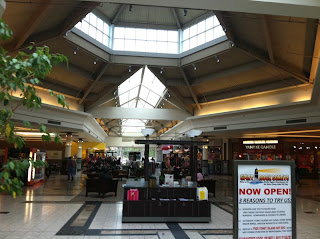
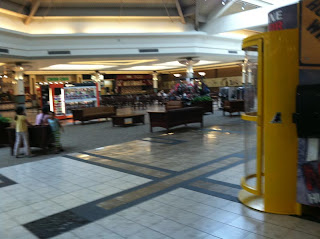
The lead-in and this photo show that an elaborate ceiling treatment can go a long way to create an attractive ambience in a mall.  I have nothing to complain about here except the lack of an indoor jungle below to compliment it.  Photos by Dustin Ransdell taken June 15, 2011.
Miscellaneous details including pretty nice flooring.  By the 90's, malls had come a long way from the standard concrete flooring of the 60's.  Photo by Dustin Ransdell taken June 15, 2011.

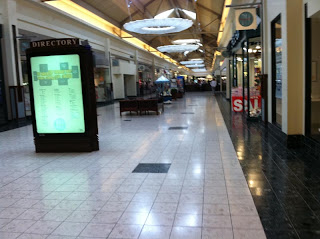
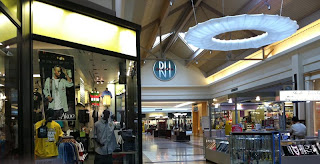
Of course, some of the architecture is a bit dubious.  Apparently the architect was enjoying some peppermint Life Savers when he was somehow inspired to hang these ring-shaped light fixture thingies from the ceiling.  Photo by Dustin Ransdell taken June 15, 2011.

Life Saver row could use some planters, though...it still looks a little cold.  I'm sure they were saving that space for kiosks that never came.  Instead of the Dead Sea (lotion) how about the Indoor Sea (water feature)?  Photo by Dustin Ransdell taken June 15, 2011.

One thing I can say for Zamias-built malls: they are neither ugly nor overly cheap looking.  They are very tasteful, but just seemed to falter on management, location and even size.  Note that these are all one-level malls built too close to larger two-level malls.  In the former case, it was now-struggling Macon Mall and in the latter case it is Carolina Place Mall.  Nearly every mall Zamias built was plagued with problems before they were even opened, and apparently construction was also delayed on the previous Zamias mall I covered.  These malls also were very anchor-heavy right as department stores were in consolidation and the mall craze was winding down, so timing worked against them as well.  The fact they killed older, more established malls also did not help their public reputation, similar to what happened with Crown America (Hess's)-owned malls.

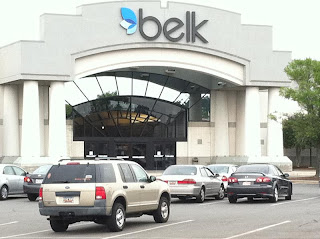
Of course, being so close to Charlotte, Belk is a standard feature.  That's Belk Belk, too.  Photo by Dustin Ransdell taken June 15, 2011.

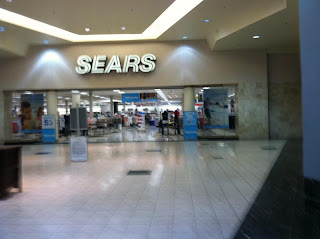
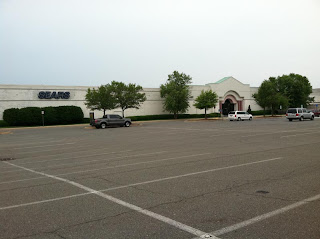
I wonder what will happen to this Sears if the chain goes belly up.  Sharing a mall with Wal-Mart, this location is bound to be struggling.  Photo by Dustin Ransdell taken June 15, 2011.

Looking down the JCPenney wing toward JCPenney.  Photo by Dustin Ransdell taken June 15, 2011.

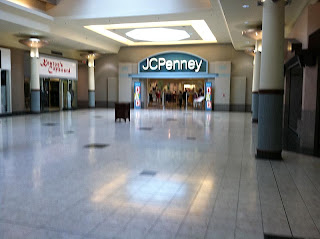
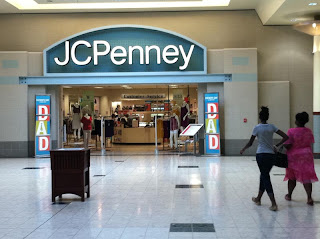
This JCPenney entrance is so 90's I feel like I'm 14 years old again in a flannel shirt and bowl cut with some STP song stuck in my head looking at it.  Photo by Dustin Ransdell taken June 15, 2011.
While the story of Rock Hill Mall is long passed, the story of Rock Hill Galleria continues on.  In all, it is a reasonably attractive mall, though somewhat less interesting architecturally than its Georgia cousin.  At one level, the mall also has a tough time competing with very popular Carolina Place Mall further north: a two level mall that continues to be one of Charlotte's premier shopping malls only 15 miles away.  The distance is far enough to keep the mall viable but close enough for frustrated shoppers to take the longer drive for better stores.  This might explain why the mall keeps Belk, Sears and JCPenney along with a few popular chain stores while still being riddled with vacancies.

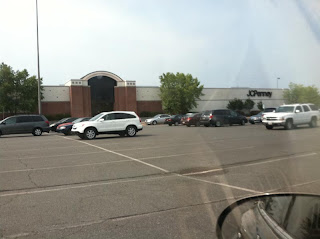
Once upon a time, Wal-Mart actually opened into this mall.  Then they built a Supercenter and shut themselves off from the mall.  None of the other discount stores ever acted this way...in fact, they embraced the mall as an extension of their business!!  Photo by Dustin Ransdell taken June 15, 2011.

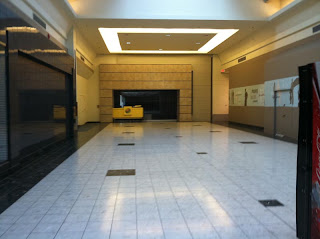
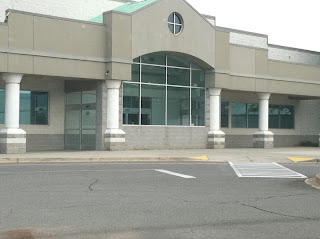
Pharmor is phar gone here in this pic, though it did manage to revive as the ill-fated Steve & Barry's University Sportswear up to 2009.  Was Drug Emporium ever here?  They took over many of the Pharmor locations.  Photo by Dustin Ransdell taken June 15, 2011.

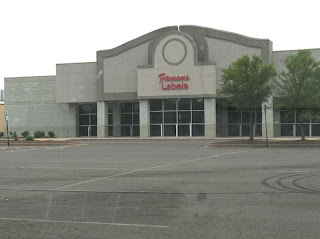
I guess "Famous Labels" did not successfully hide that they were really "Knockoffs 'R' Us".  In all seriousness, this was obviously a weak attempt to fill the void left by Goody's, which also departed in 2009 after arriving in 1998.  Photo by Dustin Ransdell taken June 15, 2011.


This image shows a relatively healthy part of the mall with Rock Hill Mall's logo in the background.  Photo by Dustin Ransdell taken June 15, 2011.

Aside from the three major department stores, the other anchors have been more volatile.  Phar-Mor, for one, failed as a chain in 1992.  It was briefly filled by Brendle's Catalog Showroom in 1995-1996, but otherwise was empty until it was finally filled in 2003 by Steve & Barry's University Sportswear, but this chain itself proved to be a dead mall filler and shoppers apparently concurred as the chain folded in 2008.  Goody's came later, adding onto the mall in 1998 but also closing in 2009 with "Famous Labels" briefly taking the space before tanking as well.  Lastly, Wal-Mart amazingly did not leave the mall, actually upgrading their store at the mall into a Supercenter in 2000.  Nevertheless, Wal-Mart has consistently proven a poor mall anchor and the other anchors clearly did not benefit from the mall nor add anything to it.  Such junior anchors today would need to be filled by stores like Best Buy and Dick's Sporting Goods to actually compliment the mall. 
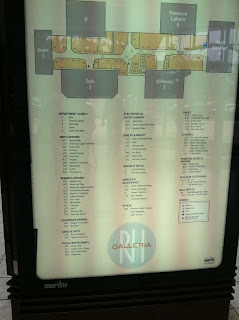
Sorry, the GPS won't help you here.  If you end up falling in the dumpster next to the loading dock on your way from Belk to Sears, it's not our problem.  Photo by Dustin Ransdell taken June 15, 2011. 


Belk's look is more dazzling than the simple arches but a little weird.  Photo by Dustin Ransdell taken June 15, 2011.

Sears here looks about like all the others built in that time period.  Photo by Dustin Ransdell taken June 15, 2011.

I kinda dig this JCPenney entrance here...it reminds me a bit of a throne.  Photo by Dustin Ransdell taken June 15, 2011.


Rock Hill Galleria is the typical example of a 90's mall born with bad karma.  The mall was clearly built with the intent on "upgrading" the shopping experience.  "Upgrading" basically meant that they fully intended to kill that dated, smaller, darker mall on the other side of town, thus destroying viable real-estate that was realistically more right-sized for the market.  However, Rock Hill Mall was facing death anyway: the mall would have had significant trouble competing with Carolina Place, but the double trouble that came from two brand new malls was far more than the 1960's timepiece could endure. Rock Hill Galleria has endured more due to the growth in the area, but it still continues to struggle.  Rock Hill Galleria also saw some change in ownership since it was built.  Zamias finally gave up the mall in 2004, selling it to General Growth Properties.  However, General Growth apparently did not see the mall as enough of an asset to keep, selling it again to Cypress Equities a few months later.  Cypress still owns the mall, but has Jones Lang LaSalle manage the mall.
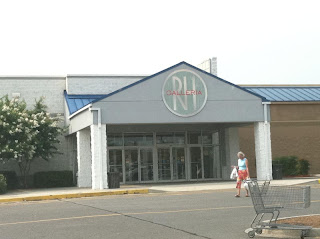
From this end, I am not impressed.  I am assuming this is close to the Wal-Mart non-mall entrance.  Photo by Dustin Ransdell taken June 15, 2011.

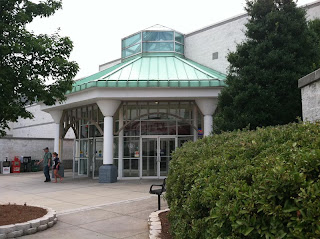
This I really do like.  I am guessing this opens to the wing with the tragic food court that is so pathetic even Subway snubbed it.  Photo by Dustin Ransdell taken June 15, 2011.

Nothing more at Pharmor.  If Steve & Barry couldn't pull it off, would Dick be interested?  Photo by Dustin Ransdell taken June 15, 2011.

Missing labels at Famous Labels, originally Goody's, which closed in 2009.  I could see at least a Books-A-Million here, but Shoe Show is more likely (boring).  Photo by Dustin Ransdell taken June 15, 2011.

The future of Rock Hill Galleria is tough to predict.  Without any big name players interested in the mall such as Simon, it will definitely have more trouble attracting big name tenants, but its strength is in its current department store anchors and market, which is still growing even during a recession.  In order for the mall to catch up to its competition in Pineville, the mall will need to broaden and upscale its offerings, which will be hard to do with a one-level mall competing with a two level mall while also considerably further from Uptown Charlotte.


While I do not put this mall on a death watch at this point, I will definitely say that further growth in the area is needed to make it competitive.  I will also say that the mall needs to find anchors and tenants that make shoppers see the mall as an alternative to Carolina Place.  Basically, the mall should be good enough they will not need to drive out out of their way to shop at the other mall all the time.  The ways I see this is possible is to bring in another department store such as Dillard's or Macy's (most likely in the place of Sears eventually), expand the mall, renovate the mall to make it extra showy and bringing in big box anchors such as the fore-mentioned Dicks's Sporting Goods, Best Buy, Petsmart, Barnes & Noble and Target.  Wal-Mart is also not likely helping the mall and could possibly be encouraged to relocate, freeing the space for anchors like the ones i mentioned.  What the mall may not bring in with higher end merchandise it can make up with diverse, fun store offerings to provide a more all-in-one experience.  This will help to fill in the dark stores within and make it more competitive.  As for right now, Rock Hill Galleria is still a moderately successful mall, but it will have to strive to better market itself if there is ever any hope the public will view it as a true shopping destination.

Saturday, July 1, 2006

North Dekalb Mall: Decatur, GA

It is always interesting when a long-outmoded mall somehow survives over 50 years showing that the local community loved it as long as it could. North DeKalb Center, as it was originally known, opened in July 1965 as Atlanta's first enclosed mall followed very shortly by Columbia Mall on Memorial Drive to the south. As a mall that once advertised its year-round perfect weather, it indeed weathered many new malls opening while even outlasting malls of similar vintage like Columbia and Cobb Center. In 2024, the end arrived as demolition began of what was left of the interior mall that itself was closed in 2020. 

The original configuration of the mall was an H-shaped center with Rich's on the east end and three anchors on the west end: a Storey theater on the south, Woolworth's in the middle facing the main mall corridor, and Colonial Stores on the north end. Inline junior anchors included high-end Regenstein's department store (their only mall-based location) and Henderson Furniture (which also had a location at Town & Country Shopping Center in Marietta). I was unable to determine exactly where these two stores were located in the mall, but I am assuming at least one was adjacent to Rich's on the south side due to the building jutting out more compared to the rest of the stores along the south block. The land for the mall was originally purchased by Rich's earlier in the 1960's, and the mall was developed by D. Scott Hudgins who was famous for developing many of Atlanta's major malls.

Its early years were successful serving the growing suburbs from Decatur northward, but it quickly lost its regional status when other bigger, better malls were built in the region including direct competition from Northlake Mall, completed in 1971. Historicaerials.com has a photo of the mall in its original configuration. Architectural drawings and outside aerial photos show that the mall had about three court areas with arched high window skylights and smaller overhead skylights with the court in front of Rich's reaching two stories high to allow patrons of the Magnolia Room to overlook the east mall court from the second floor. A similar design was employed at Greenbriar Mall, which opened one year after North DeKalb.


The first and second photos both are of the east court, featuring this big clock. The corridor to the left (original mall) in the first photo heads to the Macy's (former Rich's). In the second photo, Macy's is to the right. The second photo is one of the two Ross mall entrances.

What was remarkable is that North DeKalb lasted as long as it did, but Hudgins still owned the mall in the 1980's and wasn't content to let it die. With its then very dated design (because back then 20 years might as well have been 100), small size, and maintenance issues plaguing the center, Hudgins partnered with Cadillac Fairview to restructure the entire mall with both a new design and new layout to better compete with what was by then four other malls within a relatively short distance. The update also would add 200,000 square feet increasing it from just under 450,000 square feet to just over 650,000 square feet. Although I cannot confirm when they left, it appears that Colonial Stores (by then Big Star) and Regenstein's both left sometime in the early 80's with Regenstein's still there as late as 1981 [1]. Woolworth would close for the redevelopment, but it did not appear that they chose to reopen after initially claims that they would [2]. However, it cannot be discounted that having Rich's as the primary anchor when the nearest competitor did not have one really made a difference: Northlake had Sears, JCPenney, and Davison's...but not Rich's. If not for Rich's continued success, North DeKalb would likely have been demolished and redeveloped by the late 1980's or early 1990's most likely into a strip center. In fact, Cadillac Fairview officials were quoted as saying that the success of Rich's was the primary reason they worked to save the ailing mall [3].


First photo is looking back down the main corridor to the Macy's mall entrance (Rich's mall entrance shown below). Second photo is looking out on the longest (east) wing with Macy's behind me. Last photo is of the mall corridor extending from the east court to south court.

In 1986, the renovations and reconfiguration of North DeKalb Mall were completed with the mall renamed "Market Square at North DeKalb". This renovation reconfigured the H design into T-shape with a central diamond where the mall could maximize space, fit in a food court inside part of the diamond, and add anchors all largely within the existing footprint. Shoppers who originally could walk straight from Rich's to Woolworth would then have to navigate around angular corridors to do so. The renovation brought with it new anchors that were also new to the market as well: Mervyn's, and Lechmere. At the time both Mervyn's and Lechmere were divisions of Dayton-Hudson with one being a clothing store similar to JCPenney while Lechmere focused largely on electronics and sporting goods. As Dayton-Hudson began its evolution into Target, it would shed stores like Mervyn's and Lechmere in the process resulting in these stores eventually fading away. Eventually Burlington Coat Factory would replace Mervyn's after they left the market in 1996 while Rhodes Furniture would replace Phar-Mor that itself had replaced Lechmere. The mall's original cinema was also replaced with a 16 screen AMC theater. Ross and Stein Mart would also take up inline space by the 2000's. The timing of the mall's update was critical considering that the nearest Rich's at Belvedere Plaza, the only location not in an enclosed mall, closed in January 1986. Had the mall not gotten the huge boost it did, Rich's might have relocated that store to another mall - most likely Northlake.

It should be pointed out that the update of North Dekalb Center into "Market Square" followed a typical pattern of older first-generation malls in the late 1980's that were taking drastic measures to survive with limited options due to lack of available land to expand and locations that had become less ideal due to since-completed interstates removing traffic from them. This was less of an issue for this mall given that US 78 remained a major through route and that the Stone Mountain Freeway was later extended to end right at the mall giving it easy access to I-285, Atlanta's beltway that would be completed a few years after the mall opened. As to these early mall redevelopments, they would frequently accept anchors that were unknown to the market, were less popular, or were not traditional (such as big box stores), would massively renovate the interior (or enclose a strip or open-air mall), and often would change the name to attempt to shed any negative perceptions of the mall. Cobb Center had a similar makeover/renaming in 1987. The updates almost always added more light to the mall by putting in larger skylights, adopting brighter, softer materials and colors, and in some cases adding neon lighting as well. 


Saved 2009 directory from the mall's now defunct website showing the odd configuration of the mall.  It was this design that made me really want to see this mall for myself considering that I had never seen it prior to 2004.

By then, malls were beginning to saturate their markets, and the older malls really were not positioned to survive against demographic shifts, new mega malls, massive bankruptcies and consolidation in the department store industry, and increased competition from off-mall category killers that did not exist when the malls first opened. These older malls also lacked the land to build larger malls without great expense, and it would take the attracting of upscale stores to justify that cost. North DeKalb did well to attract Mervyn's and Lechmere, but these were both stores that did not need malls as much as the malls needed them. By the 1980's, the most popular malls were anchored by established chains or higher end stores, and these older malls usually only had one or two stores like that, in this case Rich's. Although the mall never regained its destination status, the change did buy the mall over 30 more years! That's not bad considering that North DeKalb 2.0 outlasted 1.0 by more than a decade.


Photos include view of south court, view looking down the southeast wing and view looking down the south wing. The southeast wing is really strange: it is part of the mall itself but also a store. While it has a pseudo entrance, the walkway through it is mall while the stuff on each sides is the store. This was a Rhodes Furniture when I visited in 2004. Today it is a local furniture store. The south wing (last photo) is the wing to AMC Theaters that originally opened as a Lechmere.

In the early 2000's, "Market Square" was quietly renamed back to North DeKalb Mall. By the middle of the decade, North DeKalb was also becoming very troubled. It's once exciting roster of new anchors was constantly being shaken up by bankruptcies/liquidations such as Lechmere in 1989, Mervyn's in 1995, and Rhodes Furniture in 2005. With time, the mall was looking more and more like a regular strip center with an enclosed walkway, and small tenants were fading away while its anchors began exploring their nearby options as well. It also didn't help when Rich's merged companies with Macy's in 1995 then consolidated the two stores into one 2005. The Macy's (former Rich's) at the mall was then in direct competition with the Macy's (former Davison's) at Northlake resulting in both stores cannibalizing each other for sales weakening both malls further. The construction of the Mall at Stonecrest in 2001 also took shoppers away leaving both malls to very slowly die. A plan by Hendon Properties in the early 2000's involved adding a Costco as an anchor to the mall with a parking deck, but that fell through after nearby neighborhoods fought the plan over flooding concerns. Eventually, Hendon would give up on the mall and sell the property.


The Food Court makes up the west court of the mall. The first photo is approaching it from the side and the second features the huge domed skylight over the main seating area. The last is looking back from the food court to the west (rear) entrance. Note the Applebee's on the left. This is approximately where the original Woolworth's was located.

It was fairly obvious when I first documented this mall as early as 2005 that it was terminal. What I did not know is how long it would take. It wasn't until 2016 that (the rather run down) Macy's finally closed their store, but that legacy Rich's was a keystone to the mall. Hollywood would use the mall as a filming location during that time for dystopian flicks, but Hollywood could not revive the ailing center which would finally close in 2020. However, that closure should not be seen as completely sad given that the mall managed a very long life for a second-tier center. It lasted 55 years when in its early configuration it might not have even lasted 30 years. My own system of mall success has tiers, and a "50-year mall" is generally a huge success while a "30-year mall" is a mall that never quite caught on. North DeKalb found its niche, and it worked for a long, long time.

The redevelopment plan will be yet another mixed-use urban village, and rest assured it will be as inspiring as a box of store-brand corn flakes. Unfortunately, times have changed in ways that are pretty miserable, and an expansive B-mall catering to a broad middle class living in single family homes with disposable income has been edged out of the modern paradigm consumed by corporatism and its associated depressed wages and sky-high living costs. Nearly every facet of the mall had become outdated and outmoded as decades passed, and the land it was sitting on likewise became way more valuable than the mall itself. While I'm pretty sure the new development will do fine, this full circle back to the bad old days of overcrowded, overpriced urban living vs. the expansive suburbs with nice malls full of nice stores is why so many felt their eyes tear up as the wrecking ball tore into this tarnished palace of retail. 


First photo is view of the north court followed by photos of the north wing to Burlington Coat Factory (former Mervyn's) and northeast wing to parking lot (Ross comes off of this wing as well).


This photo is looking from east court (at the clock) to north court.

And now for a look back in time to late 2004 and early 2005 at Rich's just prior to the changeover:


Rich's mall entrance prior to the changeover.


Two views of the south entrance to Rich's. This was the best preserved part of the original facade. Note the letters mounted on poles!


Rich's north entrance falls short of original, but luckily the green signs were retained in the 1986 renovation. Note that the display windows next to the door were covered up as well as the original arched awning. That is still visible underneath the ugly stucco cover.


The east side features two entrances. The one-story wing entrance was completely original. The second photo focuses more on it.


The last daytime shot of Rich's focuses on the auto center. It, too, was completely original from 1965.

Now for some night shots:


Rich's southeast entrance at night. Note the lightbulbs under the arch.


Rich's east entrance at night. The lower sign is in better shape because it is newer: note the forementioned stucco awning.


One more look at the south entrance: this time at night. This is my favorite angle of the store. The Macy's sign that is here now is in a big white box in lieu of these poles.

* Original post dated July 2, 2006, updates on January 6-7, 2025*

[1] The Atlanta Journal; Sunday, April 26, 1981, Page 104
[2] The Atlanta Journal; Friday, December 27, 1985, Page 9
[3] The Atlanta Journal; Thursday, September 11, 1986, Page 155