Showing posts with label Colonial Stores. Show all posts

Saturday, December 23, 2017

Kinston Plaza: Kinston, NC

The year before Kinston gained its first enclosed mall, Kinston was already enjoying the fruits of what was then a thriving local economy gaining its first modern shopping center with the construction of Kinston Plaza.  While small by today's standards, the center is actually a combination of strip and covered arcade that is one of the largest and most vintage arcades I have run across that is still operational.  While very local in nature today, the center once had a larger draw.


Built in 1966, Kinston Plaza was anchored by Woolco, Colonial Stores and A&P.  The arcade portion may have not been original to the center, instead added around 1970 considering that the now-closed theater that anchors the back of the arcade was opened in 1970.  The theater, named Trans-Lux Inflight Cinema, was renamed Plaza Theater in 1974, twinned in the early 80's and operated at the center until it closed for good in 2000 when a seven screen theater nearby replaced the two screen cinema.  However, the center was already in decline long before the theaters closed.


Kinston Plaza's arcade is one of the best preserved mid-century specimens featuring a mix of regionally-popular faux Colonial and 60's modern design.  While covered, the center is completely open-air making the arcade function like a cave.  The far end of the mall is now a long-closed theater.  Photos taken June 15, 2015.


Theater entrance with skylight providing eerie natural light overhead.  Photo taken June 15, 2015.


Detail of skylights, which were clearly designed with a cloudy look and obviously need some debris cleaned off.  Photo taken June 15, 2015.


Detail of storefronts in the mall, now exclusively service-type tenants.  Photo taken June 15, 2015.

It is obvious to note that none of the original anchor tenants are still in business today, so quite a few changes occurred with the anchors.  The first of those was when Colonial Stores became Big Star in 1978.  Big Star, of course, later closed after stores in the market were sold to Harris Teeter in 1988.  Second was when Woolco went out of business in 1982.  At the time, the shopping center was doing well enough and it was quickly filled by Brendle's Catalog Showroom.  By 1992, both supermarkets had left after A&P exited the market as the company continued to decline.  Brendle's itself would end operations in 1996 joining every other catalog merchant in the dustbin of history.  With the theater already closed, the shopping center probably looked nearly abandoned before 2000, but smaller chains came into fill the void and it recovered.


Leaving the mall, it is like twilight before the dawn, but about 40 years ago.  Photo taken June 15, 2015.


While ownership may have changed, this barber shop/salon is likely the oldest continuously-operating tenant in the shopping center.  Many shopping center barber shops remain mostly unchanged from 50 years ago.  Photo taken June 15, 2015.


Hollow store at corner of mall and parking lot.  Photo taken June 15, 2015.


The exterior mall entrance has, unfortunately, been updated into this deceptively boring stucco facade hiding the vintage goodness within.  Photo taken June 15, 2015.


Piggly Wiggly today occupies what was originally a Woolco.  Photo taken June 15, 2015.


This sign for the shopping center along an adjacent street is likely (almost) original considering the arrow likely replaced an older arrow with flashing lights.  Photo taken June 15, 2015.

Today, the center is alive and (mostly) well again catering to wider tastes and demographics than the original shopping center.  Major tenants include Piggly Wiggly in the old Woolco space, Big Lots in the old Colonial/Big Star and It's Fashion Metro in the old Eckerds space.  A hair salon and dance studio still operate in the "mini mall" space (what the shopping center calls it!), and the former A&P is now a furniture store.  In a town with many vacant retail centers and a mall on its last legs, Kinston Plaza remains a bright spot in the city.

Sunday, November 4, 2012

Patrick-Henry Mall: Martinsville, VA

The retail news today continues to report the trend towards "open-air malls" from the enclosed malls of yore. The truth is the open-air mall was the earliest incarnation of a mall in most cities across America, but for some reason the new open-air trend seems to have forgotten that an open-air mall is a pedestrian-only facility with covered walkways designed to protect you from the elements where you do not have to dodge cars to shop at each store. This is unfortunate as a few of these classic open-air centers are still hanging on across the country including this tiny gem in Blue Ridge foothills of Virginia.


Patrick-Henry Mall is hyphened, because the name actually refers to the two counties that border each other: Patrick and Henry. The mall itself, however, is actually in Henry County. The name of not only the mall, but also the counties is also obviously a nod to the early American revolutionary of the same name. For quite some time, this mall has captivated my attention because of its striking mid-century design that has endured well past its useful life. Indeed, if the mall had ever actually been enclosed and expanded it would have likely died much sooner, most likely either knocked down or re-purposed by the late 1990's. This is especially true as the mall itself sits in an older part of the city near downtown on the east side. The road it is on is also no longer a major route since the highways were relocated around the city.


Day and night shots of JCPenney, now a classy "Mix Bag".  You can also find some "famous brands" if you look really, really hard.  Photos by digitalsky.  First shot shows the open-air mall corridor with detail of overhead canopy. 


Mix Bag, formerly Penney's, does not keep its mall entrance open.  However, the ghost of Penney's remains on the building proving that the logo was never updated.  Photo by digitalsky


Penney's former mall entrance complete with moldy hole in the overhead tiles.  Note the tiles below as well.  This is retro goodness at its finest.  Photo by digitalsky


More detail of the Penney's labelscar and mall entrance.  Photos by digitalsky

The livelihood of Martinsville was similar to cities across the state line in the piedmont region of North Carolina in that furniture manufacturing was its bread and butter. Clearly, furniture manufacturing peaked when the mall opened in 1965 bringing to the city one of the earliest malls in the region. The crown jewel, of course, was the JCPenney store, which at that time was a mass merchant of both soft and hard-lines competing with Sears and Montgomery Ward. The mall also had a Rose's, People's Drugs and Colonial Stores as its original anchor tenants. Leggett and Sears, however, remained downtown.


Inside Mix Bag.  The store still has the same brown carpet it did as JCPenney.


Old sign for the mall somewhere in the middle of the mall.  Photo by digitalsky

  
 Side view of the former Rose's, which later operated as Watson's Backroom before closing over 20 years ago.  I am waiting for Qbert to start hopping up those stepped tiles, but I think the game is already over.  Photo by digitalsky

For over 20 years, Patrick-Henry Mall thrived. While tiny, the mall was doing well enough in the late 1980's that Sears originally considered opening a store at the mall. A few anchor changes took place during that time as well. Rose's converted to P.H. Rose before closing around 1983. It was later briefly a store called "Eagles" and the last retail store to occupy the place was Watson's Backroom, part of the now-defunct Watson's chain. Watson's would ultimately leave their store in 1990. The Colonial also changed names and hands later becoming Big Star before being replaced by a Bestway in the early 1980's, later closing and no longer operating as a supermarket. Oddest of all was People's Drug. In anticipation of Sears building a store where they were located, they built a new store opposite the mall next to what had been the JCPenney auto center. While the signs were installed, they never actually occupied the space. Peoples Drugs itself would be bought out by Revco in 1993, which was already located off-mall.


Several shots of the small open-air mall itself between Penney's and the east wing.  It is still lush with trees and vegetation making clear shots difficult, but shopping here would be enjoyable if there were any stores.  Too bad Liberty Fair Mall killed it.  Photos by digitalsky


Note the gazebo-style kiosk in the background in this photo.  Looks like the kind of place you would go to get a travel package to West Germany.  Photo by digitalsky.


Former restaurant, which was most likely Bonanza.  Photo by digitalsky


Entrance to former Rose's/Watson's Backroom.  Photo by digitalsky

In 1989, Liberty Fair Mall opened, ending Patrick-Henry's hope for any further dominance in the market. Not only did the new mall eventually steal the prospective Sears from the mall, but also they took original anchor JCPenney immediately. When all was said and done, the mall became effectively a ghost town hosting a few mom and pop tenants and offices, but no major retail since. A call center last occupied the former Rose's, and Family Dollar continues to operate in the original Peoples Drugs location. A few mom-and-pop operations also operate in the mall, but no other chain stores are located there today. JCPenney itself is now operating as a low-key local operation known as "Mix Bag". With exception to one store, the mall has never been remodeled and is essentially derelict although it is maintained and open to the public.


Photos of the center from the front parking lot.  Family Dollar is where People's Drugs was prior.  Photos by digitalsky


Here is the replacement People's Drugs that never opened.  It's hard to figure out what to put in dead store space in a town this economically depressed.  Photo by digitalsky


People's Drugs in center, Big Star to the left and the outer side of the mall on the right.  Is 1 hour parking really necessary?  Photo by digitalsky

Does the future hold promise for the forgotten center? The answer is not likely since the mall is in town with little development around it in a city that is too depressed economically to support it either way. It will also be difficult to attract new stores since the footprint of the mall is very small and landlocked. In all, the only real hope aside from bringing real industry back to the city for reviving the center for retail is if Liberty Fair Mall dies and what is left chooses to repopulate the mall. Liberty Fair Mall actually is dying, too, but it will likely be de-malled before the anchors will be demolished. However, the very recent purchase of Liberty Fair by Hull Storey Gibson suggests a cheap remodel and largely empty mall will be the situation for now  Still, I fantasize about Belk taking over the old JCPenney, a healthy little remodeled mall springing back to life and land purchased to expand the mall more. JCPenney sadly is struggling in the city with their store downgraded to an outlet: the reason why JCPenney likely would not work in their old store. Patrick-Henry would be able to offer far cheaper rent than Liberty Fair and a cozy boutique setting that the current mall cannot offer, but the mall is clearly far from the wealthy suburban setting that could better support it. Does a mall like this in a place like this have anything to offer anymore?


Annotated map of the mall.

Sunday, September 19, 2010

Westgate Mall Brochure Photos: Macon, GA

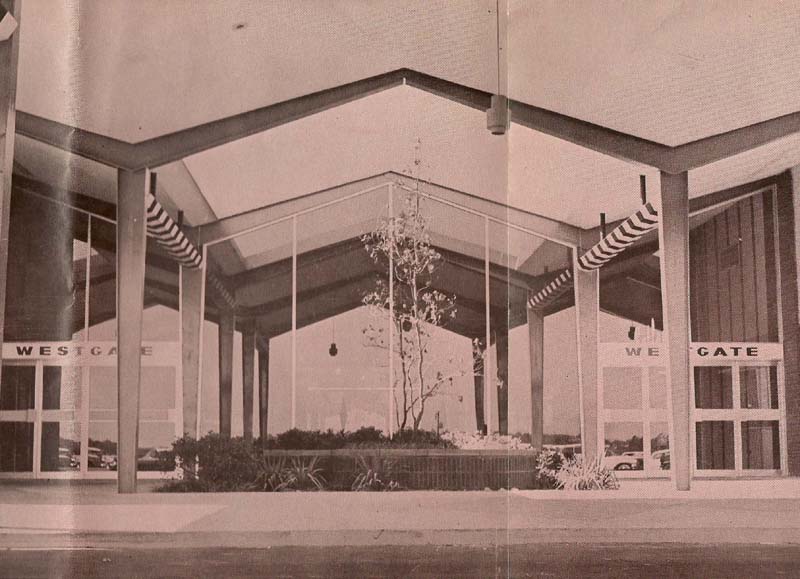
In two other posts, I discussed the long-demolished Westgate Mall/Shopping Center in Macon, GA.  While largely unknown outside of the city, it was not only the first enclosed mall in Georgia but probably also the first dead mall in Georgia.  A mall that lost its reason to exist by 1975, it was marketed in various forms for 19 more years before being de-malled in 1994.  If this had been anything but the first of its kind in the state, probably no photos would exist.  However, contributor Tony Webb was kind enough to inform me that he had some photos of the place, and he went to the trouble of getting them for this site.  His father, Bernard Webb, was the architect of the mall and Tony had a brochure from a local glass company showing the mall just before it opened.  Most of these photos involve the exterior, though a couple store fronts are featured inside.  I think you will agree from these photos that this was a very uniquely designed mall even for its time.   All images below are from that brochure sent to me by Tony Webb.


This is the artists drawing from the air.  The anchor on the left is Colonial Stores (later Big Star), and the tall anchor in the rear is J.J. Newberry's.  The grocery store on the opposite end is Big Apple (later Food Giant).  Woolworth's is shown between the front entrance and Colonial Stores.  Liggett Drug is shown on the left between the front entrance and Big Apple, which also had an outside entrance.  Liggett eventually became Eckerd Drugs at the last.


A look at the front entrance.  This looks substantial enough that you would expect a much larger mall inside!  I guess this place WAS huge for 1961.


Here is another mall entrance with the caption from the original brochure left in place.


Here is an outside entrance to a barber shop and a side mall entrance, which looks more typical for the 60's.


The store front of Butler's Shoes and mall entrance to Newberry's are both pictured here.


Hefner's Bakery looks positively classy with its logo and alternating glass/dark panel design.  I wish malls and department stores still had bakeries.


This was found on the front of the brochure crediting all involved in the construction of the mall.  Bernard Webb, Architect; Fickling and Walker, Developers, A.R. Briggs, Contractor and Binswanger Glass Co, Glazing.  Binswanger produced this brochure prior to the mall opening.


This passage in the brochure is both quaint and weird at the same time.  I don't see the connection with peaches and a mall, but I would take seeing the inside of this mall over peaches.

Wednesday, May 26, 2010

Westgate Shopping Center Revisited: Macon, GA

Westgate Shopping Center, also known as Westgate Mall [see older post], was redeveloped in 1994.  Sadly, it seems so many redevelopments of old malls in the 90's now call for another redevelopment.  In the case of Westgate, it is really in a bad spot.  The mall was ailing for years when it was finally torn down, and initially the redevelopment was wildly successful.  The only original anchor to carry over from the original mall was Burlington Coat Factory, but the new strip shopping center brought with it Home Depot and Media Play, both winners in that time period.  Wal-Mart had been added previously, which came itself in the 1980's and did not appear to connect to the mall itself.  The redeveloped center, which replaced the oldest enclosed mall in Georgia, did well for a decade but then seemed to finally fail due to a myriad of problems.


The original mall itself was not very big.  Aside from the fact it never actually had a department store anchor, the number of shops numbered only 30.  It was this compact design which probably led to the many attempts to re-tenant the center into something that Macon Mall did not have.  These days it would have been a perfect center for medical, professional or county offices, but the owners apparently instead preferred the higher dollar option of razing the mall for a traditional strip mall.  It did indeed work for awhile, but looking at where it is today, was this really the best idea?


When Westgate opened, I-75 was not completed and Eisenhower was not yet built, but it was close to downtown.  You think it would have taken advantage of the location.  The first photo shows a drawing of what the inside of the mall looked like.  Early enclosed malls instead of advertising the stores were advertising climate control!  If only today's lifestyle center builders would take a little tiny hint that this isn't California.


A listing of all the original tenants in the mall.  Note the lack of department stores.  No department store ever came to the mall, though Wal-Mart served as a pseudo-anchor in the later years.

Aside from Westgate, the only other mall I have known not to have a department store was Innsbruck in Asheville.  What the mall did have originally, however, was two grocery stores, two five and dime stores, a drug store and an auto parts store.  It was a novelty indeed, but definitely not an all-in-one shopping extravaganza.  Grocery shoppers could choose Big Apple (precursor to Food Giant and later Cub Foods) or Colonial.  Those looking for five and dime could choose between Woolworth's or Newberry's.  The Auto Parts store appeared to be a local affair, and it eventually became Otasco.  After a day of shopping, shoppers could dine at G&M Cafeteria and then get desert at Hefner's Bakery or Betty Ann's Candies.  While real shopping remained downtown at that point, it is undeniable that this was a period when malls were fun and had something for everyone.  Why did that ever have to change?


This is a corrected Westgate Mall map showing a 1993 aerial, but detailing all of the previous stores operating in the mall as well as modifications.  The first name on all the stores listed is the original tenant when the mall first opened.


The problem with redeveloping a dead mall with more retail is that the luster tends to fade quickly.  I can think of no older shopping mall that was redeveloped into a strip mall that turned out to be successful long term.  Part of that is that the owners did not take into account that the surrounding area would eventually pull it down.  This was what was there when the strip was first redeveloped in 1994.  Small shops were placed between Burlington and Wal-Mart.

The factors that killed Westgate could be summarized as crime, bankruptcy of one of its major tenants and a new shopping center down the road.  Obviously, the center would have successfully redeveloped if the neighborhood was prime for new retail.  However, nobody was interested in moving in the dying strip whose cheap stucco remodel looked hopelessly dated by 2005 and its core of shoppers shifting elsewhere.  Second, the bankruptcy of the Media Play chain was obviously a difficult void to fill along with Wal-Mart, which left the center by the middle of the last decade.  Third, Home Depot was lured away to a huge strip further west on the opposite side of Macon Mall.  The end result of this is that the once thriving strip mall is now largely empty making it twice dead much like what happened with Roswell Mall near Atlanta.


This scene looks like the apocalyse (or post-dollar crash) showing a virtually empty strip mall with major chain stores.  If not for Burlington Coat Factory there would be no car in sight.


Media Play was one of my very favorite stores in the 90's, but its all-in-one concept fell apart after the 90's as its competition became more numerous and stronger against the chain.  This is one of the few with the sign still up.  Note the light inside, though...this is a really big surprise coming in the next two pics.


Aside from the light, this damage to the building shows something severe happened.  Apparently a tornado made a direct hit on this building in 2008, which was the same one that hit Macon Mall.


...and severe it was!  The tornado apparently tore off part of the roof leaving a sizable portion of the abandoned store completely open to the elements. 


After nearly 50 years, it apparently is finally too late for Westgate.  This sign looks to predate the demolition of the enclosed mall.

It is unfortunate that the original mall did not find new use, but I wonder if it would have been thriving today re-purposed if they had not torn it down to start with.  It seems Houston Mall is doing better as a spliced up mess of medical, government and professional services than Westgate did as a strip, so maybe the owners of Houston Mall were pretty savvy not giving into the de-malling craze of the past 15 years.  Since this mall is years too late for that, I am guessing Burlington Coat Factory will probably end up at Macon Mall eventually.  Perhaps they should just tear down what is left and let it go back to nature.  It is derelict overall as it is, and it is also a victim of its own age combined with years of poor planning.  Westgate could have succeeded had it been built larger and had department stores, but the circumstances just did not work either time.