


Normally I do not lead off photos with pics of mall entrances, but these are curiously the best design-wise that this mall has to offer. The JCPenney's reflective entrance casts a gold hue against the gaudy colors of the mall, but its steps, ramps and garden underneath are a sight to behold. Belk has this likewise. Photo by Dustin Ransdell.

Detail of the garden area next to Belk reveals that floor tiles in the ramp areas are original. I'm assuming the rest of the flooring was probably terrazzo or brown brick-patterened linoleum. Photo by Dustin Ransdell.

More detail of plants and ramps outside of JCPenney. Photo by Dustin Ransdell.

Even more with some of the steps. The planters form a circular area in the middle near the entrances to JCPenney and Belk. Photo by Dustin Ransdell.
For a mall that has never changed its shape at all, the mall has seen a ridiculous amount of anchor shuffling since it opened. The first anchor changes at least were related to corporate restructuring of the anchor tenants and not anything to do with the mall itself. This came initially with the buyout of Wilson's by Tennessee-based Service Merchandise (their first major acquisition) in 1985. A couple years later, major regional chain Meyers-Arnold became another location of the rapidly expanding Atlanta-based Upton's chain. Despite this, the mall would see very little change otherwise until the end of the 1990's.
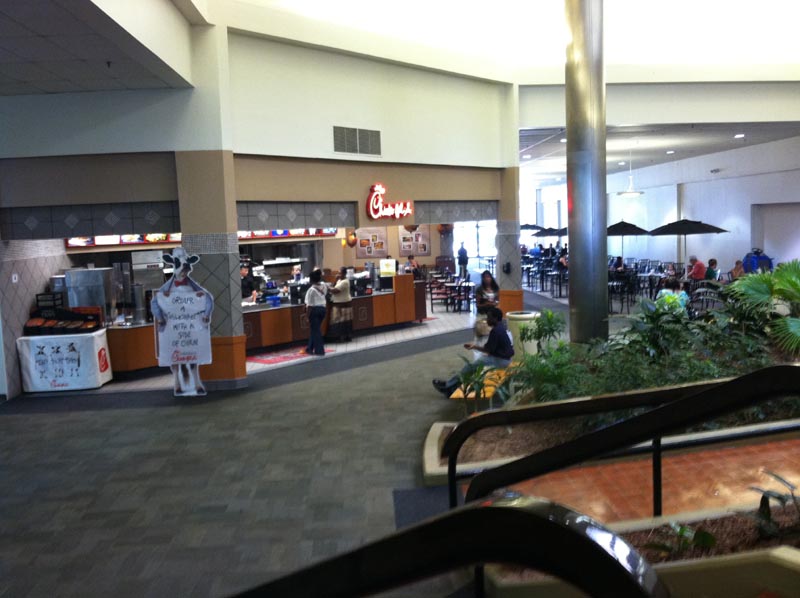
Coal mines have canaries and malls have Chick-Fil-A. As long as the mall has a Chick-Fil-A, the mall is doing fine. When Chick-Fil-A closes, the mall closure is imminent. The city has one other Chick-Fil-A nearby, but it is drive-thru only suggesting that the quirky chain is committed to the mall. Photo by Dustin Ransdell.

With a big carpeted empty circle in center court, it is clear that something is really missing. Whatever it was, the mall's original name alludes to something quite impressive. Now, it just looks like a place to to do a dance number or yoga session. Photo by Dustin Ransdell.

Here is a slightly different angle of center court, which has been a bit more difficult to get to since Upton's remained vacant for so long and Sykes Enterprises is clearly not open to the public. Chick-Fil-A is bound to love them, though, from 12-2. Photo by Dustin Ransdell.
In the early 2000's, Crosscreek Mall became Greenwood Mall when it was purchased by Hull Storey Gibson. They have been creative in their attempts of keeping this mall viable, but I give them the most accolades for keeping this one of the very few malls in their portfolio to retain a few original design features such as the indoor gardens in front of JCPenney and Belk and the sunken area in center court (which I presume once had an impressive fountain). This is one feature that does make the mall stand out from others that have been renovated into total blandness within their portfolio. The mall is also laid out at a slope with ramps and steps in the Belk, JCPenney and center courts effectively placing JCPenney at the high end of the mall and Belk on the low end.

The Belk wing of the mall looks reasonably healthy from this angle. Rue 21 seems to have become the default small town teenage store offering lower priced clothing than stores like American Eagle and Hollister. In suburban metro areas, they are usually found in upscale strip malls. Photo by Dustin Ransdell.

Empty stores like this are proof that many tenants have been vacant for quite some time. Stores like this were probably closed in the early-to-mid 90's never having been updated a single time. Photo by Dustin Ransdell.

Another dated, empty storefront is found along the entrance wing adjacent to the store above. 1979 and diagonal slatted wood seem to go hand in hand. Photo by Dustin Ransdell.
Hull Storey Gibson last renovated the mall in 2002, but their purchase of the mall likely came on the heels of the previous owners failing to re-tenant two dead anchors. This came as a result of the bankruptcy of Service Merchandise in 2002 and closure of the Upton's chain in 1999, neither related to the state of the mall itself. Service Merchandise in particular was never filled by another retail store. It instead became Sykes Enterprises, a call center. Upton's, however, finally got retooled after a long vacancy as a new TJ Maxx. The Meyers-Arnold/Upton's space was better positioned for re-tenanting with street frontage along the front of the mall facing SC 72. The Service Merchandise/Wilson's anchor does not have street frontage, which contributed to the difficulties finding a retail tenant. I wonder, though, if the owners tried to lure a theater to fill the void.

Shoe Department Encore forms the east end of the big-box trio fronting the mall. If this is the encore, then I guess the first showing was a smaller inline store? Photo by Dustin Ransdell.

Here is a view inside of the store from the mall. Photo by Dustin Ransdell.

Hey, dude, you wanna go and check out what's in Service Merchandise? SYKE!
Photo by Dustin Ransdell
Photo by Dustin Ransdell
It seems today that Greenwood Mall, as it is called, has lost much of its luster. While not a dead mall, the mall still has about a 20-30% vacancy rate for its inline tenants. If not for the pull from Columbia (Columbiana Mall) and from Greenville (Haywood Mall), this mall might be doing better and received a true expansion. In the past year, the front of the mall has been turned into a partial small strip with TJ Maxx opening in the Meyers-Arnold space with Michael's added to the left of it and Shoe Department Encore on the right. All three tenants also maintain mall entrances as well. Two other tenant spaces have been designated as well: neither with direct access to the mall. This means passersby would tend to mistake the enclosed mall as a strip mall. While the mall itself holds its own (it still has Chick-Fil-A, for instance), a shopper should not expect much variety in the stores. I guess I can say at least they found a way to keep the anchors filled, and it is indeed a stronger mall for Hull Storey Gibson.

If the mall leaves you with an empty feeling, you're not alone. But judging by this empty storefront, you almost are. Photo by Dustin Ransdell.

Exit right this way if you're bored with this mall. I take it you probably are unless you're reading this post for the history. If that's the case, you'll keep looking to see what this place looks like on the outside. Photo by Dustin Ransdell.

This appears to be the front mall entrance closest to JCPenney. It received a cheap remodel that makes it hard to tell how to even get inside. Photo by Dustin Ransdell.
In my opinion, the future for this mall is an eventual de-mallling. The mall seems successful enough anchor-wise, but it really fails to be the draw necessary to keep a roof on it for another decade. In a sense, the mall is curiously being "big boxed" without removing the mall itself. While this design may increase sales per square foot, it is hiding the fact that there is still a mall behind it. Another issue with the mall is that the mall is landlocked, so an efficient use of space is paramout. In my view, the mall layout is the biggest problem. Because of that, I am going to offer some suggestions in how to make the mall stand out better and still keep the big box modifications.

This vintage beauty on the back side of the mall, however, leaves no doubt on how to get inside. Photo by Dustin Ransdell.
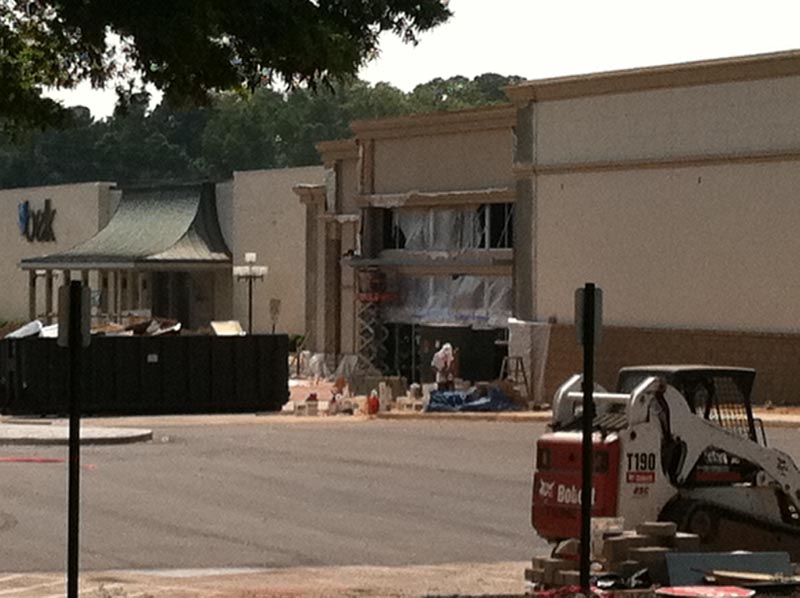
These shots so construction along the front to convert the Meyers-Arnold and adjacent space into a big box-mall combo. I guess the owners decided a "stripped-down" approach was best. Photo by Dustin Ransdell.

Another view of construction with TJ Maxx in the center and Michael's on the left. Photo by Dustin Ransdell.

Shoe Department Encore was already open at the time this photo was taken. Photo by Dustin Ransdell.

Shoe Department Encore with adjacent mall entrance. Photo by Dustin Ransdell
First, the new TJ Maxx store should be closed (yes, despite just opening) and moved to the back of the mall where Sykes is now, but using somewhat less of the Sykes location's footprint meaning the mall can extend further back into the anchor to add more inline stores. The current TJ Maxx store should then be reconfigured as a new main mall entrance with at least one junior anchor type store on one side (Old Navy, Books-A-Million, Forever 21) and a popular sit-down restaurant on the other (perhaps Lizard's Thicket of Columbia might want to branch out here, but even IHOP might work). The front entryway should also not be built on the cheap. Make it elegant and showy with glass, a two-level atrium, bright color trim and a building material besides stucco: preferably a mixture of brick and stone. Put some funky colored lights hanging down in the atrium to show up strongly at night. The center court should also be reconfigured to have a central focal point to attract returning customers (yes, this means put a nice, terraced fountain, artwork and more elaborate decoration in the sunken area). The existing front mall entrances next to Belk and JCPenney would then be closed off and given to each department store to expand their stores, making the stores more of a draw on their own. Also, replace the carpet with floor tiles in different patterns to make the mall seem more vibrant. Carpet makes malls seem quiet and sleepy. The result would be more interest in the mall itself, a better layout and TJ Maxx would not mind as much moving to the back of the mall with more direct access to the front. Make sure, of course, to place the TJ Maxx sign next to the mall entry, and rename the mall back to Crosscreek Mall since the name is more appealing.

The mall map shows a large "exterior unit available" on the back of the mall between Sykes and JCPenney. I'm assuming this new Sears Dealer Store must be it. Photo by Dustin Ransdell

Belk had a definite model they were using for stores in 1979 for smaller stores with this copper awning. This is one of the least inspired ones. The entrance on the back side of the store is sealed off but still has the awning. Photo by Dustin Ransdell

I am not too Syke-d about anchors being taken over by call centers, but I am psyched about creating bad puns based on the name. Photo by Dustin Ransdell

Here is another prototype: JCPenney's plain white "greenhouse" look. This design endured into the early 1980's. This mall reminds me of when builders sell a set list of models of houses they can build on your property. Does the Cape Cod look not do it for you? Well try the Westbrook! It's only $10,000 more! Photo by Dustin Ransdell

I don't like the sign, nor the name, but clearly I have no authority on such matters so all I can do is complain. Oh well... Photo by Dustin Ransdell
To sum things up, Crosscreek Mall is a mall that is simply outmoded and outdated, not dead. Maybe it will never be full again, but a little planning could go a long way into making it more of a shopping destination. A better design and better layout could attract a better tenant mix keeping customers in the market happy enough not to drive to Greenville and Columbia as often for shopping. While the mall has done a decent job staying viable, and it is more attractive than most Hull Storey Gibson malls, at 33 years some additional creative efforts could give Greenwood residents a mall they could be a source of pride for the area.


