Showing posts with label Bon-Ton. Show all posts

Saturday, December 2, 2017

Neshaminy Mall: Bensalem Township, Pennsylvania

The sixth mall in the Philadelphia metro area was a one-story mall in Bensalem Township, a fairly typical suburban mall with a few special touches that make it stand out above the rest.  Named Neshaminy Mall, the mall was named for nearby Neshaminy Creek.  Meaning "double drinking place", the name was derived from the language of the Lenni Lenape tribe of Delaware Indians.  From the beginning, the mall lived up to its name constructing a large fountain as its centerpiece.  Constructed in 1968 by a partnership between The Korman Company and Strouse Greenberg, the original mall looked impressive for one level with very high courts over two stories tall both in front of its original two anchors and in the center court.  Those original anchors were Strawbridge & Clothier and Sears.


As an ode to the tribe that the mall was named for, the original fountain was replaced within two years of the mall's opening with a much larger fountain that was paid for by one of the mall's two original anchors: Strawbridge's.  Sears may have also had a fountain, but it was probably similar to the original one in front of Strawbridge's and later removed.  Apparently Strawbridge's wanted to showcase their store with a much showier fountain with historic precedent to replace the more basic concrete fountain that was put there when the mall opened.  The newer fountain features a waterfall, a pool, trees, plants and a statue of Tawanka, chief of the Lenni Lenape tribe for which the name Neshaminy was derived.  It was dedicated on September 9, 1970.  Strawbridge's was a family-run store until the 1990's, and the family loved to pay homage to the area's history both on the exterior and at the mall entrances.  This was their contribution to Neshaminy Mall.


The first photo shows the fountain, waterfall and pool in front of the Strawbridge's (later Macy's) mall entrance.  More details of the fountain and court are shown both above and below.  The upper level seen above the Macy's sign was part of the Strawbridge's restaurant and was closed to the public when the restaurant closed.


A view of the fountain and statue facing the Boscov's wing.  Macy's is to the right.


Detail of the statue


Detail of the waterfall


Plaque on the fountain explaining the meaning behind the fountain and sculpture.


Fountain facing the Boscov's wing.


Fountain facing the main part of the mall toward Sears.

Strawbridge's did not hesitate to make their store the centerpiece of the mall despite not actually being in the center of the mall.  This included the third floor of Strawbridge's overlooking the mall providing a view from what was then the Corinthian Room restaurant.  This was also likely part of the reason for the fountain upgrade.  Nonetheless, aside from Strawbridge's, the mall was otherwise a fairly typical mall of the era forming a straight shot from Strawbridge's to Sears.  Over time, this arrangement proved to be less competitive, and an expansion was undertaken in 1975 to help the mall better compete with more popular Oxford Valley Mall.  Oxford Valley Mall had opened in 1973 a mere six miles away with a bigger, better mall and was stealing customers from the older mall.  The newer mall had the same anchors as Neshaminy, and the expansion of Neshaminy Mall added a northeast wing that included Lit Brothers department store and between 15-25 more inline stores.


Above is the detail of the skylights inside the former Strawbridge's/Macy's when it was still open.  The gorgeous escalator/staircases in the center of the store was a signature style of suburban Strawbridge's locations.


More detail of the stairs, escalators and chandaliers at the Strawbridge's.


Exiting back out into the mall, more detail of Strawbridge's court.  The overhead skylights and windows are 1960's, but it is tasteful and attractive giving abundant natural light.

Philly-based Lit Brothers, however, was a lower-end department store that was no longer able to compete after competition from larger chains cut into their business.  The entire chain was liquidated in 1977.  Lit Brothers closure was also due to its parent company, City Stores (now CSS industries), divesting its department store holdings in the span of 1973-1980 including other chains like Lansburgh's in DC and Loveman's in Alabama.  Pomeroy's, a division of Allied Department Stores replaced Lit Brothers the same year.    Ten years later, Bon-Ton would take over Pomeroy's when the chain was spun off as part of the sale of Allied Stores to Federated.  Bon-Ton itself would itself prove to struggle in the market, closing in 1994.  Boscov's would take over the location in 1995 and ultimately outlast all the other previous tenants.


The 1973 addition was apparently originally designed as a darker corridor with no natural light.  A later renovation added these skylights, which obviously had to be worked in above the existing ceiling trusses.  This is an unfortunate and unsightly trend in more recent malls as a way of adding skylights where none previously existed.


Like the older parts of the mall, the Boscov's court was designed with high ceilings, but did they ever serve any purpose?  Skylights added were more subdued than the 1960's portion of the mall.  The store originally opened as Lit Brothers in 1973 and later operated as Pomeroy's and Bon-Ton before becoming Boscov's in 1995. 


A small exterior entrance corridor is located next to Boscov's that appears to have originally held around 4-6 tenants.


Leaving the Boscov's court returning to the older part of the mall.

Since the initial 1975 expansion, the mall was expanded two more times.  The first was the addition of a food court in 1989 that was further expanded in 1990.  After a 1995 renovation, the mall was expanded again adding a northwest wing ending at a 24 screen AMC theater in 1998.  This expansion also brought the mall to over one million square feet.  Throughout the years, the mall also changed ownership several times.  The first ownership change came with the sale of the mall from Mutual of New York (now known as AXA) to Homart Development Company, the real estate development arm of Sears.  The mall was sold again to General Growth Properties (GGP) in 1995 when Sears sold off Homart properties and shut down the subsidiary.  GGP continues to currently own the mall.


Details of the actual center court of the mall with abundant natural light coming from large windows and overhead skylights.  If the areas around the skylights and high windows were replaced with actual color and wood trim with as impressive of a center court as exists in front of the old Strawbridge's, this would be truly impressive.


A view into the food court area.


Sears court and mall entrance.  Barnes & Noble takes up a large junior anchor space to the left of the Sears entrance.  It is worrisome what will happen to this mall when Sears closes.


This is NOT something you see everyday in a modern mall: a Time-Out Arcade!  I'm glad I captured this.  I ultimately found another Time-Out Arcade at another mall and went in with a friend to play some Skee Ball.


Before you go to watch the fifth sequel of a movie you were tired of by the second one, you "gotta go to Mo's!"  Modell's is a moderately successful sporting goods chain that has somehow found a niche among larger players in the Northeast.  It is often found off-mall.


Fun for the whole family at the AMC 24!  The addition of the theater in 1995 rounded off the mall at four anchors.

Next year, Neshaminy Mall will celebrate its 50th anniversary, but there may not be anything to celebrate considering that the mall is facing a crisis.  Between 1995 and 2015, nothing significant changed with the mall other than Strawbridge's becoming Macy's.  However, Strawbridge's was long in decline before it became Macy's with the family losing the store to May Company in the late 90's who then sold it to Federated Department Stores, which converted it to Macy's.  In early 2017, Macy's decided to close its location at the mall after 49 years of business.  This leaves a significant hole in the mall, especially when considering that the mall's only other original anchor, Sears, is very close to going under.  This leaves only Boscov's and the AMC theater as anchors to the mall.  Since dead anchors in malls are now impossible to fill, this is the beginning of the end of a very special little mall.  We wish so much that the industry could be turned around and that new stores could come in and fill these voids, but since the beginning of the decade this has proved nearly impossible for too many malls.  Non-traditional anchors are what will be needed, but this will mean that the existing Sears and Strawbridge's buildings will likely need to be demolished since they are too big for the needs of any future retail tenant.
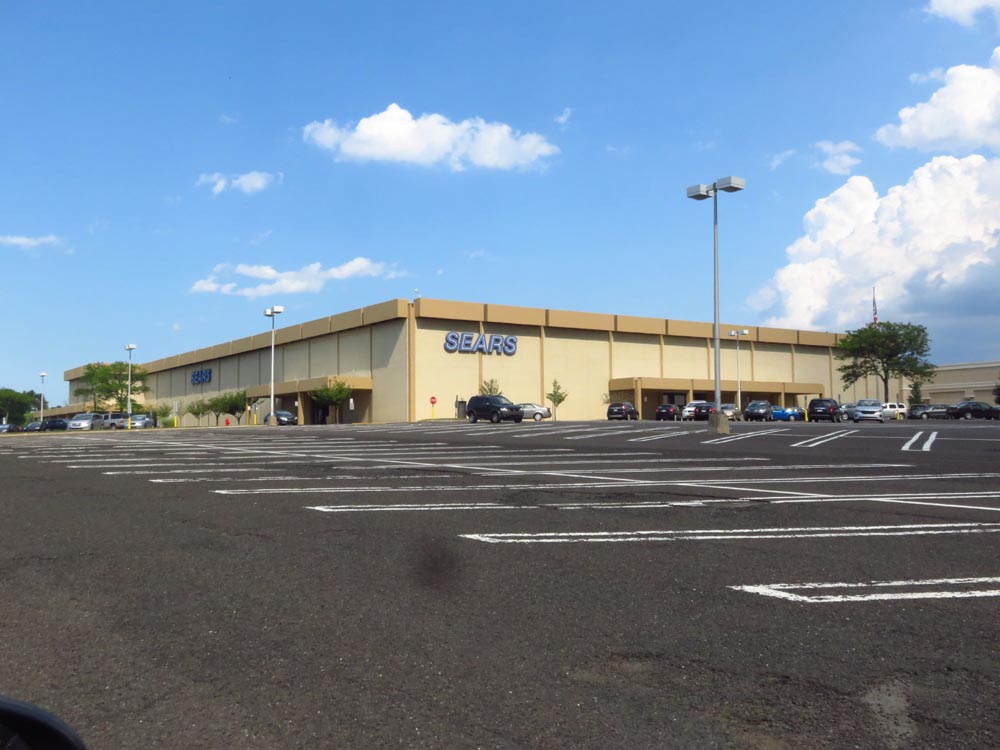

Sears at a mall should never go without a photograph: especially when it's a store from 1968!  As one of the original two anchors, the troubles with the chain are worrisome considering that Macy's left the former Strawbridge's location after 49 continuous years of business.


Sears Auto Center


Boscov's, which opened in 1977 as Lit Brothers.  As typical of Boscov's, the exterior entrance saw a few updates.  When a smaller chain like Boscov's can update their stores from previous owners, but Macy's can't even afford a gallon of paint, it's pretty obvious there is something wrong with Macy's.


RIP Strawbridge & Clothier.  The Strawbridge's "Seal of Confidence" is visible in the stone on the right.  That confidence was lost when it became Macy's.


The problems for Neshaminy as a competitive mall, however, are not new.  Since the mall was built, it has competed with two larger malls with better anchors.  It is also a reflection of the industry as a whole where department store closures and consolidation are making it harder and harder for the typical suburban mall to survive.  Neshaminy was one of those malls that was once bulletproof.  As evidence of these problems, its main two competitors are also facing difficulties.  Oxford Valley Mall, once the primary competitor to Neshaminy, is also not doing well with a dead anchor and many vacancies.  Even competing Willow Grove Park Mall, located 12 miles away, just lost JCPenney and is soon to lose its Sears although it has already downsized Sears for Irish clothing store Primark.  Neshaminy has also seen an uptick in vacancies since Macy's closure.  Unlike with many malls with a sudden loss of a major anchor, this one is harder to pinpoint.  Perhaps it can be summed up as the King of Prussia effect: a mall so dominant in the market that none of the other malls can effectively compete.  At this point, it is difficult to predict what the final outcome will be, because the mall seemed to be doing very well when the pictures were taken.  Macy's was full of customers and so was the mall.  What happened?  It seems as though the most likely outcome for Neshaminy will be redevelopment into a mixed use center keeping only Boscov's and the AMC theaters.  It's not a plan that is worth celebrating when a mall like this survives 50 years, but the wheels of change are suddenly moving too fast for conventional malls like this one.

Thursday, July 13, 2017

Warren Mall: Warren, PA

What if a mall died and nobody cared?  This is how it feels when discussing the rather sad Warren Mall.  Once a proud three-anchor mall featuring Bon-Ton, Kmart and JCPenney, today the mall is almost entirely vacant except for Bon-Ton and Dunham's Sports.  In fact, at present only three tenants continue to operate in this forlorn mall as plans are currently in the works to demolish the interior.  Built by Zamias Services, the mall also has a very similarly designed sister mall to the south with Indiana Mall.  However, the similarities will not be visible much longer.


Built in 1979, Warren Mall provided a small regional mall to Warren County and the nearby city (and county seat) of Warren.  It seemed that during the 1970's it was viewed by developers that nearly every county in the state needed at least one mall: a factor in why Pennsylvania is so overmalled.  With U.S. heavy industry not yet in decline, the region was growing modestly while malls were at their peak.  Since the mall opened, however, Warren County has suffered from the typical fate of the Rustbelt: a lack of opportunities, population loss and graying of the population (median age of 40).  In fact, since the mall opened, the county itself has lost 7,000 residents, a population loss of 8.5%!  None of those factors sustain a mall.


Walking into the mall, the few signs of life are deceptive.  Master Cuts is closed for good on the right and aside from Bon-Ton, the only other business open here is the nail salon, because getting your nails done is more important than a haircut.


I failed to get a close-up of the mall directory, so I created my own further down the post.


Detail of benches and planters in the front entrance corridor.


Approaching the Bon-Ton with a focus on the center court details in front.


Overhead detail in center court with the center court fountain on the right.

Furthermore, 20 miles to the north Chautauqua Mall in Jamestown, New York provides a more complete shopping experience.  Unlike this mall, Chatauqua Mall has a pretty typical rural selection of stores: JCPenney, Sears and Bon-Ton.  In contrast, Bon-Ton is the only thing keeping the doors open at Warren Mall.  It has been a slow decline, however.  JCPenney closed in a large round of closings in 2000 and was replaced by Big Lots.  However, Kmart hung on in the mall until 2014.  Big Lots itself left the mall in 2013 with the store remaining vacant until it was replaced with Dunham's Sports in April 2017.  Unlike Big Lots, however, Dunham's walled off access from the mall.  That wall in fact IS the writing on the wall about the future of the mall.


A few shots inside the Bon-Ton that looks about as original inside as the mall itself does.


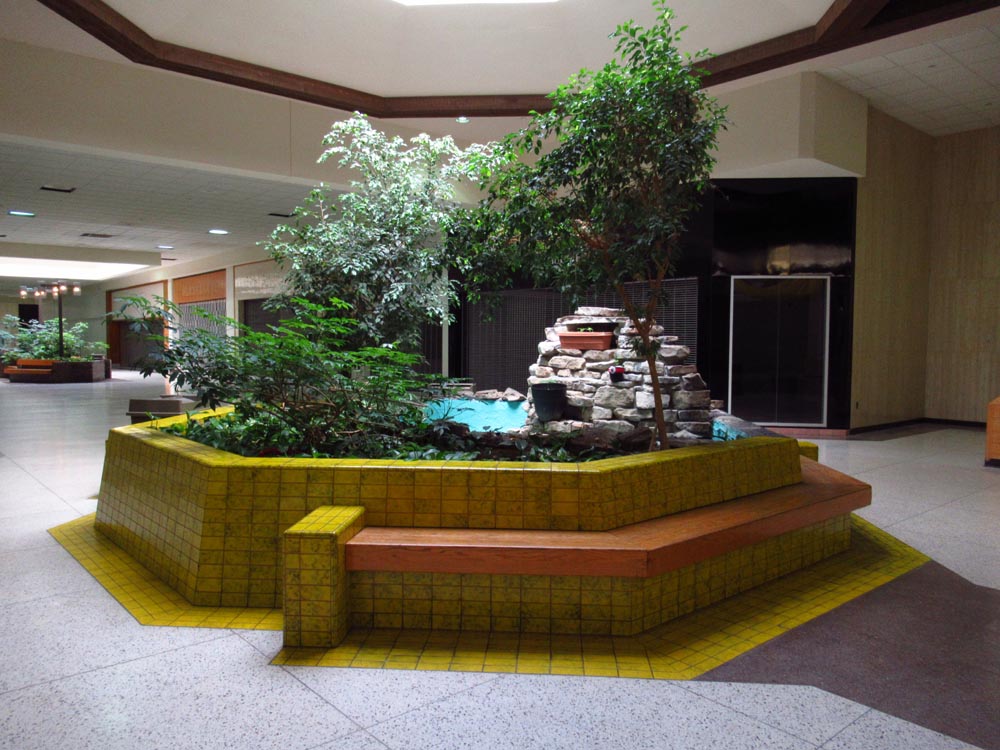
The center court fountain has sadly been turned off.  It was never super elegant: just stacked stone and a very small waterfall into the blue pool you see here, but it's striking with the yellow tiles, stained wood benches and plants basking in the ethereal glow of the small overhead skylight.  The first photo faces the JCPenney wing, second the Kmart wing and third looking into the fountain with Bon-Ton on the left.


Context of center court planter, skylight and Bon-Ton


Empty Kay Jewelry store next to center court.  It has likely been vacant for at least 15 years.

What was pretty clear is that the closure of JCPenney was the catalyst that began the exodus of inline tenants.  The mall had a few vacancies in the 1990's, but today all that is left is Napoli Pizza (which opened with the mall), a nail salon and Label Shopper, which has outside access only.  The loss of JCPenney and so many inline tenants drove the mall into bankruptcy in 2003.  While Zamias got the mall out of bankruptcy, the mall itself never recovered.


Entering the JCPenney wing, later Big Lots.


Detail of the planters and lights in the JCPenney wing.  To the right was a Waldenbooks.  The only reading going on in this mall now are bored Bon-Ton employees killing time on their smartphones waiting for the rare customer.


Label Shopper is the only store open on this wing.  However, they have closed their mall entrance and have outside access.  JCPenney is also not vacant.  It is now Dunham's Sports, but they have walled off the mall entrance in anticipation of the mall's redevelopment.


"JCPenny's...used to be here".  The light over the planter, however, makes it look like JCPenney has passed on...oh wait.


Skylight over the planter.


Next to the former JCPenney is this back entrance corridor leading to the back parking lot.


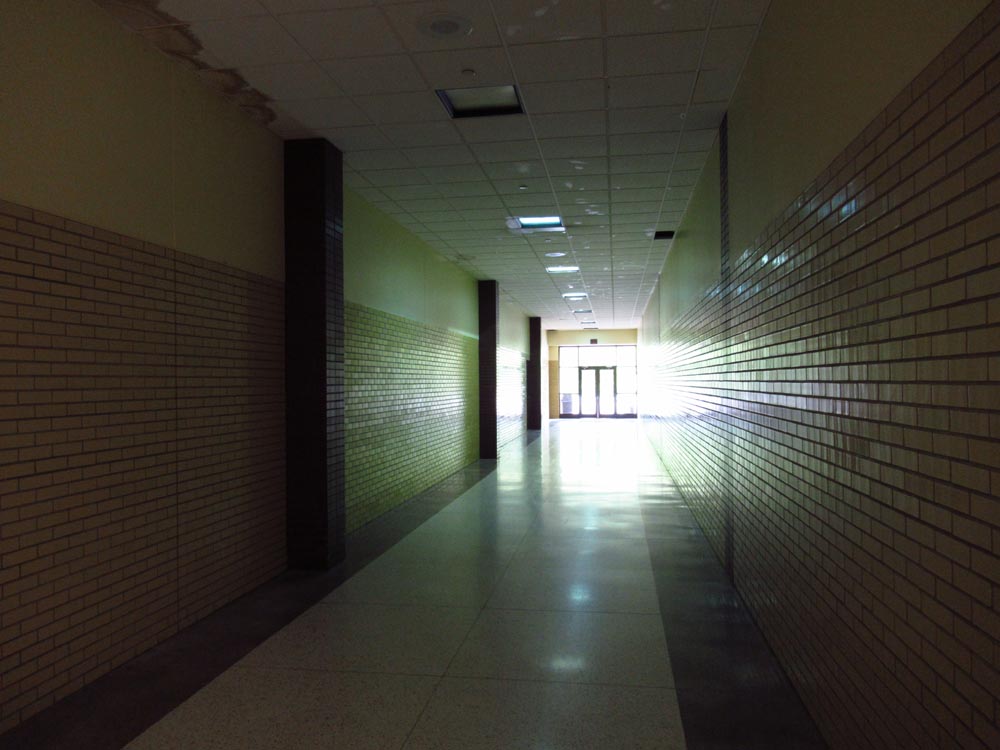
Golden glazed bricks lead the way to the light that will soon cover the site of the failed mall.


View of the outside of the back entrance reveals a very stark and vintage entry with burnt orange letters over brown blocks, dark doors and a stained white brick facade.

Overall, Warren Mall has a pretty basic layout with exception to how the mall corridor turns diagonal to the main mall instead of ending flush with the former Kmart.  The result was that Kmart sat diagonal to the rest of the mall.  This was a necessary design fluke done because the back side of the mall backs up to Conewango Creek.  In fact, the mall itself appears to be in the floodplain of the creek although I cannot find any evidence that it ever flooded the mall itself.  Otherwise, the mall has a straightforward design with one main entrance, two smaller back entrances and three anchors.  It is also still comparatively large and attractive for a mall serving a population of less than 50,000.  If the county had continued to grow as it did in the 70's, the mall would likely still be doing well today.


Former Ponderosa Steakhouse in the Kmart wing.  A wrought iron rail blocks off access to the interior.  However, a look inside reveals the once popular restaurant.


Former Foot Locker on the left with an empty kiosk to the right and the former Kmart in the background.


Inside the former Foot Locker


There is just something awfully classy about the way they did planters and lights in the 70's malls.  The skylight is nothing special, but touches like this make it far more eye catching and restful.  The plastic tarp over the storefront to the left, however, is creepy.  It was once a Fashion Bug, but it turned over and died.


Your 80's horror movie fantasies could be filled with scenes where very evil things happen inside both of those former stores.  Aside from visions of slashing and carnage, one way you can be absolutely sure that the owners do not give a damn about the mall anymore and plan to knock it down is when one empty store is blocked off with a chain link fence and another with a plastic tarp like this.  There will be slashing and carnage, however...with a wrecking ball and backhoe.  


Kmart's mall entrance sits empty and forlorn.  However, Ollie's plans to take over once the mall is demolished.

It is also important to note a few other features of the mall.  Unlike Indiana Mall, the theater was not built into the mall itself.  Instead, it exists to the left of the mall located on an outlot.  To the left of that is a Tractor Supply, which is located in what was a former greenhouse Kroger.  It is unknown when the Kroger closed, but it is believed to have closed as early as 1984 when Kroger left Pittsburgh meaning that the store was only open around five years.  One source stated a store named County Market, a small independent with currently one location in Grove City, used to operate in that space.


A ray of false hope shines down on the side planter near the south mall entrance (and de facto Kmart entrance).  Identical planters were positioned in the Kmart entrance corridor at Indiana Mall.


Napoli Pizza, the last remaining original tenant, still does a good business next to the Kmart exterior entrance.  To the right was Aladdin's Castle.  Its former arcade appearance still lingers today.


Where the mall bends into the main mall just past Kmart with this faux skylight overhead.


Nope, it's just a very interesting artificial light fixture with reflective panels to enhance the glow.


Inside the former Kmart.  It doesn't look rough because it's been closed a long time.  It looks rough because it's Kmart and was barely maintained for years before it closed!


Another back entrance corridor is just before Kmart.  This is the location of the bathrooms and mall offices.  The bathrooms are wedged into a triangular corner between this hallway and Kmart.


Patti's closed before you could ever buy "Patti Pie" here (as if you ever could).  

One thing that makes Warren Mall stand out over other dead malls is that it is remarkably unchanged from when it first opened nearly 40 years ago.  While absolutely spotless and in good repair, nothing substantial has ever been done to the mall...EVER!  The mall still features the same fountains, same flooring, same skylights, same wood trim and same planters since the day it opened.  The exterior is equally as vintage with original "MALL" signs on back entrances and a solidly 70's design.  What changed is the stores...most of those completely gone.


Re-entering center court with a dead Bath & Body Works on the left.  Usually one of the last stores to close, it has been vacant over a decade!


Exiting the interior Warren Mall...forever :'(


Label Shopper's exterior entrance is due to its former life as CVS.  It was also a Dollar General for awhile.  CVS consolidated into a downtown store.


Bon-Ton appears to only be accessible via the main mall entrance (which should at least mention that a mall is here!).  Perhaps it once said "MALL" underneath this sign.


In the back side of the mall, Bon-Ton has direct parking lot access...and the old logo to boot!!


It looks like it's just a Kmart entrance, but it's actually also the mall entrance.  It was very common in malls with Kmart as an anchor to have the Kmart entrance actually be the mall entrance with the actual store entrance inside along the mall corridor.

Obviously, a mall with no stores is not going to stay open as a mall for very long.  It is unclear what Bon-Ton's commitment is, but like the mall itself, the store inside has never been updated.  Bright orange and burnt sienna floor tiles grace the store's departments, and the lack of updates reflect the problems with Bon-Ton itself.  It is a troubled company with far too many far-flung locations in dead malls, and the chain has an unfortunate reputation of catering to old people considering that its base of stores just happens to be in markets that younger people have largely left.  With Kmart empty, Dunham's disconnected from the mall, and only three tenants retaining mall access, the signs were there that the mall was almost done, and it turns out to be true.


Overview of the front of the mall from Kmart to the former JCPenney.


Dunham's in the old JCPenney with the Big Lots labelscar on the left.  Dunham's arrival shows a commitment to the mall, but only as a redeveloped center.  They have no mall access.


The former JCPenney back entrance where store services are has been unceremoniously boarded up.


Cinemas III rests on an outlot just north of the mall.  It clearly is as vintage as the mall itself.  Unlike its sister Indiana Mall, it is not part of the mall itself.  This is likely due to the geographic constraints where the back of the mall backs up to Conewango Creek.


Former Kroger.  It is unknown how long this store ceased to be a Kroger.


The mall's sign panels have been updated, but the very awesome original logo just abbreviating the name of the mall remains.


Last but not least, check out these killer retro entrance/exit signs located along US 62.

In 2016, Zamias sold their interest in the mall to Cocca Development of Boardman, OH.  The new owners pretty much had no qualms about what their plans were: to bring it down.  It will be done in a fashion similar to what was done at Raleigh Mall in Beckley, WV.  That means they will leave the anchors standing, but demolish the interior mall while keeping remaining tenants in the new development.  This will also give Bon-Ton front parking lot access.  In addition, Ollie's Bargain Outlet is moving into the Kmart space.  With Dunham's already in the old JCPenney, this will ironically bring the mall back to full occupancy...minus the mall itself, of course.  Redevelopment of the mall is scheduled to begin in 2018.  We wish the best of luck to the redevelopment, but it will be sad to lose another well-preserved vintage gem with Warren Mall.


Here is a map and aerial of the mall and outlots.  For details of former inline tenants, these maps show various tenants from 1980-2000.


For your further interest is the aerial of the mall from Google.