Showing posts with label Asheville NC. Show all posts

Tuesday, September 13, 2011

Grove Arcade: Asheville, NC

Enclosed shopping malls were not an entirely new idea when they were introduced to the world in the 1950's.  While the multiple-anchored all-inclusive pedestrian downtown surrounded by a sea of parking was new, the enclosed shopping center was definitely not.  Before that, downtown shopping districts sometimes featured a smaller, classical version of the mall, which was known as an arcade.  Not to be confused with the gaming place that teenagers frequented from the 70's to the 90's, these arcades were typically mixed use structures with at least three levels under one roof.  In these, one or more levels were devoted to shopping with design details more ornate and elegant than their later, larger cousins. They usually fit nicely into a block of buildings downtown, and were typically not connected to any nearby department stores. 


Arcades, likewise, should not be confused with the disastrous "downtown shopping malls" of the 70's, which featured such outrageous atrocities such as demolishing blocks of historic buildings for a huge bunker surrounded by ugly parking decks or parking lots.  Unlike these ill-fated "urban renewal" schemes, arcades blended in with the downtown fabric with outer windows and architecture that appropriately complimented other buildings in the city.  They were typically intricate and elegantly designed inside and out with the main recognizable feature comparable to modern malls being the central overhead skylight.  They also typically covered a much smaller footprint being built up instead of out, typically carrying 3-4 stories.  In addition, the shopping component tended to be much smaller, holding at most 20-30 shops.  Grove Arcade was exceptionally large holding around 50: the size of most early 1960's shopping malls.  Upper levels were also typically devoted to other uses than shopping such as offices and residences meaning they were mixed-use in contrast with modern malls.  Also dissimilar from malls is that they were not designed to have "anchors".  While they may have been near a downtown department store, they were never anchored by one.  Usually, arcades had all entrances opening into the streets with their main crime being that they might have covered a large portion of a city block, but never resulting in the leveling of an entire downtown business district to make room for its quickly despised presence.


A couple exterior views of the arcade.  Due to the parking difficulties, I was not able to take as many outside photos as I would have liked.  The first photo is of the south hall looking back towards the entrance pictured above.

Today, most downtown arcades of the early 20th century suffered much the same fate as the department stores either reverting to other uses or being demolished for bigger projects because the land they sat on became too valuable for a building of their typically smaller size.  In most larger cities, highrise buildings replaced the lowly arcade although small downtown malls often anchored, less successfully, many of these newer projects.  Of the few that remained, most were ultimately converted to other uses with their original retail component long abandoned.  The historic arcade was no match for modern-era progress beginning in the 1950's.  Grove Arcade almost became a casualty itself: an almost forgotten artifact of Asheville's past until the past 15 years with plans to expand and convert the building to a government-owned high-rise very much in the works.


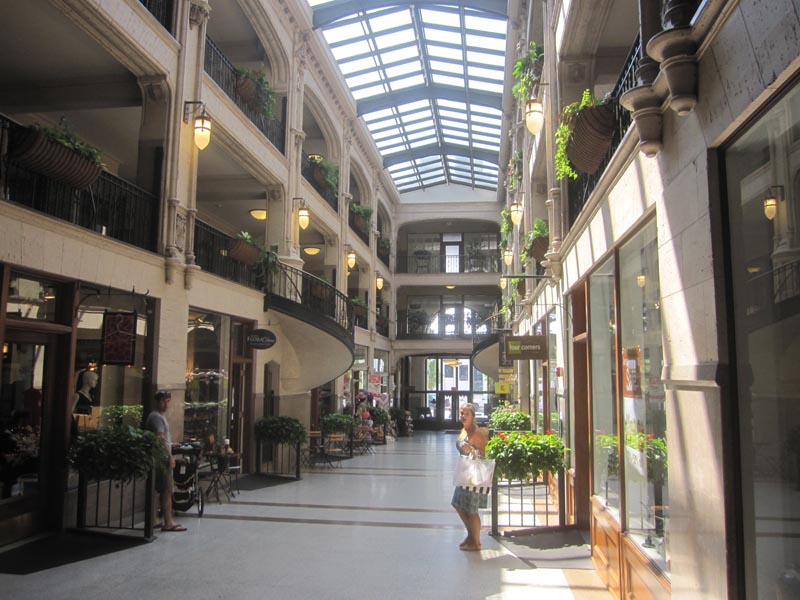
Here is another view of the south hall looking north.  Note the winding staircase on the left.  These have unfortunately been closed to the public.


One of the second level balconies crossing over at the center of the arcade.  If only they had looked at this place and taken notes when they designed Biltmore Square Mall.  It is no wonder that mall has failed.


The west hall features a stunning three-level vaulted ceiling with walls adorned with marble.  Imagine any mall looking like this when you walked in.

Grove Arcade followed the typical pattern set forth with conversion to other uses.  Opened in 1929, the arcade was a hit.  Its builder stated it was one of the finest buildings ever constructed, and few would argue the sheer size, opulence and attention to detail that went into this building was a marvel of its time.  It would continue to operate as the premier shopping destination in the city until WWII arrived.  This is when the federal government seized the facility under the authority of the war effort literally evicting all the tenants within almost overnight.  From there, the building would house various federal operations with the last involving weather forecasting.  A movement to preserve and restore the building to its original use did not gain steam until the 1990's when the government began plans to expand the building to suit their needs.


 Looking back toward the central elevators in the west hall.


This view is looking back down the north hall toward the elevators.  The guy pictured proves this is not a bad place to kick back on a warm August morning.

When one of Asheville's most distinctive structures was threatened, citizens mobilized.  A strong push was then made to get the government to sell the building back into private hands.  In this time, the structure was placed on the historical register with steps beginning in 1995 to restore the building to its original appearance and use.  This finally culminated in 2002 with the reopening of Grove Arcade back to what it was originally intended for.  Since then, the bottom level was converted back to retail with upper levels being sold as housing units.  Indeed, it has been a huge success.  While the refurbished center has failed to attract any chain stores, the lower level is nearly fully leased with various local shops and cafes.  With Asheville's tourist industry, the center is now pivotal in that district and attracts a whole new generation of crowds into its four glorious halls.  Imagine if such an attitude could prevail when a classic 1960's shopping mall is threatened with demolition.


Here is a view of the east hall and entrance.  Being designed in the same era as the Biltmore House, the attention to detail, elegance and gothic trappings are similar.


Detail of the winding staircase coupled with the tiny door below.  It seems the popularity of winding staircases sadly died out by the 1980's due to their impracticality.

The success of Grove Arcade, though, suggests the need for further experimentation.  Asheville, after all, is one of the few cities that could likely support a successful downtown shopping district like it once had.  Currently, Asheville still lacks some chain stores many other cities have.  The city also has three malls, but one is failing, and all three are landlocked by roads, buildings and steep terrain.  While one of those does have room to expand, even it would still require a substantial updating and vertical design to utilize the space.  This presents a unique opportunity as the city currently lacks a Macy's or upscale department store such as Nordstrom.  The idea I have is to consider purchasing and demolishing the RBC bank building across the street from the arcade and expanding the existing parking deck across from both.  In the RBC building, a 5-6 story structure would take the place of the current two-level structure housing a new downtown Macy's or other department store designed on the outside to look like the arcade.  Doing this would spotlight the arcade, bringing more shoppers downtown and possibly helping the arcade to truly evolve into a downtown mall without repeating the mistakes of the 1970's.  The potential is there to create a one-of-a-kind shopping destination not usually found outside of New York City or Chicago.   In a time when society is turning cold on the effects of over 60 years of suburban sprawl, such an idea seems more realistic.


Another view of a winding staircase in the south hall.


Lastly, detail of the south entrance to the arcade.  Rest assured, shoppers here were of the upper class and dressed in their finest back in the day.  I tip my hat (if I actually wore one) to the successful preservation of a historic retail treasure.

Ideas aside, the interest in historic preservation has revived some surprising treasures.  Before I saw this place, I did not even know that any arcades like this still existed: at least not as public shopping and gathering places.  Grove Arcade itself had fallen out of public use for over 50 years, and today is one of only five arcades to still exist in North Carolina.  Grove Arcade, along with the Biltmore Village retail district are beautiful works of art as well as fun shopping areas in one of the country's most beautiful cities.  With that, it is not a wonder that the malls in the city are anemic.  I hope that Grove Arcade continues to not only be a success, but also brings a new wave in experimentation in constructing new arcades with similar architectural detail to possibly bring upscale shopping back into the larger cities without wrecking them.  Just as they were a good idea in the pre-mall era, they are again a great idea today in an increasingly post-mall era.

Wednesday, October 14, 2009

Biltmore Square Mall: Asheville, NC

Throughout the fall, I have been featuring several retail points of interest in the Asheville Series, and this post wraps up the set.  This is the last of the enclosed malls in Asheville, and it is also the newest.  Built in 1989, Biltmore Square brought real competition to then completely dominant Asheville Mall with anchors Proffitt's, Hess's and Belk, a movie theater and junior anchor Goody's.  Both Proffitt's and Hess's specifically were new to the city and the state, providing two shopping options very unfamiliar to Asheville shoppers.  It was then built by Simon and featured very elegant design on a pretty basic footprint.  The location was quite odd in that it was in a place with a lack of adequate buildable land for adjacent retail as it was close to the Blue Ridge Parkway and across I-26 from Biltmore Estate.  Also, the mall struggled to attract much attention as it got its start in the middle of a recession.  It was an interesting idea, but it was also cursed.  A combination of poor planning and the mall's slow start were warning signs of the future.


Biltmore Square has continued to struggle since it was built.  While the mall hung on, it was always a second-tier mall in an area easy to overlook.  The exit showing "NC 191: To Blue Ridge Parkway" is not the type of exit you would expect to find a mall and extravagant retail options on.  In fact, most of the new retail eventually found a home two exits down on much more heavily traveled NC 280, and the mall's fortunes would have been better if they had located there.  Whlie the city has always been popular with tourists and a hopeful destination for many to live in, the anti-growth atmosphere and general lack of jobs made it difficult for the mall to get a foothold.  It would have required significant suburban expansion for the mall to have really taken off, and this never really happened.  Most people in the city would rather not see sprawl anyway, because they want to protect views from the Parkway, Biltmore Estate and not be priced out of the city by a flood of newcomers with more money than them.


Two views along the entrance wing next to Belk, originally Proffitt's.  This part of the mall is in really, really bad shape.  Mall owners need to realize that we don't relish the death of malls that take pictures of them dying: we just want to capture them on film before they're gone.


The mall map is somewhat out of date still showing Steve & Barry's and Dillard's as anchors, yet Davis Furniture is shown in the former Goody's.  Biltmore Square lost 3 out of 4 anchors in early 2009.

The mall's design was also extremely outlandish and not in character with the city.  Having a mall full of palm trees, arched skylights and turquoise/pastel tones has never been an appropriate image for a city surrounded by mountains full of actual fir, spruce and hemlock trees.  Something just felt very gaudy about a mall that looked like Las Vegas in the middle of the Western North Carolina mountains.  The owners would have done much better to build a mall with more earthtones, possibly a German theme and lots of wood trim, but such designs were firmly and completely out of style in 1989 after the 60's and 70's overkill of it.  They could have at least tried to model it somewhat after the Biltmore House, but they failed in this category as well aside from many ornate touches found throughout.  People in the city have been asking for years why it was built.


To me, the most fascinating aspect of this mall is the variety of skylight features including high windows, domed skylights and overhead box skylights.  They truly went all out, and at the time it was built there was little concern about the older mall.  That plan did not work so well in the 90's as growth no longer followed the mall.


Some additional skylight details near the Belk (Proffitt's) entrance.


I guess this is supposed to be deer jumping through a neon (flaming?) hoop?  This mall had much attention to detail when it was built.


Palm trees, domed skylights and pastels...you'd think you were in Vegas.

After the mall opened, the anchors saw some shuffling, which Asheville has seen more of than most.  The first was in 1992 when Hess's, the northern  anchor of the mall, became Dillard's when the chain sold out.  It would have otherwise become Proffitt's, but Proffitt's already anchored the mall.  Proffitt's found a less than receptive market in Belk-centric North Carolina, and their bold attempt to expand into that market weakened the company, which is part of why Belk eventually bought it out.  Belk at the time was the mall's middle anchor with Proffitt's on the south end of the mall.


I have to admit, I really like the ironworks.  This particular structure in center court, which my camera did not seem to like, has a clock with "ASHEVILLE" on top and "BILTMORE SQUARE" underneath.  The clock had stopped at almost 1 o'clock and I was there about 7.  It's not a good sign that they don't even bother to keep the clock running.  The last photo is by Pat Richardson.


Here is a look at the mall's fountain.  Nice, but not terribly impressive.  The vegetation around it was nearly obscuring it.  The fountain is one thing it has the Asheville Mall doesn't.

The merger of Proffitt's and Belk is what has really wreaked havoc on Biltmore Square.  When Proffitt's was merged with Belk, Belk took over the former Proffitt's location leaving an empty anchor in the middle instead of opening a second store.  For a time, the old Belk was filled by Steve & Barry's University Sportswear, but the bankruptcy in the chain early in the year coincided with the downgrading of the Dillard's at the mall to a clearance store (next step closing).  Even before this happened, the mall was suffering from vacancies and was already pretty much dying.  In fact, there was already talk that the mall was going under before any department stores closed.  The lack of retail expansion around it suggested that it wasn't doing so well early on.  I was quite suprised in the 90's to see that not one thing had built near the mall since it opened.  Ryan's Steakhouse and Kmart on outlots makes the mall feel firmly trapped in the 80's, and it is.  To make matters worse, Goody's also went bankrupt and closed their location in the mall in early 2009. No struggling mall could have ever had a worse turn of events than losing two major anchors in a short time with the third nearly closing by downgrading to a clearance store.  I encountered a similar scenario when I visited Century Plaza in Birmingham, which closed only two years after I visited and took the pics for an earlier post.


Beyond the fountain, the mall starts looking more lively.  From the center court to Dillard's, the mall still has quite a few businesses in operation.  Waldenbooks is still in the mall when this photo was taken.


The food court is really nice if you're looking at design alone.  The reality is that less than half of it is full.  A Chick-Fil-A holds on in the background, but it definitely has customers.


Mall entrance near the former Dillard's.  Garfield's Restaurant used to be on the left.

In all, Biltmore Square has had terrible luck in 2009.  The mall is now going from struggling mall to a mall in very serious trouble.  What major tenants do remain are likely just filling out their leases.  Most of the tenants in the mall are B-tenants including Davis Furniture, which moved from Westgate Shopping Center to fill the old Goody's.  Traffic is low in the mall, and people in the mall are in marvel at the sudden dramatic decline of the center.  Shoppers in the mall carrying Belk bags seem to be the major business in the mall, but they are finding little beyond it other than mom and pop stores such as irreverent "I Got Balls" selling, you guessed it, golf balls at the edge of the food court.  The movie theater is still hanging on, though, and it is still featuring first run movies.


Some of the oddest shops show up in malls that have difficulty keeping chains.  Once upon a time, this was part of the food court.  Today, you can...ummm...get balls here.  Eunichs need not apply.


This is the mall entrance close to Belk (Proffitt's).  Dollar Tree does not have an inside mall entrance.

This is the mall entrance closest to Dillard's.  The red building used to be Garfield's Restaurant.


Biltmore Square's main sign out on NC 191.  "Over 50 stores open for business" is sadly intepreted as "Please don't stop shopping here!"

In all, there really is not anything positive I can say about the mall.  The thing is, when malls die, they generally die quietly.  For awhile, nobody wants to admit they're dying.  The town who makes money from it and faces blight, the owners who don't want to go under and the shopkeepers in the mall who are losing business.  The tenants just quietly leave as the mall withers away until one day the doors are locked forever.  A dying mall is like cancer.  It is usually fatal, and sometimes it can be cured but more often than not it tends to come back.  Sometimes you can save them, but generally the owners just let it go and try to build something new where it was before as if it never existed.  As for Biltmore Square, I don't know, but I do know that the people are right, it should never have been built.


Belk (former Proffitt's) mall entrance.  The store seems to be holding on fairly well.  Belk carries an exclusive "Biltmore" line of products that are of course a perfect fit for this mall.  The second photo is by Pat Richardson, which brings out a bit more color in the mall entrance.  Teal was by far the trendiest color around at the time of Nirvana and Umbro soccer shorts.


Originally, this was the Belk mall entrance.  Steve & Barry's took over the spot when they took over the old Proffitt's.  Steve & Barry's had such a tacky logo...even worse than Burlington Coat Factory.  Everybody thought when they got going a few years ago they would save many of the dead anchors in the malls.  However, the poor locations in ailing malls combined with the poor quality merchandise did not set too well with the public, which led to the rapid death of the chain.


The mirrored entrance to the Dillard's Clearance Store here is frightening, because it sneaks up on you.  I did not even notice it until I was practically on top of it.  This store opened as Allentown, PA based Hess's.


Goody's mall entrance jumped out of the side of the Belk wing looking like an inline tenant.  If not for the white sign frame, I would not have even guessed this was a former anchor.  

Personally, I never did like the idea of a mall that close to Biltmore Estate, and the mall looks terribly dated now since it has never once been renovated since the day it opened.  I cannot even give any shadow of hope for it.  It is obvious there is no way it can be saved other than total redevelopment.  It is also a totally boring mall in comparison to Asheville Mall, and the new lifestyle center development at Biltmore Village has lured away many of the upscale shoppers as well.  The best course of action for the mall would be to tear everything down except for the Belk.  In its place, put up a new multi-screen movie theater, a decent grocery store to compete with Ingles and lay it out somewhat like a lifestyle center.  If not that, find some community or government use for it.  Regardless, no matter what happens the place is a goner, and no matter what the reason I hate to see a mall go.  It still had a respectable 20 year run, but I hope that next time that they will build something more appropriate.


Belk (former Proffitt's) at the mall.  More and better pictures can be found on Live Malls. The second picture is by Pat Richarson highlighting that teal again suggesting a good selection of flannel shirts to grunge out to.


The original Belk location, last operating as Steve & Barry's University Sportswear.  The second photo is by Pat Richardson showing the same on a sunnier day.


Dillard's sign was still in place and working, but it was not open when I visited, so I thought it had shut down.  In the second photo, I took the sign in reference to the rare Carolina Hemlocks planted on the corner.  I wondered why more retail in Asheville area did not feature Carolina Hemlocks as part of their landscaping, since it is native to the area.


Former Goody's entrance.  Davis Furniture did little to disguise its former function.  Photo by Pat Richardson.


 Cinnebarre sounds like a place to buy cinnamon rolls, not a place to watch movies.  I have never heard of it before, but I think I heard it was added recently in hopes of drawing more traffic to the mall.  It is drawing traffic, but unfortunately not in the mall itself.