

When White Flint Mall opened in 1977, it was a premier shopping destination for the fast-growing edge city of Bethesda. Built by Maryland-based Lerner Enterprises (owners of Lerner Shops, now New York & Company), the mall directly competed with four other malls: Montgomery Mall, Wheaton Plaza, Mazza Gallerie (which opened shortly after White Flint opened) and tiny Georgetown Square (then anchored by JCPenney). However, the 800,000 square ft. mall was still largely a boutique offering three anchors including two new to the market. All of these anchors were upscale selling higher end merchandise. Because of that, it effectively positioning the mall as the most upscale mall in the area aside from smaller Mazza Gallerie. Opening with Lord & Taylor, Bloomingdale's and the only East Coast location of now-defunct I. Magnin, the three-level mall was both architecturally stunning and elegant. In fact, the mall remained very popular for about 30 years. The factors described above, however, began its downfall.

White Flint Mall is fascinating for a number of reasons with the center court being the most fun part of the mall. The elevated platform on top of a center tower gives the mall a tree house feel. Above is a former overlook that got access cut off in subsequent remodels. The first photo shows the front of the mall with the former Bloomingdale's on the right.

It is interesting that this feature was retained in the mall despite neither the elevator nor any staircase existing to reach it.

The tower in the middle rises three levels to an elevated platform slightly higher than the rest of the third level.

The tower includes a walk-through area giving access to the elevator


A pill-shaped elevator transports shoppers three levels with an overlook of the mall. These were cutting edge in the late 70's.
Probably the biggest factor in the decline of White Flint Mall was the wealth that brought the mall to the area in the first place. Very wealthy areas tend to be highly competitive, and likewise they tend to have an ever increasing value in the real estate. In the past decade, a three-level traditional mall has had to stay very profitable to justify the cost of operating in such an expensive area, and the increasing vacancies in the mall were hurting that profitability. In addition, the mall had major competition coming from both Montgomery Mall and a major upscale retail district in Friendship Heights in Northwest DC (which includes Mazza Gallerie). Further away, the increasing popularity of Tyson's Corner as the premier upscale shopping destination for all of DC Metro also began to have a significant effect. When White Flint opened Tyson's Corner Center was a mid-market regional mall far from being the region's leading mall today. Another factor was that the mall was more difficult to reach than most other area malls lacking direct interstate access compared to both Montgomery Mall and Tyson's Corner.


At the base of the tower, center court was originally a showcase of fountains, all of which were later filled in and/or removed.

The Lord & Taylor wing is actually the least exciting part of the mall with the third level sealed off for offices. With no access to Lord & Taylor, that entire wing appears to have been sealed off years ago. Most likely it was closed off in the 90's to hide the increase in vacancies in the mall. These pictures were taken in 2012 prior to the departure of

Lord & Taylor holds on to disco era mall entrances. It is the sole remaining anchor at the once three anchor mall.

Since Lord & Taylor was only two levels, the third level never actually connected to any anchor along that wing. It appears it was once open, but eventually it was converted to offices. This view is looking back towards center court.

View of the Lord & Taylor entrance from the second level.
Over time, White Flint Mall began to suffer due to inability to better position itself to attract upscale shoppers and department stores when faced with better positioned competition. Too suburban for the ultra wealthy, too middle class for high end department stores and too inconvenient for commuters, the mall's two main competitors began to aggressively expand their offerings thus making White Flint less appealing. With White Flint never having had either a major expansion or significant major renovation, the mall gradually lost its appeal when shoppers were pulled away in three different directions. For instance, when I. Magnin closed in 1992 it was replaced by Borders Books (which itself closed in 2011). Just the fact that Nordstrom had passed over the mall in the previous year for a nearby mall was the first sign of trouble. While Borders was indeed a draw, that did nothing to bring in the upscale shoppers needed to keep the mall viable. Border's joined Dave & Busters in a failed attempt to make the mall more entertainment oriented, but this did not mesh with the more stodgy anchor lineup.

View of the Bloomingdale's wing with the already-closed Bloomingdale's
Looking back to center court from Bloomingdale's.

Third floor with Dave & Busters on the left

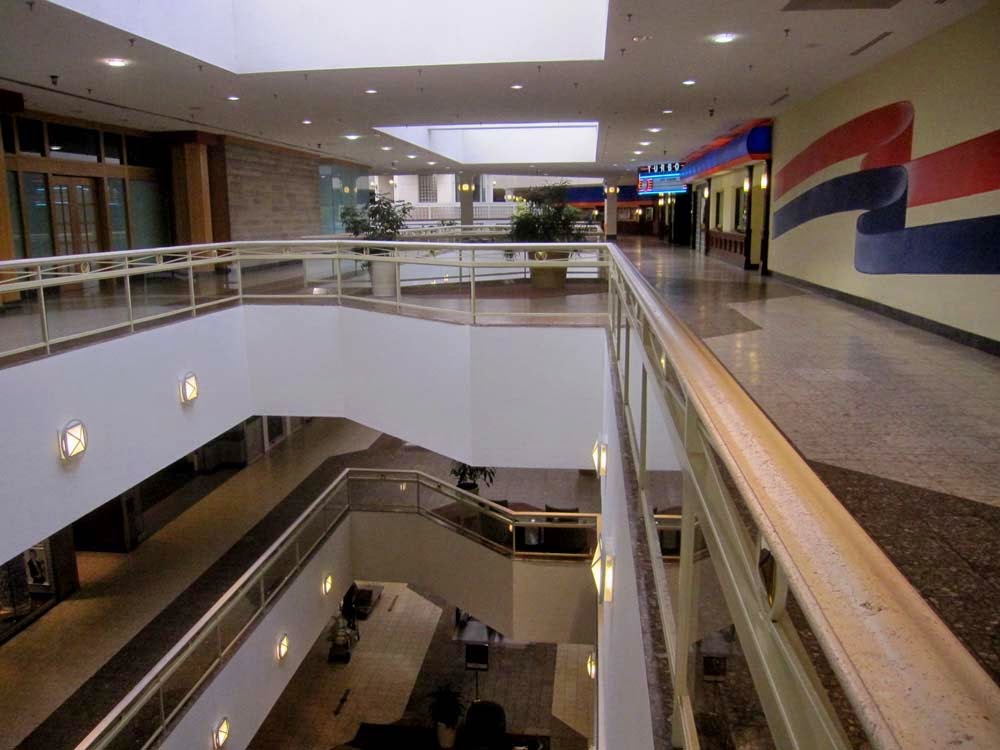
Closed theaters on third floor next to center court (adjacent to the closed portion of the third floor)

View of Bloomindale's from second floor

Steps from second to third

Bloomingdale's mall entrance from second level is super spooky

Bloomingdale's from third level
While White Flint was struggling to position itself, its competitors were increasingly drawing business away from the mall. The huge blow of Nordstrom choosing Montgomery Mall over White Flint in 1991 altered the balance between White Flint and Montgomery Mall. At the time, Montgomery Mall already had higher end Woodward & Lothrop, so the base of upscale shoppers began shifting away from White Flint. The second and hardest blow came from the redevelopment of the former Hecht's (originally Woodward & Lothrop) in Friendship Heights as part of the Wisconsin Place redevelopment. The demolished Hecht's was replaced in 2007 with a brand new Bloomingdale's that effectively cannibalized sales at White Flint's own Bloomingdale's. In addition, the mall has always had to compete with Mazza Gallerie, which abuts the Wisconsin Place development in Friendship Heights. Anchored by Saks Fifth Avenue and Neiman Marcus, the smaller boutique mall is situated in a complex with probably the most concentrated cluster of high-end department stores outside New York City. In addition, the complex includes a free-standing Lord & Taylor, which surprisingly has always operated simultaneously with the White Flint store.

Old food court sign looks pretty stuck in the early 90's

Mall directory showing the engine shape of the mall.

The main entry corridor was once pretty grand with soaring escalators overhead to the I. Magnin store, which later became Border's. Instead of occupying all three levels it was approached via an escalator from the single-level entrance wing on the first floor.


Inside Lord & Taylor at the mall entrance

Dave & Busters sign on the third floor
In early 2012, it was announced that Bloomingdale's would leave the increasingly vacant White Flint Mall citing poor sales. With the Friendship Heights store essentially replacing it, Bloomingdale's no longer had a need to operate such a large store at a dying mall that was tarnishing its image. Closing in March of that year, the building was demolished within a year to make way for the planned redevelopment of the mall. Redevelopment plans have been ambitious including demolishing the mall for a mixed used development that, according to this article, will have 21 new buildings including a 300 room hotel, four office towers, twelve highrise residential towers and a million square feet of retail space. In other words, White Flint will effectively be rebuilt into the urban downtown that Bethesda never had. Seeing the writing on the wall, it seemed that the remaining players would also stay on board with the plan. As it turned out, that was far from the case.


Third level "yellow" level parking deck entrance. The rear parking deck provided access to all three levels of the mall.

Inside of third level entrance

The mall's exterior was certainly straight up late 70's with its penitentiary-like brutalism that also resembled many office buildings of the period with the elongated single pane windows.

Dave & Busters has both outside and interior access.

Another view of the third level deck entrance
The first to react to the planned redevelopment was Lord & Taylor, which still operates at the mall today. At the pending announcement, Lord & Taylor sued to attempt to block the redevelopment in hopes of preventing the mall from being demolished while stuck in a long-term lease. While they lost in appeal, the fight turned out not to be over. It turns out that it wasn't just Lord & Taylor fighting the redevelopment. Joining in the fun is Dave & Busters who claims that lease terms prevent them being evicted. Even better is Lawrence Lerner, brother of Ted Lerner and original managing partner of the mall has also sued to block redevelopment. With a 2% stake in the mall, he claims that the redevelopment plan violates the original 1975 partnership agreement and that action on the mall was taken without his consent. It is a uniquely nasty fight surrounding a clearly troubled mall that has little chance of ever again succeeding as an enclosed mall. The result has held up redevelopment of the mall for months with the almost completely vacant mall still open to the public. In fact, the interior mall corridor was supposed to close in December 2013. Though held up, the demolition hurdles have mostly been cleared away when it was reported on July 24th that a judge ordered Dave & Busters out of the mall within 30 days. Up to their departure, Dave & Busters along with Lord & Taylor were the last two tenants remaining in the mall with the interior mall only still open because patrons to Dave & Busters must enter the mall on the third level.


Lord & Taylor's simple Mid-Century modernism on their store exteriors has not changed much. The white brick is the same although the arches give away its 60's and 70's design. The anchor apparently will remain open even after the mall is gone.
Aside from the issues surrounding the mall, White Flint Mall is a very distinct looking mall. With three main corridors, the mall has many unusual elements. First is the center court, which includes a center tower with an elevated platform on the third level. On that platform, it appears that it was possible to once go even higher to overlook the mall judging by the presence of a now inaccessible walkway above the main court. The mall also appears to have originally had a full third level with part of the third level sealed off and converted to offices due to lack of access to anchor tenant Lord & Taylor. Lord & Taylor is a two level store in lieu of Bloomingdale's, which had four levels. Most fascinating of all, though, was I. Magnin, which instead of anchoring the mall in a traditional fashion was situated in the middle of the main entrance wing above the main mall itself. Shoppers entering the main glass entry encountered escalators in the middle of the entry, which took shoppers to the first level of the store on the mall's second level. Looking up, more escalators were also visible criss-crossing the two levels of I. Magnin directly above the main mall with the glass canopy bringing light into not only the first level of the mall but also the store itself. This was not altered when Border's took over the space. The mall also had three fountains originally, all which were removed in later minor renovations. One of those was at the base of the escalator at the entrance to I. Magnin with the others in center court at the base of the multi-story tower in the center. The center also has a rear parking deck that provides direct access to all three levels of the mall.

Southeastern view of the now-demolished former Bloomingdale's


South/southwest entrance of Bloomindale's.

West entrance of Bloomingdale's facing roughly Rockville Pike (MD 355)

Close-up of main entrance. The Cheesecake Factory used to be on the right. I Magnin was inside the glass atrium.
Today, the mall has turned into a shell awaiting the demolition of the complex, which originally started early in 2014 with the Bloomindale's demolition. The Bloomingdale's wing has been sealed off with drywall, and an empty pad is growing weeds where a four-story Bloomingdale's once stood. In its place, a temporary metal awning protects the former mall entrance from the elements, and bracing secures the concrete walls that were part of the basement level of Bloomingdale's. While Dave & Busters continues to be a major draw to the mall, Lord & Taylor clearly has a sparse amount of customers. Most likely Lord & Taylor is looking for a way to break or terminate their lease so that they can consolidate into their Friendship Heights store or secure a location at Montgomery Mall when Sears closes. In all, White Flint was one of many malls whose successful run had run its course. It was simply unable to adapt to the complex and poorly understood changes in the industry. Unfortunately, it was also one of the most interesting malls in the city. As one of the most fascinating malls in the DC region, time is up for what was once one of DC's most upscale shopping destinations.


