The Tri-Cities region of Tennessee and Virginia includes the cities of Kingsport, Johnson City and Bristol with the last straddling the TN/VA border. Johnson City is the second largest of these cities, but today hosts the most popular mall in the region, The Mall at Johnson City. As the current winner of the mall race, it is a fascinating mall with a history that is more variable than most malls and a surprisingly upscale roster of stores inside disguised by a relatively mediocre anchor line-up. While the mall has become dominant in the region, its story unfolded over time and events as it fought hard to compete with two other malls in the Tri-Cities that were bigger with better offerings for many years before winning the mall race.

When the mall arrived around 1970, it was then known as Miracle Mall Shopping Center, a tiny mall anchored by Sears, Kroger and Britts Department Store along with SupeRx drugs, whose outside entrance appears to still exist though blocked off. The name Miracle Mall I love, by the way, and it is a great old-school mall name that they should bring back. Britts, which I have discussed on previous posts, was an upscaled department store variation of the JJ Newberry's variety store that was introduced originally in 1962 and closed in 1981. I also covered another former Britt's location at
Quintard Mall in Oxford, AL. Miracle Mall was also the second mall in the Tri-Cities with the lost Kingsport Mall arriving first in the mid-to-late 1960's. Miracle Mall clearly was the better mall to Kingsport's mall, but both were small and plain early shopping malls at the time they were built. Fortunately, Miracle Mall had room to expand and it never faced the threat of nearby competition that wounded and later killed Kingsport Mall.
Here, I am entering the original Miracle Mall portion of the mall from Belk Women's, formerly Proffitt's. The first photo shows the escalators used to transition from the original Miracle Mall to the newer portion added in 1982.
Sears mall entrance looks relatively contemporary, but this is the only original anchor remaining at the mall opening with the mall around 1969-1970.
Looking along the main part of the original mall basically in the center part, though it appeared there was no actual center "court". A wing extends off to the right at the Dick's sign in the distance. This was the original location of Kroger, which closed their store there and relocated in the early 1980's. To all appearances, Dick's is exactly in the original Kroger space.
Dick's mall entrance is positioned roughly just to the side of the main mall at the intersection of the main mall and the front entrance wing.
Looking along the original front entrance wing, it does not seem very substantial today. The original Miracle Mall was quite simple to have such a dramatic name. I guess they killed it because it envokes images of Wonderbread and other modern-era gimmicky names.
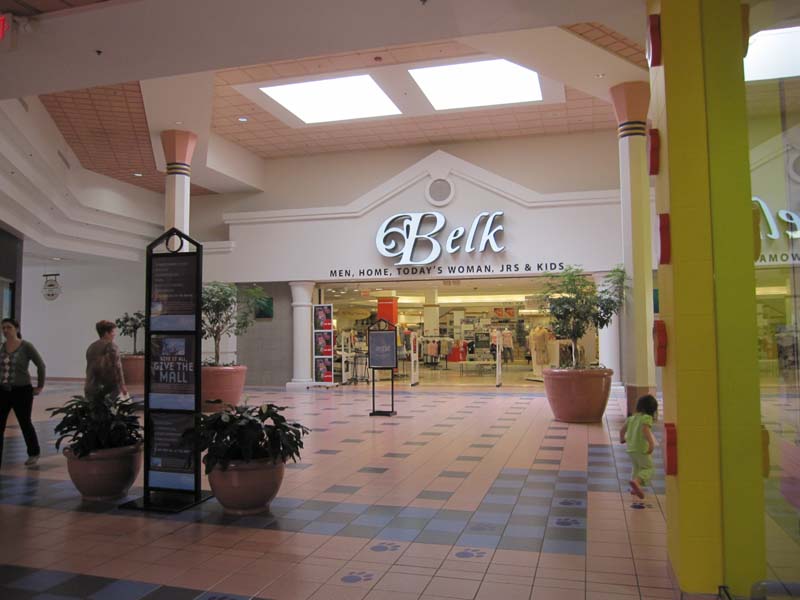
Belk Men's and Home could tell a lot of stories. It opened as Britts, converted to Parks Belk in 1982, converted to Proffitt's second store in 1995 then back to Belk in 2006. It is the only two-level anchor in the mall, and it looks somewhat threadbare inside in desperate need of a remodel. The escalators inside are original Britt's escalators.
Looking back along the old Miracle Mall portion from the entrance of Belk Men's pictured above.
Miracle Mall, however, was not without concerns in the early years of its existance. The construction of Fort Henry Mall in Kingsport in 1975 directly threatened Kingsport Mall, but by extension it also threatened to marginalize Miracle Mall. Bristol Mall, similarly constructed to Fort Henry Mall, arrived in 1978 to further erode the mall's customer base. Fortunately, Miracle Mall was able to hold onto its original anchors up to the first major expansion in 1982 when Britts closed the previous year. Additionally, two downtown Johnson City department stores that remained downtown into the early 1980's were also interested in joining the mall during the expansion. One of those was JCPenney and the other was Parks Belk. Parks Belk took over the former Britts location and JCPenney built new as the larger anchor of the expanded mall. Miller's of Tennessee also joined on as a junior anchor on the western edge of the wing between JCPenney and the older part of the mall. During this expansion, Kroger left the mall, which was replaced with inline tenants including Piccadilly Cafeteria. It was also during this time that the malls name was changed to The Mall at Johnson City.

Here, I captured an image of the mall map. You can see how the two levels of the mall are not flush by any means. Note in the map. The left anchor is the original Britts and later Parks-Belk. The bottom anchor was originally Proffitt's. The Dick's on the upper left was Kroger. SupeRx is believed to be the elongated store between the two Belk stores and the big wing to the left of JCPenney on the upper level was all originally Miller's, later Hess's, Proffitt's Home and Goody's.
Here is the mall entrance to Belk Women's, which was the original Proffitt's store in the mall that opened new in 1992.
Another view here of the escalators transitioning shoppers from the original Miracle Mall (lower level) to the upper level. This creates the center court, which is the only truly two-level part of the mall.
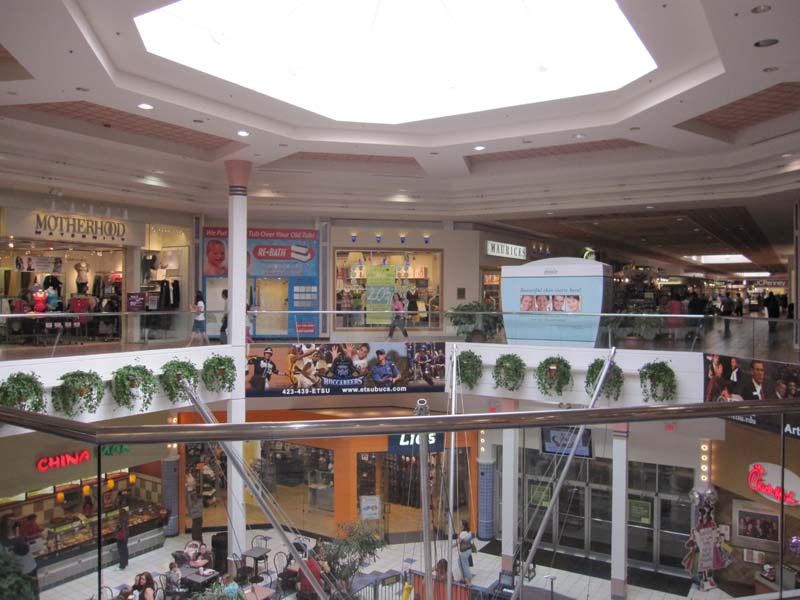
Here is center court with detail of the skylights. Note the mall continuing on the upper level but only doors on the lower level. Those doors open to the car tunnel providing access between the front and rear of the mall.
Here is a better view of the rest of the mall combined with the doors. A food court fills the bottom level, and it had pretty much everything you could expect in a food court including local favorite Petro's.
In the other side of the court, you see the lower level extending on as part of the mall (the original Miracle Mall) and the upper level greeting shoppers with a round window and down escalators. Below patrons dine on overpriced food court fare.
The 1982 expansion resulted in a highly unusual design feature due to the terrain surrounding the mall. The original mall was built in a shallow ravine with the Britts store itself situated on a hillside with the northern outside store entrance one level higher than the mall itself. It was also the only two-level anchor with the rest of the mall on a simple one-level footprint. This meant that in order to expand the mall, either the expansion would require extensive excavation of the site or it would have to be placed higher than the rest of the mall. The result was that the new wing was built one level higher than the original mall. This required escalators and elevators to transport shoppers between the old and new parts, and it also made for an escalator-filled shopping trip for shoppers entering the second floor of Parks Belk heading to JCPenney. Also included in the expansion was a car tunnel under the new portion with a side entrance into the original portion retained. In all, it seems rather unusual that mall owners did not simply decide just to make the original Miracle Mall two levels to match the new wing, but the unusual stepped-up design remains to this day.

Here is a closer view of the top of the escalators transitioning to the lower level.
Here is a view of the upper level, which architecturally matches the original Miracle Mall exactly. Both were renovated last in 1992, but they may have both looked very different before. Abercrombie & Fitch is on the right.
Two angles of the front entrance wing on the upper level. The first is facing toward the outside entrance and the second is toward the mall. Use Victoria's Secret as a vantage point.
JCPenney's mall entrance is shiny, dark but otherwise basic. It does remind me somewhat of the mall entrance at now-closed Oak Ridge Mall.
Here is a view back along the second level toward center court transitioning to the lower level.
Between 1982 and 1992, not much changed at the mall. The only significant change to note was the conversion of Miller's to Hess's in 1987, but 1992 onward proved to be a period of enormous transition for the mall, though all of it was positive. The first major change was the renovation of the mall coinciding with the construction of a new Proffitt's at the back of the mall on the site of the mall's original theater. Proffitt's entry was splashy with a center skylight along the length of the store and a contemporary look that began to solidify the mall's presence in the region, making it a very real contender against the three other Tri-Cities malls that by then were beginning to show their age. Somewhere in this time as well, an excellent food court was established on the bottom of the the two-level high court at the base of the escalators to the upper level wing. However, the mall would still have to face some growing pains as anchor changes and ownership changes would ensue.

A little over two years before, I would be standing inside of Goody's, which opened as Miller's and was later Hess's and Proffitt's Home Store. After the store closed, the owners decided to cut a new wing right through it that looks nothing like the rest of th emall. It is shiny and tasteful, but still quite plain. Forever 21 took up a huge portion of the new mall space, and owners hope the doors at the end which once opened into the anchor will open to an anchor the other way around in the future.
Looking back along the "new" wing towards the main upper level wing.
Now a new secondary mall entrance and future mall entrance for a currently non-existant anchor, this is the outside door for the new wing shown above that originally opened to Miller's.
I am now standing outside Sears package pickup looking at the tunnel under the mall. Above is the second level and inside the tunnel on the right are the doors into the food court and two-level atrium.
Inside the tunnel with the mall entrance doors on my left. This might have turned out better if I could have used a flash.
Detail of the Sears store, which is very plain and simple. Inside, the store has higher ceilings than modern stores. Sears has occupied this location for 40 years.
The challenge the mall would face came first the same year that Proffitt's entered the mall when Hess's went out of business. Proffitt's then took over the location for a home store to augment their new store in lieu of the mall attracting a new anchor to the in-line space. Furthermore, the situation grew more complicated when Parks-Belk, a Belk partner with controlling interest, would sell out to Proffitt's temporarily eliminating Belk's presence in East Tennessee and giving Proffitt's a glut of space in the mall. Proffitt's ultimately took over the Parks-Belk space, which had originally been Britt's, and subsequently freed its home store in the old Miller's/Hess's space, which was then leased to Goody's. The newer Proffitt's that first opened at the mall converted to a women's store with the older Britts/Parks Belk space converting to a men and home store. I am sure most of you are confused by now, but this was not all that happened at the mall in the 1990's.

This store showcases the Proffitt's prototype of the early 1990's. It was flashy then, but looks gaudy and rough around the edges now. It is still a sight to behold inside, though, with a skylight running the length of the store that is brighter than the rest of the mall. Perhaps Belk should build a new store next to the old Miller's and let THIS become part of the mall. Nah, never mind.
Belk went for a grand new entry when they took over the tired old Britts/Parks-Belk store. Did they do this, though, or did Proffitt's actually? I am curious as to what this looked like before, because the old Britt's store I saw in Alabama was quite plain. I have also heard this had the strange greenish awnings on it like the other Tri-Cities Parks-Belk stores did.
Dick's here looks new, but apparently fills in what was once Kroger. I am guessing something was here inbetween, because it couldn't have ALL been Piccadilly Cafeteria.
JCPenney sports a triangular tinted greenhouse look, which was common in 1982 models.
The last thing to happen to the mall in the 1990's was the purchase of the mall by Glimcher Realty. Glimcher, unfortunately, has earned a bad reputation for mall management with the failure of Eastland Mall in Charlotte being a high profile example, but this is not the case with Mall at Johnson City. In fact, Mall at Johnson City has emerged as the leading mall in the region with not only the best stores, but also the best anchors in the region. Glimcher's signature style of little to no renovations, however, is apparent at the mall as much of the mall still looks like it is trapped in the early 1990's. In a vastly under-retailed region with flagging competition, however, this seems to be a non-issue.
Two generations of mall signs here, and the first one is not only ugly but has not weathered well at all. I sure wish I had the original Miracle Mall sign to show here as well. With a name like that, it HAD to be awesome.
In 2006, The Mall at Johnson City began to see big changes again. This time, struggling Proffitt's was suddenly bought out by Belk with Belk muscling its way right back into East Tennessee Parks-free while the Parks family was most likely enjoying a prosperous retirement. Belk then absorbed both Proffitt's stores in the mall. Two years later at the start of 2008, Goody's would depart the mall leaving the original Miller's location vacant for the last time. As soon as they closed, Glimcher then converted the entire store to a new wing for the mall including a new Forever 21 store as a junior anchor. This new wing was designed with a very contemporary theme including orange and mild earthtones with the rest of the mall remaining unchanged. All of the mall entrances were also updated with a new look to compliment the new entrance in the rear of the mall. The new rear entrance was designed with a potential future anchor in mind, but the region currently is overlooked by many potential anchors including Dillard's and Macy's. Dick's Sporting Goods, however, opened in the front of the mall where Kroger was located originally restoring a unique non-traditional anchor in a region with significant outdoor recreation.

This mall entrance fronts the second level next to JCPenney and was added in 2008. Another really nice (and different) one was next to Dick's, but parking was impossible making it impossible for me to get a picture.
Sears Auto Center still works the grease in front of the mall on Roan St. It is also original, and it looks it, too.
With all the retail and economic gloom and doom, this mall is not going anywhere. The only real threat to the mall is the long-planned redevelopment of Fort Henry Mall, but that seems to be unable to commence with the mall actually struggling. Bristol Mall is also in a weak position as the city is too small to support it. Overall, all of the popular national specialty shops have chosen The Mall at Johnson City first, and on the day I visited the crowds were so heavy that finding a parking place was next to impossible. I have seen few malls that are as popular as this mall is, so its future remains bright even in a region that is generally not very prosperous. It also helps that East Tennessee State University is in Johnson City, which gives the mall an edge over its competition as well. My only doubt with the mall is that it will be able to attract another department store anchor, though the possibility of something non-traditional such as a large bookstore is decent if the real economy improves. Other than that, this seems to be a powerhouse mall with a weird design that brought down the mighty even as the oldest standing mall in the region.