Wednesday, April 24, 2013

North Park Mall: Ridgeland, MS

Built in 1984, Jackson's newest traditional mall is likely to be the last mall ever built in the city as well as the last mall in the city to operate as a traditional mall.  This is due to the combination of the failure of the city's other two indoor malls coupled with the fact that every shopping center built in the city since then has been an outdoor power center or lifestyle center.  As an otherwise unremarkable mall, this is still one of the largest malls in the state at 957,000 square feet, and its now dominant position as the remaining mall is what keeps the mall going strong.  However, this is an unenviable position as Jackson drifts into one mall territory, which likely will lead to the mall absorbing elements that have killed its predecessor Metrocenter.  This is currently the issue with Eastdale Mall in Montgomery that lost its mall competition in 2008 and now is suffering decline despite having a full deck of anchors and no other enclosed malls to compete with.  While the mall features three anchors (in four anchor spaces) and low vacancies, it is not a mall that is likely to remain immune to the forces of competition.  Currently two anchors have another location elsewhere in the city, but that is likely to change further in time.  For now, it is a reasonably attractive mall owned by Simon with two Dillard's, JCPenney and Belk, so the mall is respectable for a city this size.


North Park Mall is actually located in the town of Ridgeland, which is a suburb of Jackson instead of the city itself.  When the mall opened, it dealt a devastating blow to nearby Jackson Mall closer to downtown.  As the older and smaller center with fewer choices, both JCPenney (with the Funky "P") and Gayfer's jumped ship from the mall to join the larger North Park Mall leaving the older mall anchorless, eventually closing before becoming a medical mall.  Gayfer's was actually moving into a smaller store at North Park, but it was also in a better neighborhood.  Along with JCPenney and Gayfer's came Jackson's own McRae's and the city's second location of DH Holmes.  Gayfer's took the north anchor, JCPenney the west, McRae's the east and Holmes the south.  The opening of this mall created a whole new suburban retail corridor that sprung up along I-55 north of the city coupled with older Highland Village to the south and many other shopping options inbetween.  


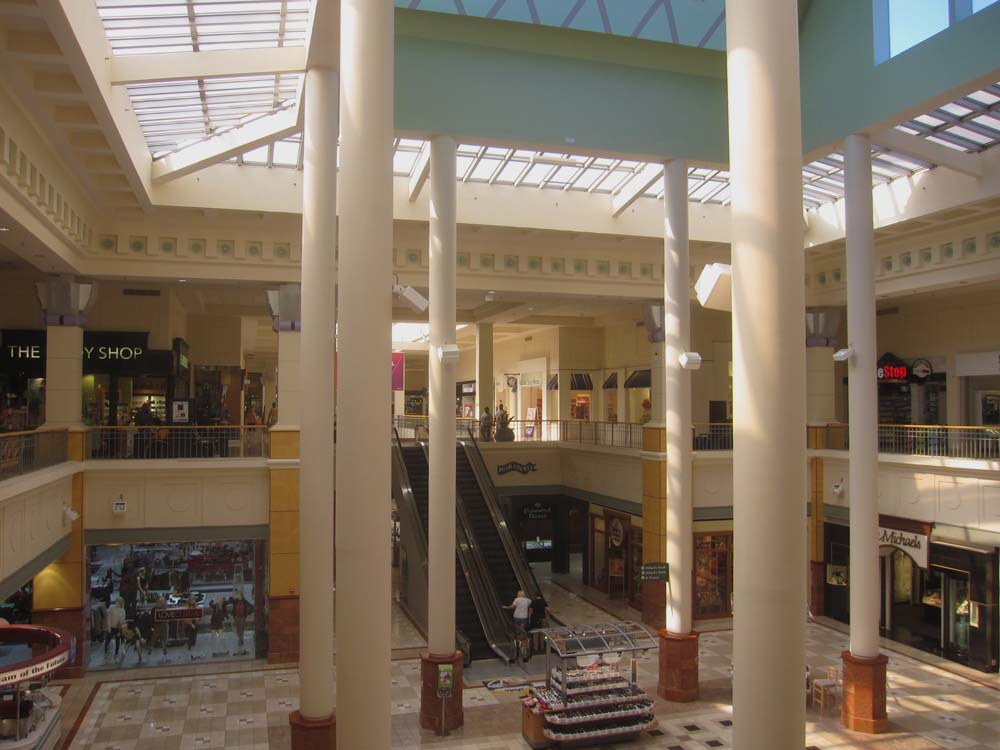
The first photo is of the mall's center court while the second photo is looking from center court down the DH Holmes/Dillard's South wing.  The center court is beautiful, although it would be more stunning with some greenery and a fountain.


Close-up detail of the Holmes mall entrance.  Dillard's has not changed this nor have they made any exterior modifications to this or its other store in the mall to their typical look.


McRae's apparently did not want to impress much with their mall entrances, because as Belk it is absolutely as plain as dirt.  Maybe somebody remembers?

For years, while North Park grew more popular, it was still overshadowed by its larger competition on the opposite side of the city, Metrocenter.  While doing fine, it was for a time a secondary choice.  Curiously, neither mall had both a JCPenney and Sears together.  Metrocenter had the Sears and North Park had the JCPenney.  It is wondered how such a situation like that could have occurred since most malls built in the 70's and 80's managed to eventually have both.  Nevertheless, as Metrocenter began its long decline starting in the 1990's at no point did North Park ever expand, suggesting that the favorable location of North Park was seen as enough by the mall's owners.  The mall renovated once before in 1995, relocating and expanding slightly for a food court, but this was as far as it went.  The mall apparently has been renovated again since, but it is unknown when exactly this was done.  The result of this was that when Sears closed at Metrocenter that the entire city became one of the first mid-sized cities in the nation without a Sears.


A couple views along the main mall wings.  No pictures were taken of the food court, which is on the lower level between JCPenney and Dillard's North.


Another view of center court with detail of the center skylights.

Nevertheless, in the period of anchor consolidation that took place in the 1990's, management was bound to be on edge.  In 1989, DH Holmes had already been converted to Dillard's, but when Dillard's also bought out Gayfer's, this resulted in the mall having two Dillard's stores.  Perhaps Sears was considered for the Gayfer's location if Dillard's closed, but it was clear that neither May Department Stores or Federated Department Stores (which are now all part of Macy's) did not have any serious interest in expanding to the market.  Furthermore, when McRae's recently chose a flagship store to replace their store at Metrocenter, they chose a location in a new shopping center in Flowood instead of designating the North Park store as such.  During the period that McRae's opened in Flowood, JCPenney also built a store in the area.  Belk, however, keeps the store open unlike Metrocenter and JCPenney so far is keeping both stores in the market.


Detail of the JCPenney mall entrance, which is the typical late 70's/early 80's design with dark glass, display windows and dark panels.


Dillard's North mall entrance, previously Gayfer's.

As basically a cross-shaped mall, the interior of the mall is bright and cheery with abundant natural light and two levels.  It is also one of only two two-level malls built in the state (not counting anchors), the other being Metrocenter.  The only malls comparable in size anywhere near it other than Metrocenter are in Baton Rouge, Memphis or Birmingham.  Nevertheless, the mall faces competition from the huge development in Flowood centered around Dogwood Festival Marketplace to the southeast.  Also, a couple exits up is Renaissance at Colony Park, which is a lifestyle center containing most of the upscale stores that likely once called North Park and Highland Village home.  The biggest threat to the mall in the future is if the anchors decide that it would be better to join one of these developments.  Currently Colony Park is anchorless and only Belk (former McRae's) is at Dogwood Festival Marketplace.  If Dillard's especially decides to leave for one of these developments and JCPenney's current troubles cause the company to fail, it would be devastating for the mall and could place the city in the eventual position of being the first city without a traditional enclosed mall.  While that is a worse case scenario, that is not entirely unlikely in the current market that faces a serious mall meltdown if JCPenney and Sears both end up closing, and even one anchor loss could be devastating for this mall.


Exterior views of the DH Holmes, now Dillard's South.  The store carries a lot of similarities to the store at the now-demolished Belle Promenade mall in New Orleans.


When JCPenney was doin' it right, they were doin' them all the same.  This store is similar to many others built in the mid-to-late 1980's.


Here is an outside shot with the food court on the right and part of the Dillard's North/Gayfer's on the left. 

For now, the mall seems to be in a good position.  However, it is a mall that seriously needs to consider making changes to make it more competitive in the long term.  In a city with few potential anchor choices, it is risky to keep four large anchors on any mall.  Expanding either the former Gayfer's, consolidating them into one larger, more updated Dillard's store would be a start with the former Holmes and connecting wing demolished for a lifestyle center addition.  Perhaps also the Dillard's should be rebuilt where JCPenney currently is with JCPenney taking the existing Dillard's north location.  This would reduce the risk of creating a vacant anchor that couldn't be filled and decrease the likelihood of Dillard's looking elsewhere.  This would also allow the mall to increase its square footage and diversify its offerings to better compete.  If this were done, this would also help the mall to attract a store like Macy's to fill JCPenney or Belk if either decided to close or relocate.  In this environment of fading malls, it is very important for the remaining malls to minimize their dependence on traditional department store anchors with the average mall aiming to have only one or two department store anchors and to convert larger portions of the mall to a pedestrian-only outdoor format with a more inviting and less insular design.  


The Gayfer's/Dillard's North here is one of the favorite late 70's/early 80's designs of Mercantile Stores featuring boxy entrances and lots of brown brick. 


The Belk, formerly McRae's, is one of the most brutalist stores I have seen.  This store was built just shy of the emergence of Post-Modern architectural design.  It is very imposing and could be mistaken for a very drab office building from the 70's.  McRae's built or acquired some very attractive or distinctive stores.  This is not one of those.  I'm sure there are many that will disagree, however.

In all, North Park Mall is a successful, albeit basic mall that should take steps to better define itself now that it is soon to be the only mall left in the city.  Perhaps it should even be renamed if they undertake the suggested renovations that I discussed here.  North Park Mall is a very generic name that has been shared with other malls, including dead ones.  Something akin to Mall of Mississippi, Capital Centre or The Mall of the Delta would be better to sell the mall.  As the center point of a sprawling retail corridor situated just beyond view of the interstate, North Park can either remain that destination or one day suffer the fate of its sister mall across town.

Also: I failed to get a picture of the mall directory, so here is the lease plan:
Lower Level | Upper Level

Tuesday, April 23, 2013

Highland Village: Jackson, MS

Among Jackson's malls, one in particular stands out as particularly unique and that is Highland Village.  Built in 1975 as an open-air two-level mall, the center tends to get somewhat overlooked because it is not a traditional mall with the usual 3-4 regional or national chains.  Nevertheless, this boutique mall does well in one of the most upscale portions of the city.  Located at I-55 and E Northside Dr, the center has high visibility and remains popular.  The center is not entirely retail, however.  Its offerings are actually a mix of office and retail with the upper level almost entirely made up of offices.


Highland Village in all contains 48 stores located on the lower level of the center.  The stores are a mix of local boutiques, but it has a couple national chain stores (Talbots and SAS Shoes), and its major anchor is a small very high-end department store, Maison Weiss, which has a second location in downtown Oxford, MS.  Maison Weiss exists to provide a very upscale shopping experience in a market under-served by upscale stores carrying designers typically only found in stores like Nordstrom.


The first photo is one of the two center court areas of the mall.  The second photo shows a covered area looking from the upper level next to the covered court.  The mall is open-air, but it features a mix of open and covered areas providing places to run from the frequent downpours, but still have an outdoor feel. Of course, with the humidity in Mississippi, I'm not sure than outdoor feel is exactly a wise business plan.


This is obviously not a true mall considering that escalators are not present anywhere in the mall.  This is also evident as to why only offices are upstairs.  While it is possible retail was on both levels, the design suggests it was always offices on the upper level.  Even if the retail part doesn't do well, you can always get a root canal here.


This is something that it's hard not to like, though.  Shady canopies with nice flowers and trees.  I'd be all for taking the roof off of malls if they looked like this and were pedestrian only with cozy spots like this.


One of at least three stunning fountains in the mall.  I have more pictures of this to follow.


Part of the same court with the fountain above.


The children are bound to love all these levels to run up and down and look off.  The child in me loved it, too.  The child in me no longer runs and screams and pisses off their parents, though, when they explore the place.


Many elements of this place still give its age: especially the wooden shingled mansard, heavy use of brick and flat roof.  It's okay with me.  It beats pink stucco.

The mall itself is stunning featuring so many elements lost in modern malls.  The mall features many trees and planters, several fountains, sculptures, a terraced layout and different styles of overhead walkways and staircases providing access to the upper level.  The center court of the mall is covered as well to provide a place of protection from the frequent Mississippi downpours.  The design is also distinctive featuring a 70's interpretation of traditional architectural designs.  The urban courtyard effect of the mall is also fits well with the classic look of a Mississippi Delta town.


Here is the covered court area of the mall.  It is so vibrant and lush and inviting, and would be great fun to relax in during a thunderstorm as long as that didn't involve large hail and a tornado.


Now THIS is a fountain.  These are the kinds of fountains that malls used to always have.  Terraced with waterfalls and deep blue pools.  Now malls act like a small cast iron old timey fountain is some sort of a replacement for something like this.  Sorry, they suck.


Another view of the court and fountain.  Also note the plants.  Yes that means you Simon, CBL and Hull Storey Gibson.  This place looks much more inviting and richer with greenery that isn't grown in a giant movable pot.  


Take only pictures here, leave only critical remarks at other malls.


I can imagine having an office here would be nice.  Unfortunately, I'm not to the level to have any office yet.


View of steps and interesting ceiling treatment on the upper level.


Looking west towards I-55.  The green and white canopies look like giant caterpillars trying to devour the place.


Along the west side of the mall, you find this cute although far less impressive fountain.  Oh well, it's better than just concrete.  The vines are a nice touch, too.


The only unfortunate aspect of the center is that it has little room to expand being landlocked on all sides.  The result is that Highland Village will always be a small boutique mall and never able to morph into a major shopping mall without tearing down tracts of houses in nearby subdivisions.   Fortunately, this means little risk that the mall will lose its quaint charm.  That charm was enough to draw Whole Foods, which broke ground on November 8, 2012.  This is a major event since this will be the first Whole Foods in Mississippi when it opens later this year.


A couple views back on the north court area.  You can make out some nice places for a lunch, the fountain and a big blue caterpillar that is crawling down the stairs.


The north court fountain is simply stunning.


Now I see what the blue caterpillar is after.


For this to be called "center court", it must be halfway between the two courts I mentioned.


"Promenade" is actually Maison Weiss department store, and it is situated on the north side of the mall.  The large open area is the outdoor north court and the diamond-shaped area is the covered south court.


Maison Weiss department store with shopping center sign.  The sign is a delightful 70's throwback.


Here is a better view of the entrance to Maison Weiss department store.  It does not open to the rest of the mall.

Centers like this later morphed into the modern lifestyle center.  The open-air mall design is very rarely used these days without being set up like an urban downtown with streets, though exceptions exist in places like Richmond, VA (Short Pump Town Center) and Madison, AL (Bridge Street Town Center).  Open-air malls were the original malls in the 50's, but most failed or were enclosed due to the popularity of enclosed malls in the 70's, 80's and 90's.  Some were built in the 70's, and like Highland Village were largely boutique malls that typically did not catch on such as Merchant's Walk in Cobb County, GA.  Since then, their popularity has come around as enclosed malls have faded in popularity and became too expensive to operate while lifestyle centers and upscale strip centers have come to dominate.  This is why it is very unusual to see a surviving 70's open-air boutique mall like this one.  It is a center that survived the fads and has come full circle to remain pretty much the same as it always was.

Sunday, November 18, 2012

Jackson Mall: Jackson, MS

Some malls never really die even if that means the mall is reinvented into something radically different than it originally was.  Jackson Mall, now Jackson Medical Mall, is a good example of that.  The concept of "medical malls" has had mixed success.  The Riverbend Medical Mall in Rome, GA was an abject failure while 100 Oaks Mall in Nashville and this mall have both been wildly successful.  While the concept is definitely unconventional, the mall is a mix of offices and a small amount of retail keeping the oldest mall in the city alive when it otherwise would have been closed and demolished.


Opening in 1969, Jackson Mall was the very first mall in the state of Mississippi.  Unfortunately, it did not provide a complete retail experience for Jackson.  Closer to downtown than the other three malls in the city built later, stores that had a presence in the city such as Sears and McRae's remained downtown.  The anchor line-up in the original mall included a two-level Penney's, huge three-level Gayfer's and Woolco with Elmore's variety store near Woolco.  The mall was a straight shot south to north between Penney's and Woolco with Gayfer's off to the west side in the middle.  It also has a main entrance in the middle on the east side and side entrance wings near Woolco and Penney's.  In other words, it was a pretty conventional mall for the era aside from two showy anchors and quite unexciting when Metrocenter and later Northpark Mall arrived on the scene.


This is the current mall directory.  The South Office Center cluster next to the red shops on the left is the former JCPenney, the West Office Center is the former Gayfer's, either 3 or 5 is the old Elmore's, Piccadilly Cafeteria is 35 and the UMC Cancer Institute is the former Woolco.  The first photo is pretty much how the entire main mall looks.  I was unable to photograph center court.


Southeast mall entrance where the retail shops are located.  This is next to JCPenney, and the entire left wall into the mall and former mall entrance contains the former store.


East side of former JCPenney.  Note the design in the white part with the "Funky P" laid out in an array.

When Metrocenter opened, Jackson Mall was able to co-exist with the newer, larger mall since they served different markets in the city.  Jackson Mall served the east and north parts of the city while Metrocenter served the areas south and west.  However, the closure of Woolco in early 1983 began the mall's troubles.  By then, the mall was located far from the interstates in the city and failed to expand and modernize to remain competitive.  When Northpark Mall opened in 1984, it was a catastrophy for the mall immediately taking both JCPenney and Gayfer's leaving the mall anchorless.  Soon after, the mall would close with nothing to draw customers in what had by then become a declining area left behind by retail development.  Most of that new development had mostly sprung up along the eastern side of I-55 while the mall was well west.


View of JCPenney court looking toward Piccadilly and the southwest entrance.  The main mall is to the right.


JCPenney mall entrance with southeast entrance wing to the left.


Woolco court.  Note the large tree and planter.  How come a repurposed mall can have one but a real mall can't have a single one?

In 1995, a local doctor came up with the idea to revive the dead mall as an inner city revitalization project.  Instead of a conventional mall, Dr. Aaron Shirley, according to the mall's website, "proposed that Mississippi's first retail mall be converted into a state-of-the-art ambulatory health care facility providing quality care for the urban poor of Jackson, Mississippi".  As a result, the mall reopened, anchors were filled with medical offices and a retail component was even retained to serve the patients and employees.  A Piccadilly Cafeteria is still operational on the west side near Gayfer's and a few small shops operate in the mall clustered near the former JCPenney.


View of the mall and main entrance with the former Gayfer's in the background.


View of southeast mall entrance with JCPenney in the background.


This former Woolco is pretty self-explanatory.

In appearance today, the interior of the mall retains much of its 1960's appearance.  It has the same high courts next to the major anchors, and the main change seems to be the wooden flooring throughout.  Outside, the anchors also maintain much of their original appearance: especially the old Penney's, which still has a Funky "P" array repeating over the entrances outside.  The mall also is probably busier than it was at its peak keeping a completely full parking lot.  In fact, it was extremely difficult to find a parking place when I arrived.  Rest assured, most of the people that were there probably did not want to be there.


The pictures of this mall are not the best, because it was difficult to get pics both inside and out.  The absense of parking and presence of too many people made getting good angles tough, especially outside.  This was the former Gayfer's.


This is my best shot of the old JCPenney.  Other than the lack of a logo, the store still looks like it never stopped being JCPenney.


Another impossible mall angle due to congestion.  JCPenney is ont he right, the southwest mall entrance in the center and Piccadilly Cafeteria is on the left.

While the mall is no longer in its original use, I applaud the efforts to keep the mall alive.  I believe it is important for the state's oldest malls to be kept open and in use at any cost as they are historically significant.  Malls such as McAlister Square in Greenville, SC, the oldest in South Carolina, likewise found a re-use as a multi-university campus.  While I wish these historical malls could become real malls again, I was pleased to see that all of Jacksons malls are still intact in some form and that the city has a vested interest in keeping them all alive.