Showing posts with label Dick's Sporting Goods. Show all posts

Wednesday, December 20, 2017

Town Mall/Cranberry Mall: Westminster, MD

Town Mall of Westminster is a cozy mall nestled on a hillside on the north side of the the city of Westminster.  Situated at the southeast corner of the intersection of Routes 27 & 97, the mall sits in the transition zone between the outlying Baltimore suburbs and rural farmland.  Opening on March 4, 1987, the 430,000 square ft. mall came along during a time with a ton of transition in the retail industry, and it indeed opened up with a very unusual roster of anchors.  Today the mall remains marginally successful helped along by its unconventional anchor mix.  Its trade area serves Westminster along with several other towns and communities in the area in both Maryland and Pennsylvania.


Cranberry Mall as it was originally known was a mall that was delayed for many years.  Complications involving zoning, roadways, land use, and the original owner being unable to finance construction of the first mall.  This delayed the construction of the mall for over 15 years.  In fact, had everything fallen into place, this mall would have been built in 1972 instead of 1987.  Some of the original tenants that had considered opening at the mall included G.C. Murphy and Giant Food.  Perhaps the delay led to a mall that ended up being slightly higher end than the original mall would have been.  This is considering that a mall with the kinds of anchors originally proposed resembles several dead malls found across the Baltimore region that consisted primarily of low-end tenants such as North Mall, Chatham Mall, and Timonium Mall.  Each and every time that everything seemed to come together to build the mall, it was delayed yet again.  It wasn't until the land was sold to the Shopco group in 1985 did plans finally materialize for a mall.


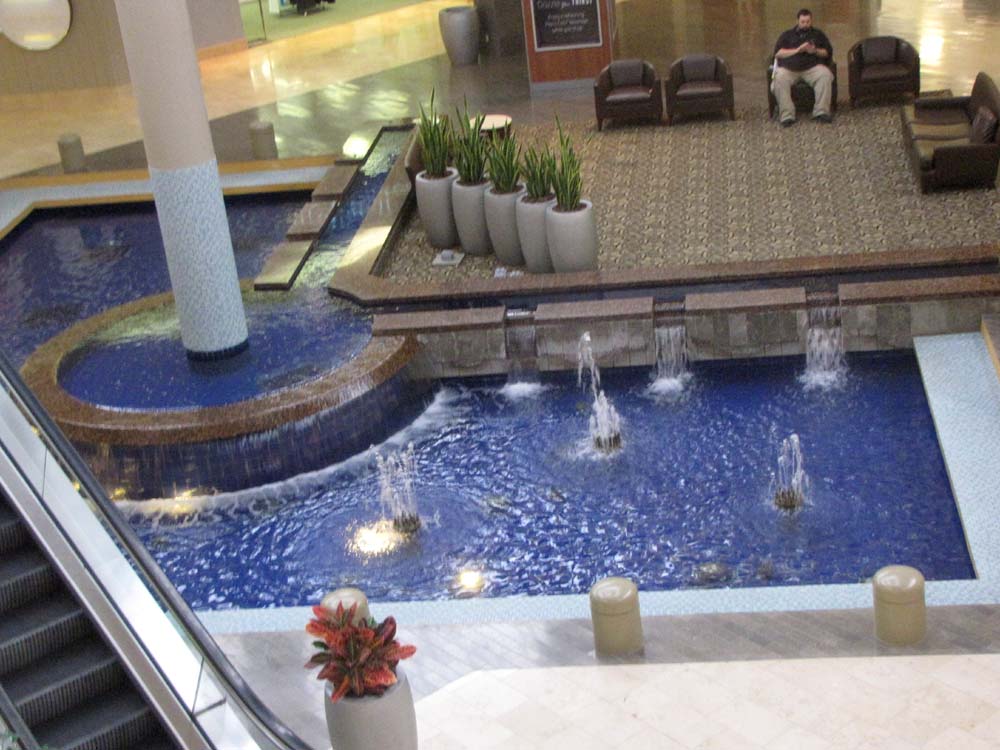
The first view is the center court fountain with Sears in the background.  Sears was built for the defunct Baltimore-based Hutzler's.  The second two photos show the same fountain in respect to center court.  It's a cool fountain, but it looks a little lonely with no plants around it.  These days, you just have to be happy that at least the mall still has a fountain.  Mall fountains are a major reason I got into this hobby, so I'm very unhappy to see them go.


A couple views of the court outside of Belk.  The moody 70's-style skylights are one surprising feature to find in a mall built in 1987.  The whole mall looks like it was designed in the early 80's with few modifications when it opened.


One of two ramped sections in the otherwise one-level mall give the mall personality.  It is very appropriate considering that Carroll County is quite mountainous.


Boscov's has certainly been a positive for this mall given that it might have not survived had they not come in.  It was previously a Montgomery Ward.


Toy department inside Boscov's.

The unusual anchor mix was something original to the mall.  Built by the Shopco Advisory Group, the originally planned anchors were Virginia-based Leggett, Baltimore-based Hutzler's, and New York-based Caldor.  Caldor was expanded during that time as part of a legacy of Baltimore-based Stewart's (both were owned by the same company).  Hutzler's, however, was going under during the mall's construction meaning that the store was built but never opened.  After three lawsuits against the failing chain for non-payment of construction and non-completion of the store, the Hutzler's space was taken instead by Sears.  Montgomery Ward later joined the mall in 1990, resulting in one of a few malls around the country with both Sears and Wards as anchors.  In all, it looked like a situation that would end badly, but the mall is still hanging on 30 years later.


Leaving Boscov's with the mall directory on the right.


Town Mall (Cranberry Mall) directory.  Sears was built for Hutzler's (opened as Sears), Belk was Leggett, Boscov's was Montgomery Ward and the cluster of Dick's Sporting Goods, Paradise of Fun, and Gold's Gym was previously discount chain Caldor.  Caldor opened original to the mall, but most Baltimore-area locations were formerly Stewart's Department Store.


The second fun little ramped section includes a very cool greenhouse dome in one of the stores.  They were very popular in the late 1980's, but it is unclear what that originally was.  Chick-Fil-A still going strong is a good sign.  They are the chicken in the coalmine.  When they go, so does the mall.


Approaching Dick's Sporting Goods.  It is hard to tell how this looked as Caldor since it has been so heavily modified unless the entrance on the right in black is original.  In any scenario that the mall gets redeveloped, Dick's will definitely be one who stays.

Although Leggett was mostly found in Virginia, the logic of Leggett opening in the mall was not as strange as it seemed.  Leggett was previously located in Westminster Shopping Center and had opened there in 1963 before moving to the mall.  Today, Belk occupies the former Leggett space.  The older shopping center is situated less than a mile from the current mall and is currently doing well, although it is no longer a true regional shopping center.


A look at the two entrance wings next to Dick's Sporting Goods.  I'm not sure which one is which, but I'm pretty sure the second one is the northwest entrance wing since it appears the mall's theaters are on the left in the background.  The other is the northeast entrance meaning shoppers have to enter the mall to go to Dick's.  It's a bit ironic that the mall's Chick-Fil-A is not in this food court.


Sears is sporting the dual entrances on the east wing off of center court suggesting this was a Hutzler's idea.  


Somehow I knew that Toys 'R' Us Express stores in malls were going to be a novelty.  .  Now that the company has announced at least 100 stores closing, we likely will not be seeing these ever again.  This is sad in a sense considering that this same chain likely killed a real toy store chain such as Circus World or Kay Bee Toys within the same mall in the past decade or so.  Photo from May 4, 2013.

Since the 1980's, a number of anchor changes have taken place.  In fact, the mall does not have a single original anchor.  The first to change was Leggett, which was sold to Belk in 1996.  Belk largely passed on most of the former Leggett stores in Maryland leaving this as one of only two Belk stores in the state although a store is proposed to open soon at Valley Mall in Hagerstown.  It is also the second most northern Belk store in the entire chain (the northernmost store is in Morgantown, WV).   While Leggett was affiliated with Belk as part of the Belk family of stores, it was a separate chain operating in Virginia, West Virginia, Maryland and Delaware.  Following the change from Leggett to Belk, the next anchor to change was when discount chain Caldor folded in 1999.  From 2003-2009, Steve & Barry's University Sportswear used part of the former Caldor space.  Today that store is divided between Dick's Sporting Goods, Gold's Gym and Paradise of Fun.  Dick's also has a mall entrance.


Climbing back up the second of two ramps with Belk emerging on the horizon.


Belk mall entrance from the south court.  What wonderous water feature was covered up by this garish maroon carpet?  This carpet at least needs a dripping snow cone justification.

Shortly after Caldor faded into history, Montgomery Ward shut down for good in 2001.  However, it did not remain vacant long as Reading, PA-based Boscov's stepped in to fill the void shortly after.  At the time, there was real concern the mall would not survive, so Boscov's was seen as a godsend.  The resulting anchor changes meant that this is the only mall where Boscov's and Belk share a store.  Piedmont Mall (now Danville Mall) in Virginia also once shared a Belk and Boscov's, but the Boscov's in that mall was short lived.  The result of this anchor shuffle fortunately did not lead to a dead mall.  However, the unconventional anchor lineup has not resulted in a healthy mall.  The mall today has many vacancies, and it is questionable how much longer Belk will continue to operate this store so far from their base with the nearest Belk store over 80 miles of that location.  Unless Belk expands in the region, this store will remain a very isolated outpost.  It is a worry that Belk will close this store when they open in Hagerstown despite them being in entirely different markets.


Belk, formerly Leggett, sporting an exterior that looks more like 1982 than 1987.  It is still quite attractive in a 1980's brutalist sort of way.


When it was Leggett.  Images from The Baltimore Sun from February 21, 1987 and March 8, 1987.

Cranberry Mall became Town Mall in 2000 when the mall was sold to Strategic Resources.  In addition to the new name, the new owners commenced a renovation that was completed in 2002, thus the look was somewhat updated.  However, the updates to the malls were not extreme, thus the mall still looks somewhat vintage.  In addition, the design itself looks older than its age with design cues that look more early than late 1980's such as ramps, a center court fountain, and recessed skylights giving it a few distinctive vintage elements not present in most other malls of the region.


Sears and Boscov's.  Notice that the Sears looks nothing like a Sears, but the Boscov's looks everything like a 1990's Wards.  It is unclear if the Hutzler's sign ever even made it to the exterior of the Sears.


I'm sure this mall entrance update from 2000 took the greater part of 15 minutes to design.  Exactly why did the mall have to be renamed in the first place?  Also, it is actually TownMall, but I am not willing to refer to two words in a name like that.  If it was CranberryMall, it would be ludicrous.


Caldor grand opening flyer with a real treat...a list of all the locations open in the area in 1987.  So many are long gone and several anchored long-demolished community and regional malls across the region that were hammered by a combination of industry changes, anchor loss, and severe economic decline in the Baltimore region.  The Baltimore stores are probably the primary culprit for Caldor liquidating in 1999.  Image from The Baltimore Sun from March 1, 1987.


Not much out there shows the mall's original logo, but this ad certainly does.  It was definitely one of those very classy and attractive logos used in the late 1980's.  I still do not understand what was wrong with the name.  Image from The Baltimore Sun from March 1, 1987.

These days, Town Mall looks to be one that will likely be demalled within the next 5-10 years.  Both Sears and Belk are stores likely to exit the mall in the near future.  The mall also has a very awkward layout with poor access to the north end where Dick's and Boscov's are located.  The likely future of this mall will be that when Belk and Sears finally do depart that the interior mall is demolished, anchors relocated, a small outdoor lifestyle center portion is constructed and Wegman's brought in as a new anchor.  A mall with those three anchors would likely be far more popular than the current mall, and it would be more appropriate for a smaller city that likely lacks the demand for an enclosed mall.  For 30 years, however, this retail anomaly has held well enough on its own despite many bumps in the road proving that the long wait for it to be built might have been for the best.  It will be interesting to see what becomes of the place within the next few years and how well it survives.

Friday, May 29, 2015

Augusta Mall: Augusta, GA

In the malls wars of Augusta, GA, Rouse Company may have played second best when they lost the battle to become the first mall in the city to DeBartolo's Regency Mall.  However, what Rouse may have lacked in speed they did not lack in business savvy.  As one of the earliest and most successful mall developers in history, the Rouse Company's Augusta Mall is still going strong after opening nearly 37 years ago on August 3, 1978 exactly one week after Regency opened.  Built in the company's signature style, the mall has evolved from what was originally seen as a boutique mall into a very large and popular mall that at present is the only successful mall remaining in the region and the only enclosed mall remaining open to the public in the Augusta metropolitan region.


In terms of signature Rouse style, that style included the elements that are readily identifiable with other Rouse malls: square sunken water features with steps down into the pools with fountain jets in the middle, mature trees and abundant vegetation, vaulted trellis ceilings throughout, abundant natural light and lots of triangular elements.  It was undeniably more attractive and contemporary than its whitewashed nearby competitor, and its location was also far more ideal.  Unlike Regency, which was located at the junction of two surface U.S. highways away from any freeway, Augusta Mall was more conveniently located and visible off of Bobby Jones Expressway (GA 232, later I-520) at Wrightsboro Road.  History has shown that this mall was not only better planned than its competition but also that it was going to win the race even if it got a slower start.  Perhaps if Regency had been located in another side of town the story might have had a different ending.


Augusta Mall at least as recently as 2011 still had at least one fountain!  This elegant fountain in front of Sears along with this second shot of the elevator was taken by Neil Barker on May 29, 2012.


Neil also took these photos of the signature clock found near the center of the mall.  Augusta Mall lacks a true center court similar to many Rouse Malls.  


A view of the food court.  Photo by Neil Barker taken May 29, 2012


Looking up to the second floor on twin escalators near Dick's (former Davison's location).  Photo by Neil Barker taken May 29, 2012.

Augusta Mall in its early planning days was spearheaded by Rich's interest in opening a mall-based location in the city.  However, the sale of Rich's to Federated Department Stores in 1976 helped delay the construction of the mall.  While reason says that this mall should have been the only mall planned in the city, a challenge from the bullheaded DeBartolo family meant that Augusta Mall would initially face competition from a larger and more locally-oriented mall.  Thus, Augusta Mall opened as a far smaller mall at 500,000 square feet than it ultimately would become.  Regency was significantly larger coming in at around 1 million square feet.  Rich's at the time was new to the market, and Atlanta-based Davison's was not as popular as Augusta-based J.B. White.  At the time, neither mall realized that the decline of malls, local retail and department stores would contract the market enough that it could only support one mall.


Augusta Chronicle ad for Davison's at Augusta Mall.  Sent by C. Lewis


C. Lewis also sent this photo of Davison's in 1978 shortly after opening.  Notice that they were still using the older logo with the big yellow "D" and blue "Davison's" that year.


Joe Austin took this photo in 1986 as Davison's was in the process of being transitioned to Macy's.  By this time they dropped the elegant "D" from the logo leaving this far more stripped down blue sign.


Another photo showing detail of the Davison's logo taken by Joe Austin.


Joe Austin also captured this image of the original downtown Augusta Davison's store, which was still intact in 1986.  It had closed in 1978 when the Augusta Mall location replaced it.  It had been in this location since the 1940's when Davison-Paxon (part of RH Macy at that point as well) purchased local department store Saxon-Cullum.  The building has since been sadly demolished.


The last remaining vestige of Davison's at Augusta Mall is this small portion of the store that extended into mall space.  It operates disconnected but part of the current Macy's that continues to operate in the former Rich's.  


C. Lewis sent these photos of Rich's as well shortly after the store opened in 1978.  Other than the Rich's logo, the store is pretty unremarkable.   It was new to the market when it opened with the mall.


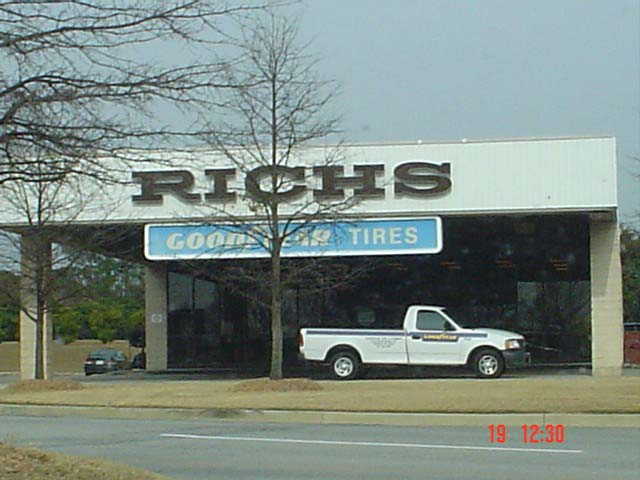
My friend Lou Corsaro took these pics for me in 2004 of the Rich's store and auto center at Augusta Mall shortly before the changeover to Macy's.  The mall entrance had been modified from its original appearance, which included the signature wavy glass used on their 1970's mall entrances.  


More current pics of the Macy's (former Rich's) both inside and out taken December 26, 2011

Initially, Augusta Mall was only able to lure one downtown department store: Davison's.  All other downtown department stores instead chose Regency over smaller Augusta Mall.  JB White, Cullum's, Ruben's and Belk Howard all passed over Augusta Mall for the larger Regency.  Because of that, Regency Mall was initially more popular than Augusta Mall.  Also, at the time that both malls opened, neither JCPenney nor Sears had left their locations closer to downtown.  At that point, JCPenney had originally committed to Regency Mall, so it looked like Regency would reign as the most popular mall.  However, a sign of things to come was when JCPenney changed their mind and opened instead at Augusta Mall.  However, dates are conflicting on the opening of JCPenney at the mall.  Some sources say 1979 and others say 1987.  The Augusta Chronicle states 1987 coupled with an 130,000 square feet expansion of the mall.  The exterior design appears considerably dated for 1987, but JCPenney was building with dated store designs throughout the late 1980's that did not match the designs for similar stores of the era.


Neil Barker took these photos of the JCPenney mall entrance and lush vegetation placed in front.  This wing and store was added in 1987.  Photos taken May 29, 2012.


My own photo of the upper level mall entrance to JCPenney.  Photo taken December 26, 2011.


Neil Barker took this exterior photo of the JCPenney, which on the outside looks extremely dated for 1987.  On the outside it could easily pass for 1979.  Photo taken May 29, 2012.


My own photo taken the prior year shows the exterior of the JCPenney the day after Christmas, 2011.

For the next 8 years, the competition between the two malls located a mere five miles from each other was pretty stiff.  Regency's popularity, however, took a major blow when the lax security coupled with the already negative perception based on the location of the mall in a far more blue collar area led to the kidnapping and murder of a teenage girl in 1985.  At that point, retailers began to take a more serious look at Augusta Mall.  From 1979-1987 the only visible change to happen at the mall was the conversion of the regional Davison's nameplate to the more famous Macy's nameplate in 1986.  This changed after JCPenney arrived.  Sears soon followed departing its larger 1950's location at the corner of 15th St & Walton Way near downtown for Augusta Mall thus opening at the mall in 1990.  The new store was the second major expansion of the mall further drawing shoppers away from Regency Mall adding another 120,000 square feet bringing the mall at this point to 750,000 square feet thus bringing the mall to a competitive size with Regency.  Both expansions also architecturally matched the original part of the mall.  Overall, the gain of two major anchors and 250,000 square feet at Augusta Mall painted Regency into a corner they couldn't walk out of beginning a rapid decline over the next decade of one of DeBartolo's biggest follies.


Neil Barker also took this shot of both levels of the Sears mall entrance with some of the fountain visible.  On my visit a Christmas display blocked much of this view.  Photo taken May 29, 2012.


The Sears store moved here from a larger store closer to downtown in 1990 completing Augusta Mall and dealing a terminal prognosis for its once much larger competitor.  The addition of Sears completed the mall traditionally, but it was not the final anchor to open at the mall.  Photos taken December 26, 2011.


These photos from August 3, 2014 show the original 1950's Sears that was replaced by the Augusta Mall store in 1990.   Georgia Regents University now uses the building.   Photos by Edric Floyd.

The last serious competition to Augusta Mall surfaced in 1988 with the opening of Aiken Mall across the Savannah River in South Carolina.  While nowhere close to either mall, the opening of the mall was enough to dilute the market share of both malls.  However, it appeared that Regency Mall was more affected by this than Augusta Mall with Regency closer to shoppers in Aiken.  Nevertheless, the late 80's were a banner period for the mall.  After the Sears expansion to Augusta Mall at the end of the decade, Augusta Mall transitioned from being a boutique mall into a major regional shopping mall with four solid anchors.  With crime problems, security issues, poor location and the decline of local retail sharpening the decline of Regency Mall, it was clear that Augusta Mall was going to become the default option for the region.  This became painfully clear as J.B. White decided to relocate to Augusta Mall building an elegant new flagship store at the mall to replace their dated and plain store at Regency Mall.  Pushing Augusta Mall to five anchors, it was the near the end of the road for Regency Mall when the new Augusta Mall store opened in 1998.  However, J.B. White was sold to Dillard's the same year meaning that the new J.B. White store at Augusta Mall only operated as such for a few months.  Belk Howard, however, closed at Regency a couple years before and did not choose to relocate resulting in Belk completely exiting the Georgia side of the Augusta market.


C. Lewis took these rare photos of J.B. White after it opened at Augusta Mall.  Despite building a stunning store, the logo update from the classic script was unfortunate.  As the flagship store for White's (a division of defunct Mercantile Stores), it was converted to Dillard's within months of opening.  Photos taken in 1998.


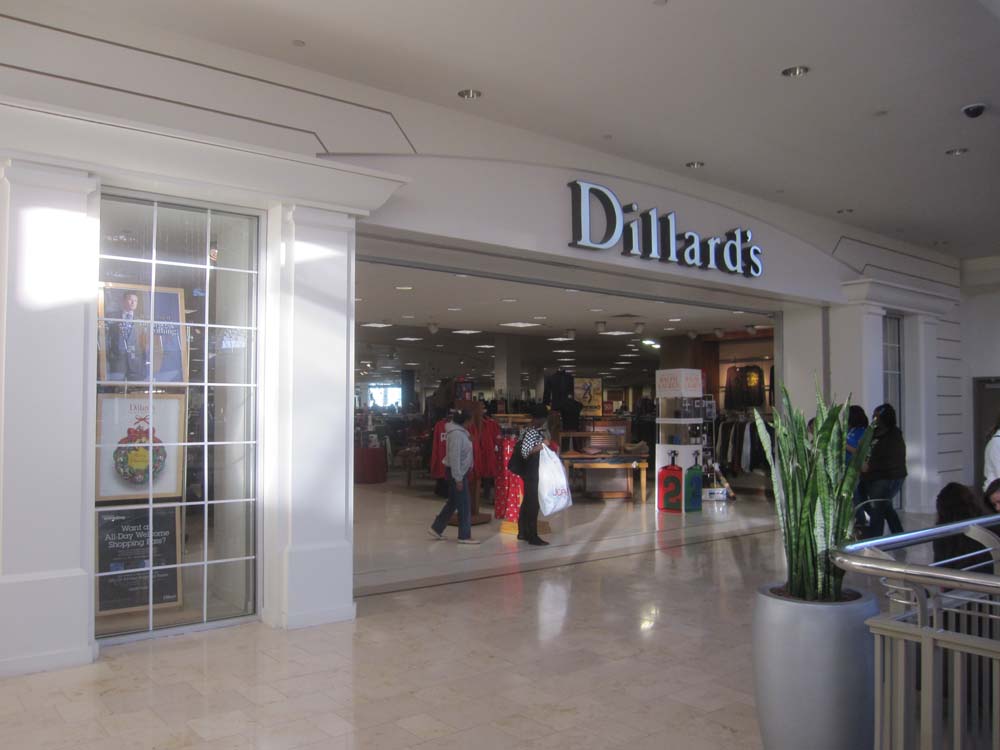
Dillard's mall entrance was equally impressive drawing heavily from lowland Southern charm.  It is a huge departure design-wise as well from the typical bland Dillard's mall entrance showing that Dillard's was willing to preserve the history of the flagship location of at least one store it took over.  Photos taken December 26, 2011.


A couple interior shots of the J.B. White/Dillard's were taken to show the level of detail that went into this store.  The elegant skylights shined on the detailed murals showing the history of both Augusta and J.B. White.  Dillard's thankfully did not remove anything left over from J.B. White other than the store signs.  Photos taken December 26, 2011.


The small trees seen in 1998 have grown much bigger on what was likely the last store that Mercantile Stores ever built.  Mercantile built showplace anchors in their final years of operation in contrast to the extremely bland stores they were known for in the 1970's.  Photos taken December 26, 2011.

Augusta Mall was not immune, however, to anchor consolidation and its effects.  Both Augusta Mall and Regency Mall were solidly mid-market malls although Augusta Mall was always more upscale than its closest competitor.  Despite being the second largest city in Georgia, demographics have been inadequate to draw many retailers including upscale stores.  In fact, a large percentage of the local economy is military from Fort Gordon, which is located only four miles away.  With lower median incomes and high levels of poverty in Richmond County (nearly 17% below the poverty line), the pool of potential mid-market department stores declined throughout the 2000's.


A view of the second level exiting Dillard's.  Sorry for the foggy photo quality as my camera was closing in on its untimely death.  


Sears court looking away from Dillard's toward Macy's


Sears court looking toward Dillard's.


A couple shots along the upper level as hoards of post-Christmas shoppers made longer views difficult.

The effects of anchor consolidation were noticed when in 2003 Rich's and Macy's were merged into one store known initially as Rich's-Macy's then just Macy's in 2005.  Since the mall had both stores, the original Rich's was eventually converted to Macy's and one level of the Davison's/Macy's store was converted to a furniture store for a short time.  Discontent with keeping a half-open anchor on an end-cap, plans were announced in 2006 to convert the former Davison's store into a new outdoor wing with new anchors.  Thus, GGP who had acquired the Rouse Company in 2004, commenced work to demolish the top level of the former Davison's converting it to open-air promenade with Barnes & Noble as an anchor.  The lower level of Davison's was left intact, but was converted to a Dicks's Sporting Goods.  Part of the old Davison's previously extended to the left of the former mall entrance, however, and it remains today a part of Macy's.


Some views from the lower level.  The last is approaching what used to be Davison's/Macy's.


The entrance in the background used to be the upper level mall entrance for Davison's.


A couple shots looking back towards Dillard's.  The first shot is just inside from the former Davison's upper level entrance and the second is of the clock, which Neil Barker captured in far greater detail.


Neil Barker captured the updated mall entrance next to the older Rouse design to the right.  Several malls in Rouse's native Baltimore also had this design.


The older Augusta Mall is still visible in this photo I took on the day after Christmas, 2011.

Today, Augusta Mall enjoys a prime position in the market, but its location is not as prime as it used to be with the market starving for competition.  In a visit in 2011, it was apparent that the mall was extremely overcrowded.  However, Augusta Mall is also in a position similar to nearly dead Macon Mall where despite high incomes in the immediate neighborhood, the mall is still only five miles from its long-vacant competitor Regency Mall.  At this point ANY competitor could quickly throw the mall into dead mall status quickly partly due to its proximity to an area known for crime and decay.  For example, in less that a decade Macon Mall went from a huge and highly successful mall to a mall with only two remaining department store anchors in a largely vacant mall all because of a lifestyle center that opened on a higher income side of the city.  Augusta Mall has so far avoided that partly due to the failure of the Riverwatch development along I-20 coupled with the mall's expansion.  The Riverwatch project was a very formidable threat to the mall when it was planned.  It would have included a new Belk and Dillard's store and would have funneled retail further away from South Augusta.  If it had been completed it would have not only led to the downgrade or closure of the Dillard's store at the mall, but it would have also likely led to an eventual exodus of other stores and anchors from the mall as well leaving it in a Macon Mall situation with just Macy's and JCPenney anchoring a struggling mall.


Another view of Dick's and the piece of Macy's left over from the lower level.  Photo by Neil Barker taken May 29, 2012.


Here is the outdoor portion in what used to be the upper level of Davison's.  The outdoor fountain was certainly a nice touch.

For right now, the viability of Augusta Mall is not in question.  A mall with few vacancies, five anchors and a lack of nearby competitors it is well positioned for at least short-term success.  The main short-term threat to the mall will be the eventual closure of Sears as the chain's difficulties are unavoidable for any mall that has this store with a space that will be difficult to fill.  Unlike Regency, however, the mall's future is not tied to whether one dying carriage trade retailer can stay open.  However, Augusta Mall joins many malls across the country as a solidly mid-market mall: a struggling sector in danger due to the decline of mid-market department stores as a whole.  Will Dillard's or JCPenney be around 10 years from now?  Will Dick's stay committed to the higher lease terms of a mall when they could easily relocate elsewhere?  Will Macy's remain in the mall and not locate elsewhere especially after Belk sells the company freeing up real estate opportunities?  If the fortunes turn sour for Augusta Mall over the next few years, the least that can be said by that time is that the mall will have had a very successful 40 year run as it has been loved by many over several generations.